
London’s Original Railway Hotel: The Gateway to Paris

There’s something I find very romantic about railway hotels. Maybe it’s because they belong to an era when travel felt more glamorous – when journeys weren’t just about getting somewhere quickly, but about the anticipation built around them. Transport took longer and holidays were rarer, so I imagine they felt even more sacred. The journey itself was part of the event.
In the nineteenth century, railway companies began building grand hotels beside stations for travellers breaking up long journeys. But they quickly became much more than practical stopovers. These weren’t budget places you reluctantly checked into before catching an early train the next morning; they were destinations in themselves.
As rail travel exploded across Britain and Europe, railway companies competed not only with speed but with spectacle. Hotels became status symbols: enormous Gothic landmarks attached to stations, showcasing wealth, innovation and modernity. They introduced luxuries many people had never experienced before – electric lighting, lifts, private bathrooms and hot running water. Railway travel was the future, and these hotels wanted you to feel it.

Paris embraced the idea too. Monumental station hotels rose alongside the city’s great gares. Near Gare Saint-Lazare, one of the most striking examples still stands: today’s Hilton Paris Opéra, originally opened in 1889 as the Grand Hôtel Terminus. Designed by architect Juste Lisch for passengers arriving through one of Paris’s busiest stations, it was built to impress. Its spectacular Belle Époque foyer – now recognised as a historic monument – still carries traces of that era.
Many faded as air travel took over, but recently there’s been a renewed fascination with these spaces – not just because they’re beautiful buildings, but because they preserve that old-world travel fantasy that modern airports have mostly beaten out of us.
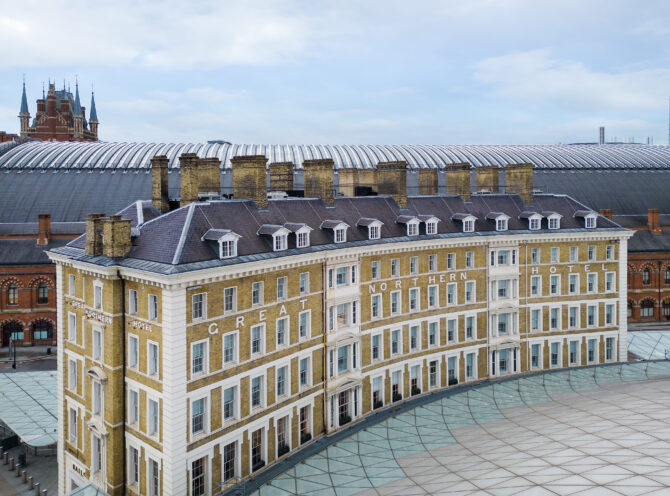
And sitting right at the centre of that story is Kaya Great Northern Hotel.

Opened in 1854, London’s oldest railway hotel occupies a curious place in the city’s history. Designed by Lewis Cubitt – the architect behind King’s Cross itself – it was built during the great age of steam, when railways represented possibility and progress. Unlike many historic hotels that feel detached from the lives they once served, this one still exists in almost exactly the environment it was built for, because this isn’t simply near King’s Cross station – it’s attached to it.
Step outside and you’re immediately part of one of London’s busiest transport hubs. But more importantly, you’re standing at the beginning of one of Europe’s most iconic journeys. St Pancras International sits just next door, making the hotel feel less like a London destination and more like a threshold – one foot in London, the other edging towards Paris.
There’s this subtle Frenchness woven throughout the hotel and the railway-to-Paris connection isn’t accidental. Before Eurostar, travellers heading to France boarded glamorous “boat trains” from London termini before crossing the Channel by ferry. Today, St Pancras has become Britain’s gateway to Europe through the Channel Tunnel. The hotel leans into that identity and you can feel little nods to Belle Époque glamour, traces of continental elegance, and the kind of atmosphere that makes you briefly wonder whether you should be wearing gloves and boarding the Orient Express.
I visited for a friend’s birthday, and we stayed in one of the hotel’s Heritage rooms and immediately did that thing where you walk in and silently start calculating how much it would cost to move in permanently.

As a committed bath enthusiast, I locked onto the grand freestanding tub within seconds. Some hotel baths are decorative – there for aesthetics more than actual use. This one absolutely wasn’t. The bed, meanwhile, may genuinely have been the largest I’ve ever slept in; one where you lose awareness of where the other person actually is.
One of the unexpected highlights was access to the pantry area at the end of our corridor – stocked with fresh pastries, fruit, tea and coffee, with views stretching over King’s Cross. It felt like being part of a very civilised secret club.
Dinner at Rails was another pleasant surprise. Hotel restaurants can sometimes feel like an afterthought – convenient rather than memorable – but this genuinely exceeded expectations. We started with smoked salmon and beetroot carpaccio with chive crème fraîche before moving onto mains that felt incredibly comforting and indulgent. I went for the Chicken Cordon Bleu with Dijon mustard cream while my friend chose braised ox cheek with silky pommes purée.

By this point, we had become perhaps slightly too comfortable with our temporary luxury lifestyle. So naturally, instead of having dessert in the restaurant like sophisticated adults, we ordered crème brûlée and sticky toffee pudding to the room and ate them in bed while watching Love Island.
This resulted in a shared moment of pure bliss and we felt incredibly smug!
Morning arrived with yoghurt bowls, Eggs Benedict, green juices and enough coffee to restore us to society again. And throughout the stay, the staff were invested in making things special rather than simply efficient – warm without being overbearing, attentive without hovering.

Railway hotels have always been about movement – the excitement of where you’re going next, and on multiple occasions we teased with the idea of booking a Eurostar.
Paris feels close enough to daydream about. Even if, for one birthday night at least, staying exactly where we were felt like the better journey.
Share to: Facebook Twitter LinkedIn Email
More in hotel, hotel review, London
Related Posts

By Poppy Pearce
Leave a reply
Your email address will not be published. Required fields are marked *