
Manet & Morisot: Inside the Friendship that Changed Modern Art
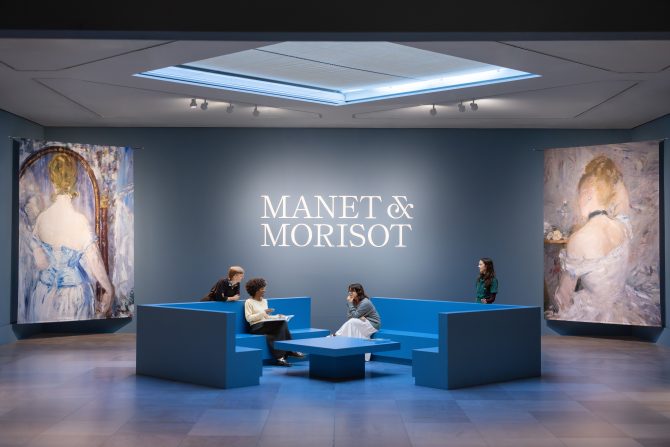
A major exhibition in San Francisco shines a new light on the creative friendship between Édouard Manet and Berthe Morisot, exploring how their artistic dialogue helped shape modern art.
Appropriately, French painters Berthe Morisot and Edouard Manet met at the Musée du Louvre. Introduced by a mutual friend in 1868, their meeting sparked a long friendship and artistic exchange. The result of these 15 years of respectful influence is featured in the Manet & Morisot exhibit at the San Francisco Legion of Honor fine arts museum. It’s the first scholarly exhibition examining the mutual professional and personal connection between the two artists.
The exhibit opens with the beginning of their friendship, when Morisot was a model for Manet, and includes his masterpiece The Balcony. By the early 1870s, the relationship evolved as Morisot’s skill as a plein-air painter granted her a strong position in the Impressionist movement. Over the course of the 1870s, the two artists’ influence on each other’s style was evident. Morisot copied her friend’s topics while Manet’s style softened to become more impressionistic.

According to Legion of Honor curators, “theirs was the closest relationship between any two artists in the Impressionist circle, and it played a key role in the course of modern art.” Manet painted portraits of Morisot, but they also spent their time sharing ideas and art styles which ultimately provided encouragement and inspiration to both.
When they met, Manet was in his 30s and married. He was considered a pioneer of modern painting and was known for modern-life paintings that shocked the Parisian art establishment. He was an active participant in the traditional Paris Salon. Morisot was in her twenties, unmarried and had just taken her first steps in her career as a painter. She would become one of the leading figures in the Impressionist movement.

Both artists were from upper-middle-class families in France. Manet was happily married and introduced Morisot to his brother, Eugène, whom she married. Although a bit of an outsider, Manet received official recognitions, including a Salon medal and a Légion d’honneur. He struggled for early success but developed a strong, steady market for his work. He is considered the “father of modern art.”
While Morisot looked to Manet for approval and guidance in her early career, by the mid-1870s, it was Manet who began leaning towards Morisot’s style. He started experimenting with her choice of colours and subjects, and began changing his brushstroke to a more fluttering style
Morisot renounced the Paris Salon (against Manet’s advice) and exhibited at the first Impressionist exhibition, becoming its only female founding member. She exhibited her work in all but one of its eight exhibitions (she missed a year when she had a child) and developed a signature style. Morisot was one of four notable women in the Impressionist movement, along with Mary Cassatt, Eva Gonzalès and Marie Bracquemond.
An example of Manet’s influence on Morisot are their similar boating pictures. Manet’s Boating is a closeup of a man and woman on a boat with blue water as the background. Morisot’s Lake in the Bois de Boulogne features two women on a boat but she makes it her own. Zigzags of paint provide a glimmering reflection of the moment along with a wide vista of a park, lake and ducks paddling in the background. Morisot’s painting was shown at the Impressionists’ fifth group exhibition in 1880.

Vice versa, Morisot’s influence on Manet is shown in two pictures of women before mirrors. Morisot’s Woman at Her Toilet has a woman sitting before a mirror, back to the viewer, pinning her hair. There is no reflection in the mirror, and her way of painting is soft and sensuous. A week after her painting went public, Manet held a show that included Before the Mirror where a woman is untying her corset while she looks at herself in a mirror. The paint strokes of her garment are brisk yet soft, as are the other brush strokes of drapery, wallpaper and blurred mirror. This is considered the most ‘morisotian’ painting in Manet’s oeuvre.
As the connection between the two artist’s work became stronger, their lives diverged. Manet became ill and struggled with painting. Morisot continued painting but was busy with a daughter and household management. Her husband, Eugène, took over the role of managing her career, exhibitions and sales. Evidently, she was still concerned with Édouard Manet’s opinion as she continued to ask, “What does Édouard think?”

Prior to Manet’s death in 1883 from gangrene caused by complications from syphilis and rheumatism, the two artists painted pictures of women representing the four seasons. Morisot painted Summer and Winter, which inspired Manet to paint Spring and Autumn. Manet died before completing Autumn, but the four paintings are shown together in the exhibit, showcasing the striking parallels.
“The friendship between these two great artists – collaborative and competitive, playful and charged – really did have a determining effect on the course of art history,” said Emily A. Beeny, Chief Curator of the Legion of Honor. “Its story is written in their pictures. Considering them side by side, we watch it all unfold: their shared interests and struggles, their mutual influence and understanding.”

Morisot was distraught by Manet’s death and spent the rest of her years buying his paintings and supporting Claude Monet in his campaign to acquire Manet’s Olympia for the French national collection. Several of her last paintings are shown in the exhibit with her trend toward Symbolism. Morisot died in 1895 from pneumonia and her reputation declined. It was revived in the 1980s by feminist art historians.
The exhibit Manet & Morisot will be at the San Francisco Legion of Honor until March 1, 2026. It will then travel to the Cleveland Museum of Art from March 29 – July 5, 2026.
Share to: Facebook Twitter LinkedIn Email
Related Posts



Leave a reply
Your email address will not be published. Required fields are marked *