
The Rise of Eco-Retreats in Rural France
Across France, a quiet transformation is underway that blends sustainability, creativity, and an irresistible longing to reconnect with nature. Travellers are increasingly turning away from crowded cities and well-trodden tourist circuits, searching instead for authentic stays where simplicity, slowness and natural beauty take precedence. As this shift toward more conscious travel rises, eco-retreats have emerged as one of the most compelling hospitality movements in the last 15 years.
These new sanctuaries, scattered across forests, valleys and remote rural corners, are redefining what it means to “get away” in France. They are run by passionate hosts who have chosen to leave behind urban life to create refuges rooted in ecology, craftsmanship and a love for the land. Whether perched high in the trees, overlooking waterfalls or nestled in quiet woods, they share a common goal: to offer meaningful, low-impact escapes that support local communities and preserve fragile landscapes.
Here are the stories of several standout eco-retreats in France and each of them illustrates, in its own way, how France’s rural hospitality scene is being reinvented.
A New Philosophy of Rural Escape
The rise of eco-retreats in France is not simply a trend; it reflects a deeper cultural shift. Over the past decade and following the disruptions of the pandemic, travellers have increasingly sought places that feel “real”, meaning holidays closer to nature, more serene, more rooted in local heritage. Sustainability and authenticity now rank among the top priorities for domestic and international travellers. This aligns with the global movement toward “slow travel,” a philosophy that encourages exploring mindfully and favouringimmersive experiences.
Eco-retreats fit naturally into this growing desire. They offer an antidote to modern overstimulation: no neon lit lobbies, no background buzz of traffic, no sterile hotel rooms identical from one city to another. Instead, they invite silence, birdsong, forest scents, and a deeper engagement with place.
Coucoo Cabanes: Forest Domains Blending Comfort and Conservation

With several resorts spread across France, Coucoo Cabanes has become one of the country’s most distinctive eco-retreat networks with nature-immersive sites where each cabin is designed to blend seamlessly into its surroundings. Their treehouses, floating cabins and stilted hideaways share a signature style: curved wooden designs, large windows framing the landscape, and a cosy, cocoon-like atmosphere that encourages guests to slow down and disconnect.
What sets Coucoo apart is its strong ecological commitments at each of its sites. Cabins are built from natural or sustainably managed materials, water consumption is reduced through efficient systems, and artificial lighting is kept minimal to protect nocturnal wildlife. Each site is developed with a low-density approach that preserves forest balance and supports biodiversity.
Despite operating multiple locations, Coucoo manages to maintain a handcrafted and intimate feel at each site. Guests can soak in a private Nordic bath, watch wildlife from their terrace, or simply enjoy the silence that only deep woodlands can offer. The result is a network of eco-retreats that proves scale and sustainability can go hand in hand without sacrificing charm, comfort or authenticity.
Le Bois de Rosoy: Nature Luxury Near Paris

Barely an hour from Paris, Le Bois de Rosoy in the Oise department offers a completely different yet equally compelling interpretation of the eco-retreat. At first glance, this family-run domain looks like a forest hideaway designed for romantic escapes: treehouses with Nordic baths, cabins surrounded by greenery, suspended terraces with candlelit views. But beneath this aesthetic of gentle luxury lies a sincere environmental mission.
The founders converted this former woodland into a domain that emphasises renewable energy, respect for biodiversity and minimal impact construction. Many of the treehouses rely on natural insulation and low-consumption heating systems. The maintenance of the forest follows ecological principles: dead trees are preserved as wildlife habitats, and new plantings favour indigenous species.
The experience here is one of deep immersion with nature with all the comforts that modern travellers appreciate. This blend of eco-responsibility without austerity reflects an unmistakable shift in rural France: sustainability is a source of enhancement, not restriction.
For Parisians seeking a weekend escape, Le Bois de Rosoy serves as a reminder that meaningful nature retreats are not reserved for the distant corners of the country.
Slowmoov: Holiday Villages and a True Slow-Tourism Philosophy

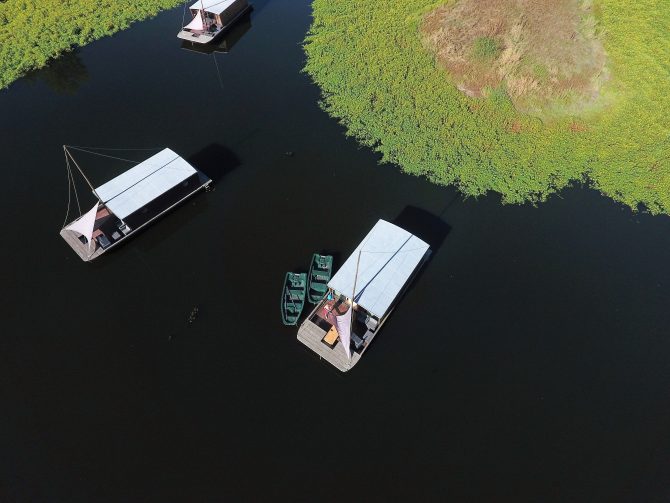
Slowmoov is made up of “unusual holiday villages” with three nature-immersive sites located in the Burgundy, Champagne, and Limousin regions. Their eco-concept revolves around offering charming, off-beat accommodations: wooden cabins, gypsy caravans, pods, toues cabanées (traditional riverboats converted into cosy lodges), and whimsically themed cabins. All are designed to blend naturally into their surroundings while providing comfort and atmosphere.
At the heart of the brand lies a strong commitment to “slow tourism”: taking time, disconnecting from routine and reconnecting with nature without compromising on quality or pleasure. Whether it’s a treetop cabin for two, a family-friendly caravan sleeping four to five guests, a snug pod for a minimalist retreat or a floating cabin that drifts gently with the breeze, each accommodation invites visitors to settle into a slower rhythm.
Across its three villages, Slowmoov offers a modern vision of rural tourism in France with original, restorative, environmentally conscious getaways for couples, families or small groups seeking to breathe, unwind and simply enjoy the peace of preserved natural settings.
Les Cabanes du Hérisson: Gentle Tourism in the Heart of the Jura

In the Jura mountains, not far from the iconic Cascades du Hérisson (a chain of waterfalls cascading through emerald forests) lies one of France’s most emblematic eco-retreats: Les Cabanes du Hérisson.
Here, the concept of ‘gentle tourism’ is not merely a slogan, but a lived philosophy. The cabins, crafted from locally sourced wood, blend almost invisibly into their surroundings. No trees were cut unnecessarily; the architecture adapts to the terrain rather than shaping it.
Guests come primarily for the region’s natural beauty: hiking paths that wind through mossy forest, crystalline lakes, panoramic viewpoints over the Haut-Jura. But they stay for the peacefulness of the retreat itself with the absence of artificial noise, the star-filled nights, the sense of timelessness that mountain forests so effortlessly provide.
The hosts emphasize collaboration with local producers and artisans, recommending nearby cheesemakers, small restaurants, and traditional craft shops. Their approach ensures that tourism benefits the local economy while encouraging guests to take the time to discover the soul of the Jura.
A Movement Rooted in Values
What connects these four very different eco-retreats is a shared set of values. They respect for the land, support for local communities, hold strong beliefs in slow, meaningful travel and above all, share the desire to create spaces that inspire guests as much as they house them.
Eco-retreats are not about deprivation; they are about intention and honouring the natural settings that make rural France so captivating. They also respond to a growing expectation among travellers: the wish for their stay to create a positive impact, or at minimum remain carbon-neutral, rather than adding to overtourism or environmental harm.
As climate concerns grow and travellers become ever more aware of their carbon footprint, France’s rural eco-retreats offer a promising path for the future. They prove hospitality can be both inviting and responsible, immersive and respectful, memorable and mindful.
Lead photo credit : Slowmoov ©
Share to: Facebook Twitter LinkedIn Email
More in best family holidays in france, eco retreats, french holidays, holidays in France, Rural France holidays
Related Posts
Leave a reply
Your email address will not be published. Required fields are marked *