Porquerolles Island: a guide to France’s best-kept secret
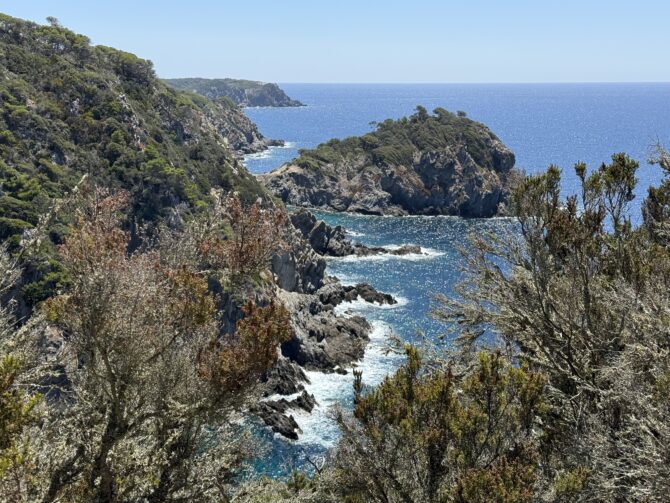
Overlooked next to its Côte d’Azur neighbours, Porquerolles dazzles with cobalt waters, pine forests, and centuries of history. Here’s your complete guide to France’s golden island.
Peter Yeung
Once occupied by the Celts, Phoenicians, Greeks, Romans, and even the British, l’île de Porquerolles, or Porquerolles Island, has been admired by many civilisations. Yet today, compared to other sites of the Côte d’Azur, it can be overlooked by visitors.

Do not make that mistake. Porquerolles, with its cobalt blue waters, a stunning variety of sand and stone beaches, aromatic pine forests, world class art, gorgeous vineyards, and centuries-old historic sites, is the Mediterranean island of your dreams.

There’s a reason why it, along with the neighbouring Port-Cros, Bagaud, and Levant, are known as the “Golden Islands” of France.

Here’s a guide on the best things to do on Porquerolles Island and how to get there.
Impersonate a lizard on a beach
Most visitors, justifiably, will come to Porquerolles to do an impression of a lizard on one of the island’s many top-tier beaches. The water here is often crystal clear, like a bathtub, even though it’s just off the coast of Hyères. If you feel like relaxing all day, the Plage d’Argent, with fine white sand and shallow waters, is around a 20-minute walk from the port. But with convenience comes popularity.

Less crowded is the pebbly Plage de Notre Dame, about an hour walk from the port in the other direction. Otherwise, if you feel active, spend a day on a beach crawl across Porquerolles, which is 7km long and 3km wide, stopping to dip at the countless calanques along the way.
Marvel at the Villa Carmignac’s modern art
Set in a grand Provençal farmhouse and its gardens, the Villa Carmignac showcases world class art in the most exquisite surroundings. The 2,000-square-metre cultural mecca, opened in 2018 by billionaire businessman Édouard Carmignac, houses over 300 modern art works – including many inventive and immersive installations – that rival even the finest Parisian collections. Think Andy Warhol, Niki de Saint Phalle, Yves Klein, Olafur Eliasson and Tracey Emin.
Film buffs will be interested to know that Jean-Luc Godard’s 1965 classic Pierrot Le Fou was partly filmed here. Book your timed entry slot ahead and beware that the villa is closed from November to April.
Taste the terroir of the local wines
Porquerolles’ particular geography and climate also comes with an added benefit: wine. The sea breeze here helps to regulate temperatures among the vines, which prosper thanks to the abundant sunshine throughout the year. The island’s varied soils, composed mainly of schist rock and clay, help to give the wines a distinctive flavour, too.

They can best be sampled at either Domaine La Courtade, a 38-hectare vineyard that produces white, red, and rosé Côtes de Provence wines (guided tours of the magnificent vines as well as informative wine tastings are available), or at the more quaint Domaine de l’Ile, which produces organic whites and rosés.

Hike through the island’s rich history
Due to its strategic position just a few kilometres to the south of mainland France, Porquerolles is packed with historic fortifications. Napoleon, at the time a captain, laid the first major foundations of the defences, including the central fortress, coastal batteries and watchtower. Most can be reached via the island’s 51km of marked trails, by foot or by bike, including the Fort Saint Agathe, built under Francis I around 1531, and just a stone’s throw from the port, the majestic Porquerolles lighthouse, to the south, or the Batteries des Mèdes at the eastern tip of the island or the Fort du Grand-Langoustier to the west. Most of the sites are open as part of the European Heritage Days, but can nonetheless be admired year-round from the outside.

Go diving to see the aquatic life
Porquerolles is an under-rated destination for scuba diving, perhaps because it wasn’t until 2012 that the marine area surrounding the island was added to the national park. For starters, there’s the wreck of the “Cement Carrier” off the west coast, surrounded by pretty seagrass and, only 12 metres underwater, it’s ideal for beginners. Not far away is the Reef of Jaune Garde, where you can spot schools of groupers, moray eels, nudibranchs, octopuses, and barracuda. For more experienced pros, there’s the atmospheric wreck of the Grec ship (also named Sagona), located at a depth of 40 metres quite far off the east coast. Although there is a diving centre on the island itself, divers generally use the services of scuba diving centres in Hyères.

Feast on delicious seafood à la Provençal
After all that activity, or indeed relaxing, you will no doubt need some sustenance. Porquerolles is one of the best places in France to treat yourself to some fruits de mer (seafood) or indeed other regional specialities. My pick would be to go to Hôtel Restaurant Le Porquerollais, with its charming, wood-decked dining room and pretty outdoor terrace. There you’ll find delicacies such as carpaccio de gambas mi-cuites (shrimp carpaccio), soupe de poisson de roche (rock fish soup), and all kinds of catch, from tuna to monkfish, sole, octopus and lobster. For a delightfully refreshing dessert, don’t miss the nage de melon, a fruity, minty cold broth, when in season.

How to get there, get around and where to stay
Several ferry companies offer services between the mainland and Porquerolles. The Tour Fondue ferry terminal, reachable by public bus 67 from central Hyères or the train station, serves the island daily with a regular 20-minute boat ride. Book your ticket online ahead, especially as in peak summertime there is a limit of 6,000 visitors a day. The return time can be left open but make sure to arrive at the terminal reasonably in advance as there can be large queues.

For those on a budget, there are a number of campsites within walking distance of the Tour Fondue ferry terminal. Alternatively, several hotels are on the island itself, most by the port, but they won’t come cheap. The peaceful yet also pricey Hôtel Le Mas du Langoustier is away, on its own to the west. The island also has a number of bike rental shops, including electric bikes adapted for people with reduced mobility.