
Breathing New Life into the Alps’ Vintage Ski Cabins
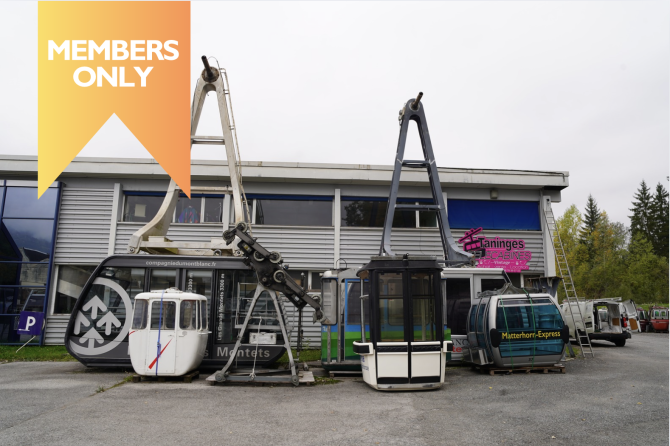
I’d driven past it countless times, that curious collection of gondolas piled beside the road to Morzine and Les Gets. From a distance it looked like a ski-lift graveyard, faded reds, greens and yellows stacked like oversized toys against the grey Alpine sky. But behind the gates of Taninges Télécabines is something entirely different: a workshop where brothers Stéphane and Julien Gaudin have spent more than 25 years rescuing and re-imagining the Alps’ retired cable cars.
Outside, the yard is already a museum of mountain engineering. A bright yellow cabin, the oldest in their collection, stands beside a weathered red one from the Aiguille du Midi, its lettering still visible, and another from Grands Montets, the Chamonix lift destroyed by fire in 2018. There’s even a pod from the Matterhorn and a handful from Saint-Gervais, lined up like relics of past ski eras.
Inside, the hangar is stacked floor-to-ceiling with gondolas from across the Alps: Courchevel, Les Houches, Les Arcs, Morzine, in an array of colours, from lemon yellow beside glossy green, matte grey next to bright red. Some are polished and fitted with wood benches and glass tables; others still wear the flaking paint and sticker ghosts of decades past. Rows of old skis, piste signs and vintage snowmobiles fill the gaps between them. It feels part workshop, part living archive.

“It started with my parents,” Stéphane says. “They worked in antiques, and we were helping them when we were very young. About 25 years ago, we came across a small two-seater egg from Flégère in Chamonix. It was fabulous. We bought it, and I still have it today.”
For years, the brothers were met with disbelief. “Everyone thought we were mad,” he admits. “We felt completely alone, but we said to ourselves, one day there’ll be something to do with these cabins.” They carried on collecting, scouring the Alps before old lifts were scrapped, and slowly built what’s now one of the largest private collections in France. “We don’t count them,” Stéphane shrugs, “but there are hundreds.”

Over the last decade, the rest of the world has caught up. As French resorts modernise, hundreds of lifts are taken out of service each year. Most are recycled for scrap metal, but a growing number are being repurposed as part of a wider upcycling movement of giving industrial relics a second life. “Ten or fifteen years ago, things started changing,” Stéphane says. “People began thinking about ecology and reuse.”
The movement has spread far beyond Taninges. Across the Alps, resorts are selling off their old cabins and chairs to locals eager to keep a piece of ski heritage. In Combloux, for instance, residents were offered the chance to buy a seat from the Beauregard lift when it was replaced — €500 for a four-seater “mythical chair.”
One of the buyers, British homeowner Victoria Tills, told me she couldn’t resist. “We thought it would be a fun addition to the chalet or maybe a nice place to sit in summer. It’s more design than Alpine history, but we wanted one we had a connection to, so getting a Combloux chair felt right.”
Getting it home was the real challenge. “They’re really big and really heavy,” she says. “It wouldn’t fit in the car, so we had to leave it there for weeks. We even debated putting it on wheels and rolling it down the mountain — but decided an out-of-control chair wasn’t the best idea.” Eventually, a friend with a trailer helped three “fairly hefty blokes” manhandle it into the garden. “We still haven’t worked out how to put it up yet,” she laughs. “The neighbours already think we’re the crazy anglais.”
The Combloux tourist office said many locals snapped up the chance to own a piece of the old lift, a part nostalgia, part design statement. As Victoria puts it: “It’s a one-off thing. If I ever move back to the UK, God knows what I’ll do with it.”

Meanwhile, the Gaudins were ready. “We said years ago these cabins would become decorative objectsin chalets, hotels, company lobbies. And now, that’s what’s happening.” Today, their workshop produces everything from dining pods and garden saunas to statement pieces for architects and event planners. “We work with a lot of architects,” he explains. “They want cabins in restaurants, hotels, nightclubs, even in town-hall Christmas displays. People eat fondue or raclette inside. It’s simple, but it works.”
Each restoration is different. “When a cabin is in good condition, we keep it,” Stéphane says. “When it’s not, we rebuild it — sanding, painting, bodywork, everything.” A small cabin takes about a week to restore; larger ones can take a month and a half. A sauna conversion is around two weeks. He insists on preserving what he calls the âme, the soul, of every piece. “You have to keep as much authenticity as possible. Polish it, don’t overdo it.”
As I look around, Stéphane is busy sanding the curved side of an old Poma egg, its dull metal coming back to life before he vacuums away the dust. Nearby, another gleaming green cabin waits to be shipped. “This one’s going to a restaurant,” he says. “Wooden ceiling, benches, electrics, it’s all ready to serve dinner on.”

Some projects verge on art. A few of the cabins in their collection are unique: one that served the Brussels World’s Fair, another from Lausanne, and several designed by celebrated French engineers. “Each one is different — in shape, in spirit, in story,” he says. “They’re works of art.”
But finding authentic pieces has become harder. “For the old cabins, it’s almost impossible now,” Stéphane says. “It’s a page that’s turning. Most were dismantled forty years ago and thrown away. Now you have to be lucky, maybe one turns up in a barn or a garden.” The recent flood of modern gondolas on resale sites has made the market chaotic. “It’s anarchy,” he says. “Everyone wants one now.”
Despite the demand, his approach remains personal. “When we keep cabins for our collection, they’re like our babies,” he tells me. “There’s a soul behind each one.” Some are too special to sell: a scarlet cab from the 1940s, an ambulance lift, and a handful so rare the brothers are the only owners left. “They’ll be for the museum,” Stéphane says — the dream he and Julien have nurtured for years. “We already have a unique collection, maybe the only one in the world. One day, we’d love to open a museum here in Taninges or even a travelling one that could go abroad. But for that, we’ll need help from the council and the state. This valley is surrounded by ski resorts, it deserves a place like that.”

We step back outside. The afternoon light falls across the line of gondolas, the yellow pod, the Aiguille du Midi relic, one from Brévent and another from the Matterhorn. They stand side by side, waiting for their new life.
Ohlala! It looks like you’re not a Member yet
Join to view this content!
(If you are a Member, log in or reset your password below or contact us so we can help)
- Log in
- Forgot password
Lead photo credit : Members Only - Telecabines Katilena Dartford
Share to: Facebook Twitter LinkedIn Email
More in alps, cabin, Chamonix, French culture, skiing in the French Alps, telecabines
Related Posts



Leave a reply
Your email address will not be published. Required fields are marked *