
In the Footsteps of Louis de Funès, the Man with 40 Faces a Minute
Dominic Bliss looks at the life and legacy of France’s favourite comic actor of the 20th century…
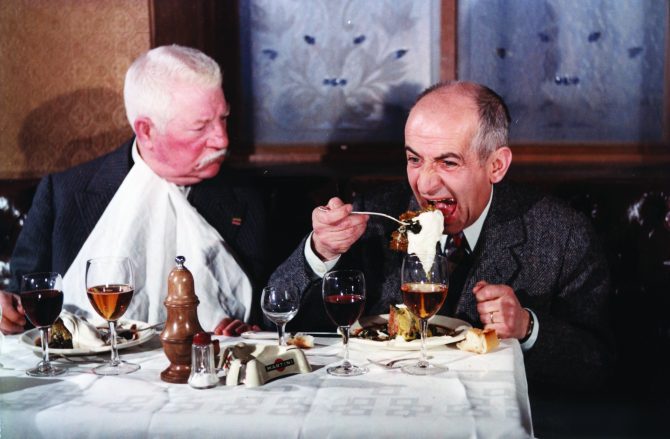
“L’homme aux 40 visages par minute,” they called him. The man with 40 faces a minute. Louis de Funès, indisputably France’s favourite comic actor of the 20th century, if not of all time, possessed an endlessly elastic array of facial expressions, contorting his features at will to suit the comic situations he found himself in.
These situations were myriad and hilarious. During a career that spanned half a century first in theatre, then primarily in film he delighted audiences in his home nation and across much of continental Europe, appearing in more than 100 roles on stage and more than 150 in film. His very first film performance-a 40-second bit part as a cabaret porter in a fantasy-romance called La Tentation de Barbizon (The Temptation of Barbizon)-was released 80 years ago next spring.

Then followed in quick succession a vast parade of movies in which he played characters as varied as waiters, doctors, soldiers, a journalist, a taxi driver, a psychiatrist, a robber, a dancer, a conductor, a skier, a bank manager, a teacher, a rabbi, a Gestapo officer and, on multiple occasions, a policeman. It was for the latter that he is best known.
With his bald head, expressive eyes and Gallic nose, he derived his comedy through a mixture of hyperactive energy, hot temper, mimicry, slapstick and petit-bourgeois authority. In 1973, he was awarded the Légion d’honneur.
De Funès was born in 1914 in Courbevoie, in the northwest suburbs of Paris, to Spanish parents who had eloped to France. His younger days were distinctly lacklustre and he found himself expelled from schools and sacked from the menial jobs he took, later working as a pianist, mainly in Paris’s Pigalle district. His first stage role was in 1926 when, aged 12, he joined his classmates in a comic opera at the municipal theatre.
Post-war years
Standing just 5ft 4in tall, de Funès’s small stature and ill health meant he avoided combat during the Second World War. After the war, he became a jobbing actor, earning his living through minor film roles, low-paid theatre work and voice dubbing. It wasn’t until 1963, when he played a wealthy businessman in Jean Girault’s film Pouic-Pouic, that he finally became a star. From then on, he was guaranteed top billing. Between 1964 and 1982 there was a series of six movies with Girault, in which he played Ludovic Cruchot, a scheming, sycophantic gendarme. Alongside another great French comic actor, André Bourvil, he appeared in Le Corniaud in 1965 and La Grande Vadrouille the following year. The latter, a madcap Second World War caper featuring RAF airmen, Resistance fighters, opera singers, Catholic nuns and German soldiers, drew audiences of more than 17m and, to this day, remains one of France’s most successful films.

His comic reputation now established, it seemed de Funès couldn’t put a foot wrong. For much of the 1960s and 1970s his films were top of the French box office, while fellow comic actors all vied to work alongside him. But ‘FuFu’, as he was known to friends, never achieved fame in the English-speaking world.
Handsomely rewarded for his hard work, he lived in the impressive Château de Clermont- inherited by his wife Jeanne-in Le Cellier, just northeast of Nantes, overlooking the River Loire. Here he loved nothing better than tending to his roses and living the quiet life. But all that vigorous theatrical exertion, for which he was famous and so loved, took its toll on his body. A heart condition meant he suffered three heart attacks in all, the third of which killed him in 1983, at the age of 68. A devout Christian, he died at the Centre hospitalier universitaire de Nantes and was laid to rest in the cemetery at his château, where roses still grow on his grave. His wife died in 2015 and lies in the same plot. De Funès had two sons by Jeanne, Patrick and Olivier (the latter also an actor) and a third son, Daniel, from his first marriage.
It’s here in Le Cellier that anyone wishing to follow in the footsteps of this comic genius should start. There used to be a museum here, dedicated to de Funès, which closed in 2016 through lack of funds. To fill the vacuum, some of his biggest devotees decided to create a fan club of sorts. Aloïs Robinard and his parents set up a cultural association called Sur les traces de Louis de Funès (In the footsteps of Louis de Funès), which organises guided walks around the sites the actor lived in and frequented. At times, in an events space in Le Cellier called the Salle de Louis de Funès, there are film showings, concerts and exhibitions of memorabilia. As well as loyal fans, actors who worked with de Funès occasionally come along.
The legend lives on
“Louis de Funès is still as popular as ever because he played characters who were spiteful but at the same time likeable,” says Robinard. “We love him, despite his foul moods, his grumpiness and his lunacy. I don’t think we’ll ever see another film star with such integrity in his acting, his facial expressions and his desire to do his very best.”
Robinard, who has written a book called Louis de Funès: Un Homme Tranquille, points out how children, in particular, love the grimaces and funny faces the comedian used to make. “Many people tell me, ‘when you’re feeling down, just watch a Funès film and straight away you’ll be in a good mood.”
De Funès remains enormously popular in France because his films “convey universal truths”, says Robinard. “He brilliantly mocks important figures. Even today, on social media, film clips of him are used to mock well-known people.”
In contrast to his extroverted film characters, de Funès himself was a shy man. “He was calm, reserved, quiet and passionate about gardening, nature and the River Loire,” Robinard says.

“He was serious yet didn’t take things seriously. His life was all about his plants and his fishing trips in Le Cellier, where the River Loire flows. He was the very image of a simple man. Everyone respected him. He was comfortable away from the cameras – he said, ‘here, I’m at peace; they bloody well leave me alone.”
It’s at the other end of France where you’ll find the other major tribute to de Funès. In the Provençal town of Saint-Raphaël, where he filmed many of his most famous sequences, the Musée Louis de Funès houses hundreds of film clips, voice recordings, photos, artworks, notebooks, letters and memorabilia.
De Funès’s legacy lives on elsewhere too. In 1984, a rose cultivar was named after him. In 1998, he was honoured on a French postage stamp. And in towns and villages across the nation there are street names dedicated to him: a square in his home town of Courbevoie; an avenue in Paris; a cul-de-sac in the Moselle; and sundry streets in Lyon, Normandy, the Pays de la Loire, Vendée, Loiret, the Vosges and the Paris suburbs.
But it’s his numerous movies that will ensure this adored actor achieves immortality. Viewers still regularly enjoy his uproarious antics on French television. There’s a strong chance “the man with 40 faces a minute” will still be making faces in decades to come.
Looking for more like this?
France Today magazine is your essential travel companion through France, written for an international audience of educated Francophiles interested in French travel, culture, gastronomy, shopping and entertainment, art & design, society and history.

Share to: Facebook Twitter LinkedIn Email
More in Actors, comedy, French actors, French film, Louis de Funes
Related Posts


Leave a reply
Your email address will not be published. Required fields are marked *