
Rebirth of a Gothic marvel
Sponsored
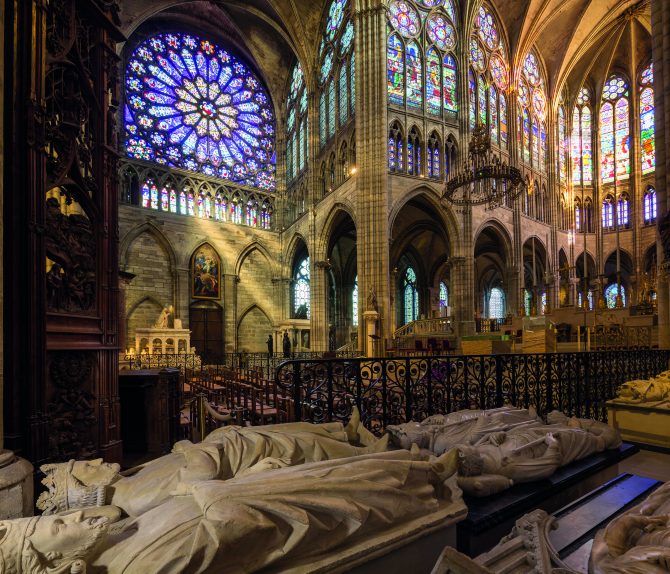
Following extensive renovation works, Saint-Denis’ basilica cathedral has regained its iconic silhouette and opened a new visitors’ experience.
Located on the outskirts of Paris, Saint-Denis’ cathedral, which is also the royal necropolis, has been undergoing some much-needed TLC. The façade has regained its original splendour, and the south rose window has been carefully restored, as have the stained-glass windows, returning the monument’s radiant beauty that once earned it the nickname the Lantern (Lucerna) up until the 18th century. The latest parts to be reconstructed are the north tower and spire and the scaffolding has just been peeled back to reveal their Gothic beauty.

Exterior of the basilica © Suivez la flèche
To mark the occasion, a brand-new exhibition pathway was inaugurated to create a more immersive experience for visitors. Think animated movies, touch screens, tablets and tactile elements for the visually impaired. The tour is organised around 3 main themes: the royal necropolis, the basilica’s architecture, and its history – all accessible in French, English, and Spanish.
The experience is further enriched with the new opening of La Fabrique de la flèche, giving an exceptional behind-the-scenes view of the reconstruction and the architectural challenge is presented. Visitors will be able to watch the stone masons lay the carved stones live on a screen or chat with the blacksmiths and ask about their trade. Alongside documentary films and a permanent exhibition, La Fabrique also has a virtual reality room in which visitors can step in the shoes of a Medieval builder.

©Lisa Millet
Centuries of history
Located on the outskirts of Paris, the Saint-Denis basilica is a marvel of Gothic architecture dubbed as the first of its kind. It also happens to be a necropolis, housing the remains of some of France’s greatest queens and kings, as well as princesses, princes and some members of the court.
It was built on the site of a 5th century church that had been erected over the burial site of the bishop Saint-Denis, who died around the year 250. According to legend, after Saint-Denis was decapitated by the Romans in Lutecia, he is said to have picked up his head and to have walked north while reciting prayers, until he collapsed at the site where the cathedral was built.

© Suivez la flèche
From the 7th until the 19th century, the Saint-Denis abbey welcomed the tombs of 40 kings, 26 queens and dozens of servants of the realm. They bear witness to the power of France’s greatest dynasties, from the Merovingians to the Carolingians and the Capetians.
Visitors can walk among the Europe’s largest funerary sculpture collection with some 70 sculpted tombs and recumbent effigy. Effigies of Dagobert, Anne of Brittany, Francis I, Louis XVI and Marie Antoinette, as well as the tomb of Henry II and Catherine de’ Medici are all present with these ancient stone walls.

© Patrick Cadet / Centre des monuments nationaux
First of its kind
The 12th century brought around the architectural changes that still stand today. Under the steam of Bishop Suger, advisor to kings Louis VI and VII, the basilica was gradually rebuilt in a new and unprecedented style, featuring innovative techniques for the time, such as ribbed vaults. These would allow higher, more aerated construction and therefore, the introduction of larger and more intricate glassworks.
Considered a landmark of Gothic art, it would go on to inspire the creation of new buildings throughout Europe!

© Philippe Berthé / Centre des monuments nationaux
In the early 19th century, Napoleon transformed the former monastic buildings of Saint-Denis into the Maison d’Éducation of the Légion d’Honneur, still active today. He also commissioned architect François Debret to restore the basilica, launching a vast renovation of its stained glass, façades, and sculptures. Criticised for his methods, Debret was eventually replaced by Eugène Viollet-le-Duc, who dismantled the north tower in 1847, hoping to rebuild it. The dream was finally realised…in 2024 through the Suivez la Flèche heritage project.

© Suivez la flèche
Elevated to cathedral status in 1966, the Basilica of Saint-Denis, now managed by the Centre des Monuments Nationaux, stands as a lasting emblem of France’s history.
Opening hours of the basilica:
From October to March
Monday to Saturday: 10:00 am – 4:45 pm
Sunday: 12:00 pm – 4:45 pm
From April to September
Monday to Saturday: 10:00 am – 5:45 pm
Sunday: 12:00 pm – 5:45 pm
Closed during religious services and on 1 January, 1 May and 25 December.
The royal necropolis (that is, the “museum” area and its collection of royal funerary sculptures) is located within a church that remains a place of worship and is therefore subject to regular exceptional closures. These closures also result in the closure of the Fabrique de la flèche, unless otherwise stated.
- Thursday 11 December: access from 11:30 am to 4:45 pm
- Saturday 20 December: access from 10:00 am to 1:30 pm, then from 3:30 pm to 4:45 pm
- Sunday 21 December: access from 12:30 pm to 4:45 pm
- Wednesday 24 December: access from 11:30 am to 3:45 pm
- Thursday 25 December: closed all day
- Wednesday 31 December: access from 10:00 am to 3:45 pm
- Thursday 1 January: closed all day
- Sunday 4 January: open from 12:00 pm to 2:30 pm
Lead photo credit : Inside the Saint-Denis basilica © Pascal Lemaître / Centre des monuments nationaux
Share to: Facebook Twitter LinkedIn Email
More in cathedrals, Centre des Monuments Nationaux, Discover the secrets of France's heritage sites, heritage, Paris outskirts, Saint-Denis
Related Posts


Leave a reply
Your email address will not be published. Required fields are marked *