
The Gorgeous Gares of France
Justin Postlethwaite looks at the history of France’s railway stations and picks out some of the country’s must-see terminal buildings…
Offering restful journeys, sublime views, great value and impressive timeliness – plus clear ecological benefits compared to air and internal-combustion transport – the French rail network is admired around the world.
But for many commuters and visiting Francophiles alike, the point of arrival or departure in a town or village – la gare (rooted in the Old French word garir or garer, meaning to guard or shelter) – is also a place to be explored and cooed at. The country is blessed with dozens of eye-pleasing terminals, from major TGV hubs to tiny village outposts with just a few passing trains a day.
Private initiatives saw the creation of France’s early train lines the first was the 21km one inaugurated in 1827 to transport coal from the mines of Saint-Étienne to the Loire, all pulled by horses. Ten years later came the first train line dedicated to passengers, and the State intervened to organise and regulate the network, leading in 1938 to the creation of the nationalised SNCF (Société nationale des chemins de fer français). At the time, it employed an astonishing 515,000 railway workers.
Other notable waypoints in the rail travel timeline include electrification in 1955, with a new single-phase industrial frequency power system that was subsequently adopted for high-speed rail; the TGV’s first world speed record (380 km/h) in 1981; and in 1987, the launch of TER (Transport express régional) trains, which signalled closer collaboration between SNCF and the regions.
As for the stations, many of the grandest that still serve as buzzing hubs today originated in the middle of the 19th century, in line with the boom of
industrialisation and urbanisation. Imposing yet inviting, they were monumental emblems of progress and modernity, key locations in France’s collective and social history.
So too were those built in subsequent eras, right up to present-day France, with award-winning gares such as Saint-Denis-Pleyel metro station north of Paris – the future gateway to the Grand Paris Express due for completion in 2031 -inaugurated by President Macron in June 2024. It points to the continued collective need and desire for rail travel, with attractiveness allied to function.
As ever, our pick of good-looking gares is subjective and intends to showcase the unmissables. If you have a favourite and wish to send us photos, email us at [email protected]. All aboard!
1. LIMOGES, HAUTE-VIENNE, NOUVELLE-AQUITAINE
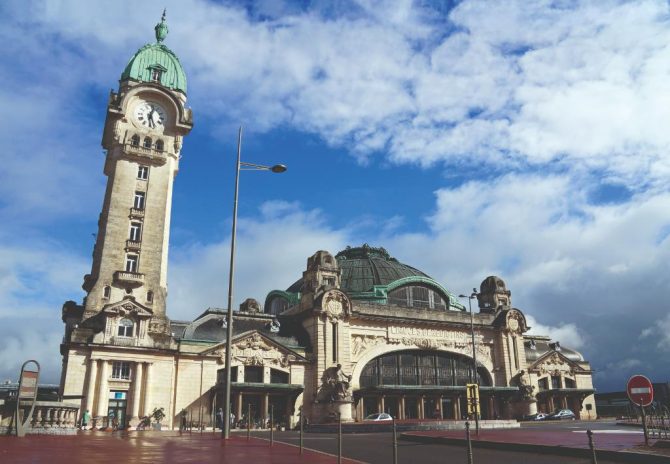
Widely acknowledged as the most impressive looking railway station in France, the original wooden Gare de Limoges-Bénédictins opened in 1856. The version we see now, with elements of Art Nouveau, Art Deco and Neoclassicism, was designed by the architect Roger Gonthier and erected between 1924 and 1929. Instead of sitting alongside the station’s 10 lines, it was built over them, while the huge dome (coupole) and clock tower (campanile) lend it a striking silhouette. Spot too the decorative limestone sculpture work by Henri Frédéric Varennes, and vast stained glass windows by master glassmaker Francis Chigot. It was listed as a monument historique in 1975. Tours of the station are available with Limoges’ City of Art and History tour guides.
www.destination-limoges.com/en
2. METZ, MOSELLE, GRAND EST
France has the Germans to thank for this neo-Romanesque beauty, commissioned by Wilhelm II, the last German Emperor, and completed in 1908 during the first annexation of Metz into the German Empire, the previous station having been destroyed by fire in 1872. Measuring more than 300m in length, it was conceived to move the most soldiers in the shortest possible time from France to Russia, with a direct line to Berlin and platforms big enough to accommodate not just troops on foot but those on horseback too!
Its epic scale aside, there is also plenty of rich ornamentation and design detail in medieval and Germanic style to enjoy: bas-reliefs depicting first-class passengers, stained glass windows, historiated capitals, basalt lions, friezes with Celtic motifs, and oriental palmettes (fan-shaped leaves of a palm tree). It’s a truly magnificent site to visit.

Photo: Shutterstock
3. GARE DE LYON, PARIS
For Parisians, this beloved Belle Époque train station signifies holiday escapes and trips to and from the sunny south. The Gare de Lyon is the northern terminus of the Paris-Marseille line (with stops in Lyon, hence its name), and one of the capital’s six mainline hubs.
Replacing the previous station built in 1855, it was designed by Toulon architect Marius Toudoire and was unveiled for the 1900 World’s Fair. Among the visual treats are a 67m tower with a clock measuring 6.4m in diameter and, inside, the large fresco painted by Jean-Baptiste Olive, depicting the places one could visit by hopping aboard and heading south.
For foodies, the Gare de Lyon also houses a must-visit eatery, Le Train Bleu. With its gilded mouldings, ceiling frescoes, glittering chandeliers and club chairs, it makes for a spectacular dining experience, whether you are catching a train or not.

Photo: Shutterstock
4. TROUVILLE-DEAUVILLE, CALVADOS, NORMANDY
This small but perfectly formed Côte Fleurie seaside station whose evolution -is largely due to the tourist pull of Normandy’s burgeoning coastal leisure pursuits from the 1860sowes its existence to the financier and politician, Charles, Duke of Morny. He got permission to extend the Paris-Saint-Lazare-Lisieux railway line up to the Calvados coastline and it was inaugurated on July 1, 1863.
However, today’s version, a very cute gare in the Neo-Norman architectural style (using local materials such as brick, pottery tiles from Bavent and faux timber modelling), arrived in 1931 when the original passenger building was demolished and replaced by architect Jean Philippot’s creation. On the main north-west elevation, you cannot miss the three gables decorated with the coats of arms of the towns of Deauville and Trouville – the two adjoining towns the station serves and a clock. The station was declared an historic monument in July 2010.

Photo: Shutterstock
5. LA ROCHELLE, CHARENTE-MARITIME, NOUVELLE-AQUITAINE
First conceived in 1906 to improve access for visitors to the burgeoning seaside resort, construction of architect Pierre Esquié’s majestic, monumental station began in 1909, but was interrupted by the First World War and work did not resume until 1919. Finally inaugurated in November 1922, it is dominated by a 45m-high bell tower (Grosse Horloge), taller than the famous towers at the port town’s harbour entrance.
The façade is decorated with engravings inspired by marine fauna while the passenger hall is adorned with a large mosaic of sailing ships by A. Biret.

Photo: Shutterstock
From France Today Magazine
Lead photo credit : Photo: Shutterstock
Share to: Facebook Twitter LinkedIn Email
More in france, French train stations, train station
Related Posts



Leave a reply
Your email address will not be published. Required fields are marked *