
A Little Canteen with a Big Impact
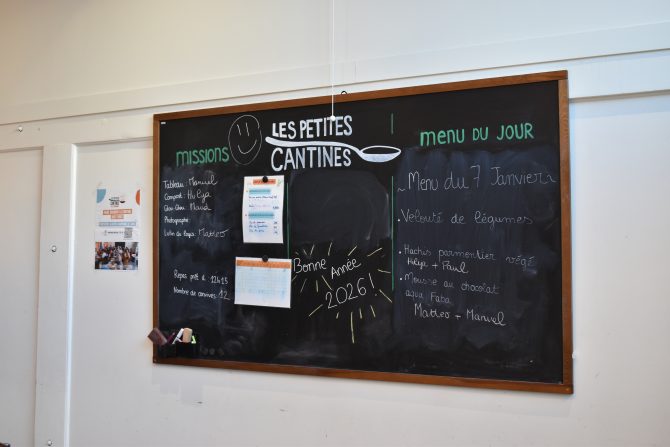
At 9.30am on a Tuesday, the kitchen is already a hive of activity. Vieux Lyon, the old town, may be the most touristy part of Lyon, but Les Petites Cantines makes all of the neighbouring cafés look quiet. Oven dishes with a Tetris-like arrangement of thick-cut slices of aubergine fill every available space on the tables. One group of people is busy frosting long, loaf-shaped carrot cakes, another is blending huge vats of soup: courgette and kiri (soft cheese) flavour. I don a little fabric headscarf and an apron and get stuck in, basting aubergine slices with olive oil from the most enormous jerrycan of oil I’ve ever seen.
The three-course feast we’re preparing will be served to the public for just €13, including coffee, and you can add on a glass of wine for the princely sum of €2. That’s cheaper than any restaurant I’ve ever been to in Lyon, but Les Petites Cantines isn’t a restaurant, it’s a community-run canteen.

In 2013, co-founder Diane Dupré la Tour suddenly found herself a single mother, aged just 32. Her three children were the survivors of a car crash which had killed her husband. Following the accident, neighbours, friends and family members cooked for her, providing some of the only moments of solace in her darkest time.
The first Petite Cantine opened three years later, at the start of 2016, in Vaise, Lyon’s 9th arrondissement. It was a joint venture between former financial journalist Dupré la Tour and her friend Etienne Thouvenot, who was Head of Innovations at a household appliances company at the time. Dupré la Tour and Thouvenot discovered that loneliness could be as fatal as smoking 15 cigarettes a day, and was exacerbated by factors like unemployment and financial instability. It was something that affected all generations and all walks of life, as Dupré la Tour had discovered firsthand.

The public was extremely responsive, and a decade after the first Petite Cantine opened its doors, there are 17 branches in France. And that’s set to more than double, with 20 other Petites Cantines already in the works – including a project they’re supporting in La Réunion! And that’s set to more than double, with 20 other Petites Cantines already in the works. Each canteen generally has only two salaried members and is otherwise entirely volunteer-run. Even the founding members of each canteen are usually volunteers.
“I really admire the people who galvanise the opening of a new Petite Cantine,” says Sarah Jacquemin, Head of Marketing and Communication, when I speak to her at Les Petites Cantines Villeurbanne. “It’s a lot of work, you’re essentially setting up a whole restaurant in your spare time for most of them!”
Each month, some 6,000 meals are plated up to hungry diners around the country. How much you pay works on an honesty box system.

“One of the fundamental principles of Les Petites Cantines is trusting people, which is why the cost of a meal is give-what-you-can,” she says. “We believe that people will enjoy the experience so much that they’ll want to pay fairly, and we find it always balances out financially.”
Nobody eats for free. The suggested donation is €13, but many choose to pay more, which subsidises those with lower means. As a non-profit, it’s a delicate balance to be found. Many local businesses and market vendors also help to keep the overheads low by donating surplus or unsold produce to Les Petites Cantines. This also keeps the menu seasonal. Roughly 95% of meals served at Les Petites Cantines are vegetarian, and on the rare occasions where meat is served, there’s always a vegetarian option included too. All and any dietary requirements can be met — inclusivity is at the core of Les Petites Cantines — but even the most omnivorous diner is asked to book a slot at least 24 hours in advance. Knowing how many people they’re feeding helps to prevent food waste.

Anyone can help cook at Les Petites Cantines, even as a one-off, and tourists are welcome. Chefs are asked to arrive at 9.30am, diners at 12.30pm. On the day that I don my apron, I find myself surrounded by people I’d never usually meet. I make epic quantities of aubergine parmigiana with sixth form students and retirees, and it strikes me that this is probably the longest conversation I’ve held with either teenagers or retirees for a long time. Like many, my social circle is largely made up of people my own age, something even more exacerbated when you’re a foreigner in a city. When we dish up, I share my table with film studies students — it feels appropriate since Lyon was the birthplace of cinema. We needn’t have worried about wasting food, there’s barely a crumb left when the last dishes are scraped clean.
After lunch, I stay to help clean up, a process made light work by many hands. Some people leave straight away, but there’s no blame culture. It’s expected that you’ll help out when you have time; an honesty box system applies just as much to sharing out tasks as to money. And although Les Petites Cantines is spreading like wildfire across the country, its sustainable growth that is the goal.
“We’re not trying to open 500 Petites Cantines in France by tomorrow,” says Jacquemin. “We just want to show that this kind of place is possible and can transform the way we live together.”
Lead photo credit : Photo: Anna Richards
Share to: Facebook Twitter LinkedIn Email
More in Food, French food, French food bank, petites cantines, volunteering in France
Related Posts

Leave a reply
Your email address will not be published. Required fields are marked *
REPLY