
Going Sober in the Southwest of France
I attended my first wine tasting when I was seven. Perhaps considered young by some, but in the southwest of France, nobody blinked twice.
My family was spending a year’s sabbatical in France. Or at least, my parents were; my brother and I still had to attend school. This had been my mother’s dream since her early twenties, and now she was living it out in the most quintessentially French way one can. Here we were, a typical middle-class Canadian family, living on a vineyard an hour away from Bordeaux, in the region of Nouvelle-Aquitaine.
During the wine tasting with our landlords, Mari-Jo and Pierre, who also owned and managed the vineyard, I tasted a red wine from a bottle wrapped in paper. I spoke honestly: “It tastes like the smell of gasoline,” and while my parents and brother laughed, Mari-Jo earnestly nodded her head, eyes lit up. “Oui, Anna,” she said. “C’est exactement ça!” She explained that the wine I was tasting was a Côtes Du Rhône, famous for its richness and use of ripe grapes, which could sometimes lead to a slight taste of gasoline.

Although I was no sommelier prodigy, I did gather some wine basics during that year in France at the ripe age of seven. I learned that the clear streaks on the side of the wine glass represent the residual alcohol, and that you can really get more flavour from a sip of wine if you let a bit of air in and swish it around in your mouth for a moment, and that the dry clay-like clumps of dirt from which the vines grow are not a bad thing, but rather a key feature that makes the region’s wines what they are.
My parents bought a townhouse in the area one year later, and we returned to France every summer or every other summer after that. When I was 16, my parents and I returned for six months. I was once again a student in a French school, but things were different as a teenager. Turns out, French teenagers experiment with substances not so differently from teenagers in North America.
It was during this coming-of-age period that I had my first binge-drinking experience, I tried shisha, smoked cigarettes, and suffered my first hangover. On that last one, my father, a drinker himself, knew exactly what was happening that morning when I went back and forth to the toilet three times to vomit profusely. My mother, thankfully, remained blissfully unaware.

At 16, I wasn’t participating in blind wine tastings or discussing the merits of a St-Emilion merlot against a Cabernet Sauvignon from the Medoc region. Sure, there was plenty of extremely affordable wine available, but my friends and I mostly drank “rosé piscine,” in other words, rosé on ice, or beer, coolers, aperitifs, and hard liquors.
Ironically, just as I was discovering the magical world of alcohol, my father was exiting it. He had quit drinking at different times in his life, and after one particularly bad experience relatively close to the beginning of our six-month stay in France, he decided to quit, once and for all. I am proud to say that this cold turkey commitment to sobriety that he made back in 2010 has remained steadfast up to present day, save for one unfortunate backslide.
As for me, I never felt the need to quit drinking. I’ve had some bad experiences, of course, and I may have relied on it too much in my twenties as a social lubricant. Still, overall, I feel relatively comfortable in my relationship with alcohol.

But this past October, when I travelled with my now-husband to France for our wedding, for the first time in my adult life, I was sober, because I was six months pregnant. Being sober in the southwest of France is no small task, and this trip allowed me to fully appreciate what my father had given up those many years ago. To be sober in France isn’t just to give up alcohol; it’s to actively not participate in one of France’s most fundamental cultural touchstones.
Sobriety in France is therefore more complicated than the simple question of drinking or not drinking. Wine is offered at lunch, is often the aperitif of choice, and of course is served with dinner. In fact, at many establishments, the menu du jour or the prix fixe menu will include wine, specifically chosen by sommeliers to complement the taste of each menu item. Wine can also be an event in itself. For many summers, my parents attended the Fête des Vins hosted by neighbouring villages, trying wines from different terroirs, and (sometimes) making use of the spit buckets.
I am not a wine aficionado, so although being sober at my wedding felt inconvenient and not exactly fun, I didn’t find myself craving it for the sake of flavour or food pairings. What I really missed in my sobriety was the slight buzz one gets from a glass of champagne, or the warm feeling of red wine, or the joy of an ice-cold white or rosé at sunset. I craved the pomp and circumstance of alcohol, and this was a problem that could be solved.
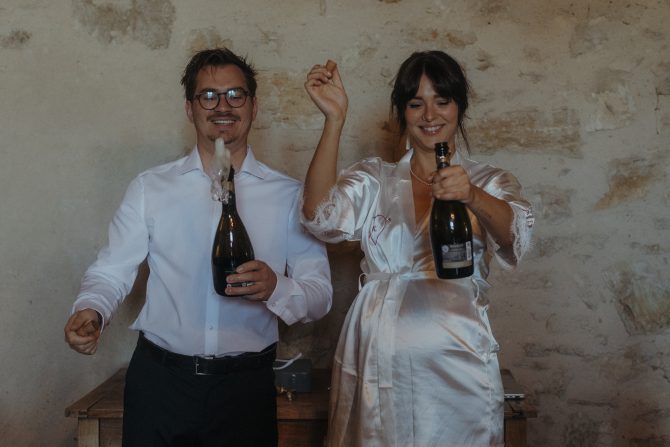
Thanks to some family friends, who are also local restaurateurs who have been experimenting with alcohol-free beverages for some years now, we were able to source a six-pack of “no-secco” for the wedding weekend. On the morning of my wedding day, as my girlfriends and I got ready together, I popped one of the bottles, getting the same rush from the “pop!” sound that any real bottle of bubbly might give me.

During this trip, I also discovered the wonders of Corona Cero. At zero proof, these taste exactly like the real thing. As friends and family members nursed their hangovers on the Sunday morning with leftover wine, beer, and spirits from the night before, I enjoyed my Corona Ceros, lime and all. Even my father, who has long rejected “mocktails” and other non-alcoholic replacements, found himself enjoying the light and refreshing taste of these highly believable dupes.
For me, going sober in the southwest of France, even for my wedding, wasn’t so difficult, despite the region’s rich cultural connection to wine. Even rural France is joining the trend of alcohol-free drinking. In fact, I had such a believable non-alcoholic Aperol Spritz at a restaurant near Bergerac that I had to check with the server that it was, genuinely, non-alcoholic.

For true wine lovers, though, I can’t imagine that being alcohol-free in Southwest France is particularly easy. France maintains its reputation as one of the best and most diverse producers of wine in the world. And no wonder — they’ve put in their hours, after all. Knowing this rich historical and cultural background, along with my own (temporary) sober experience in France, I now find myself raising a non-alcoholic glass of wine in honour of my father. Unlike me, he truly does love and know wine, and his commitment to sobriety over the last 15 years has been a much greater sacrifice.
Giving up alcohol, and especially wine, in one of the world’s greatest wine regions is no small feat, and certainly not for the faint of heart. However, it is possible, and with the recent boom of tasty non-alcoholic alternatives, there is no better time to do it.
Lead photo credit : Husband with real champagne, Anna, with no-secco Photo: Chiara Ernsting
Share to: Facebook Twitter LinkedIn Email
More in alcohol free, drinking in france, dry january, dry january abroad, French alcohol, sober holidays, sober holidays in France, Sober in France
Related Posts
By Anna Dodd
Leave a reply
Your email address will not be published. Required fields are marked *
REPLY
REPLY
REPLY