
A French Story, a Universal Message: Gisèle Pelicot Debuts Memoir in London
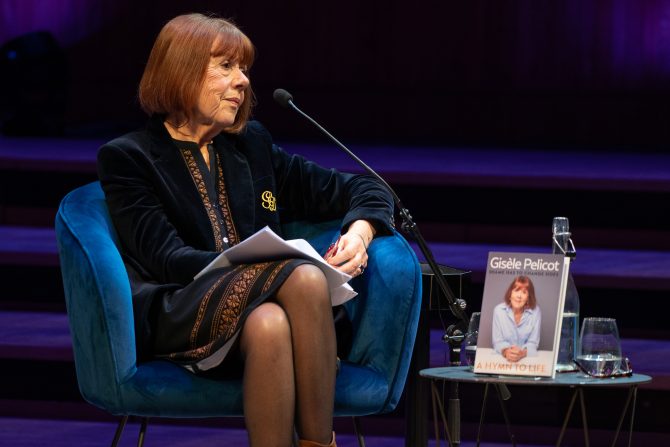

There were no grand theatrical flourishes on the stage at the Southbank Centre in London on Friday night. Just two simple chairs set at the centre – one for Gisèle Pelicot, one for Samira Ahmed – and a lectern at either side where extracts from Pelicot’s memoir, A Hymn to Life, would be read.
The spareness felt deliberate. Nothing distracted from the woman at the heart of the evening: a French grandmother who has become an unlikely feminist icon after insisting that the shame of sexual violence must rest not with victims, but with perpetrators.
When Pelicot entered the auditorium, the awe in the room was almost tangible – something you could taste in the air. The audience rose instinctively. This was not celebrity adoration; it was something deeper, closer to reverence. Here was a woman who had endured nearly a decade of chemical submission and orchestrated rape by her husband and dozens of men, and who had then chosen to make her trial public, refusing anonymity so that the reality of what had happened could not be softened or obscured.
She spoke throughout in French. On entering the auditorium, every audience member had been handed an earpiece, through which translators delivered her words in real time. Yet hearing her unfiltered voice first one word ahead – calm, measured, composed – added to the gravity. Pelicot’s poise was extraordinary. So, too, was Ahmed’s. Their conversation unfolded with care, dignity and mutual respect.

Early in the discussion, Ahmed asked about Pelicot’s childhood – about growing up in post-war France, in a generation shaped by silence. Pelicot reflected that in her family, suffering was not shared; pain was hidden. “I show the positive side,” she said. “The painful things, I did not share.” It was a revelation that cast her later endurance in a new light. When her mother died at nine, she said, she grew up fast. Tragedy forged her character; it gave her the steel that would later allow her to stand in court and correct a judge who referred to “sex scenes” instead of rape.
That correction, and her insistence on naming violence accurately, has become emblematic of her wider message. Throughout the trial in Avignon, she refused language that diluted the crime. In London, she repeated that clarity. Rape was rape. Barbarity was barbarity. Words mattered.
The readings from the memoir were delivered in turn by Kate Winslet, Kristin Scott Thomas and Juliet Stevenson. Each stood alone at the lectern, allowing Pelicot’s prose to speak for itself. In one extract, she described embodying in court “the tortured body that was being talked about all the time,” giving it voice and consciousness, even elegance – “all the things that rape seeks to destroy.”

Perhaps the most moving passages recounted the women who gathered outside the Palais de Justice each day. They queued for seats in overflow rooms, waited in the cold, wrote letters. “This crowd saved me,” she wrote. On stage in London, as those words were read aloud, you could sense a parallel: another crowd, in another city, in another country, listening in solidarity.
The conversation ranged widely, from the medical professionals who failed to recognise signs of chemical submission, to the psychologist who branded her a “slave girl” under her husband’s control. Pelicot described her fury at that assessment. “I was never a slave,” she said firmly. A slave does not need to be drugged unconscious.
She spoke, too, of denial – her own and that of others. Of a lost friendship, rekindled after twenty years. Of her daughter, who discovered she too had been photographed without consent. Of the security guard in a supermarket whose vigilance ultimately triggered the police investigation that saved her life. Of the police officers who pursued digital evidence when others might have dismissed her husband as merely an ageing man with an “urge.”
What emerged was not only a story of individual cruelty, but of systemic failure – and courage. Pelicot was clear that without evidence she might never have been believed. Even with proof, she was humiliated in court. Defence lawyers implied consent. Some of the men convicted still denied wrongdoing. “It was a trial of cowardice and denial,” she said.

An audience member named Grace asked Pelicot a question that struck at the heart of survivor courage: “After decades of experiencing sexual violence, I have found the courage to pursue justice for the first time. For those of us at the very beginning of the journey that you have walked, what words of encouragement would you offer?”
Pelicot responded in French: “Je pense qu’il faut qu’elles aillent au bout de leur démarche. Il ne faut pas regretter… Elles sont dans une extrême solitude. Il ne faut surtout pas s’isoler. Il faut se faire accompagner… Se redonner confiance… il faut qu’elles osent porter plainte… Trouvez la force. Et je pense qu’onl’a tous en nous… Il faut se faire accompagner, il faut se faire aider… J’ai consulté des psychologues, des psychiatres… Chacun va à son rythme, mais je pense qu’il faut qu’elles s’écoutent avant tout et qu’elles fassent la démarche de porter plainte. C’est très important.”
Translation: “I think they must follow through with their process. Do not regret it… Victims often feel shame. They are in extreme solitude. Above all, theymust not isolate themselves. They must seek support… regain confidence… they must dare to file a complaint… Find the strength. And I think we all have it within us… One must seek help, be accompanied… I consulted psychologists, psychiatrists… Everyone moves at their own pace, but I think the most important thing is to listen to oneself and take the step to file a complaint. It is very important.”
On whether sexual violence is uniquely French, Pelicot was emphatic: “This issue – chemical submission, sexual violence – is universal. Every day, there are cases in Germany, England, Spain, the United States. It concerns the entire world.”
She also reflected on prevention and the role of society and technology. Education, respect, and vigilance – particularly regarding the online spread of pornography and predatory digital behavior – are key. Children must be taught boundaries, the dangers of online spaces, and the importance of mutual respect. Tech can be used to exploit, she warned, but it can also be part of the solution if approached responsibly.

And yet, astonishingly, the evening was not defined by despair. Pelicot spoke of walking, how long walks helped her think, helped her decide to make the trial public. She laughed about binge-watching The Queen’s Gambit while temporarily living in a borrowed apartment, trying to reclaim fragments of ordinary life. She spoke movingly of the partner she has since met and who was in the audience, proof, she said, that life can surprise you even after devastation.
In the audience, I noticed fathers sitting beside daughters. At one point, as Pelicot urged victims not to isolate themselves and to seek support, a teenage girl wiped her eyes while her father squeezed her hand. It was a small gesture, but it felt significant – an intergenerational reckoning unfolding quietly in the dark of the auditorium.
Asked what message she hoped men would take from her story, Pelicot did not rage. Instead, she described the book as a message of hope. Look at what I have survived, she seemed to say. Life is still worth living.
She is 73 now. When Ahmed asked about her plans, she smiled. She hopes for serenity, for time with those she loves. But she will always be there, she said, for women who need support.
As the final applause thundered through the auditorium, the simplicity of the stage felt entirely powerful. Two chairs. Two women. A lectern. No spectacle – only testimony, language, and an insistence that shame must change sides.
Outside, along the Thames, conversations lingered. The awe remained. Not because Gisèle Pelicot presents herself as fearless, but because she has transformed private violation into public reckoning. In doing so, she has given countless others permission to speak – and, perhaps, to stand upright in their own stories.
A Hymn to Life, by Gisèle Pelicot – published by Penguin Random House

Buy the book: https://www.penguin.co.uk/books/475698/a-hymn-to-life-by-pelicot-gisele/9781847928962
Lead photo credit : Gisèle Pelicot- A Hymn to Life Photo: Pete Woodhead ©
Share to: Facebook Twitter LinkedIn Email
More in A Hymn to Life, French autobiography, French memoir, Gisele Pelicot
Related Posts



By Poppy Pearce
Leave a reply
Your email address will not be published. Required fields are marked *