
How Parisian Cabaret Continues to Break the Rules
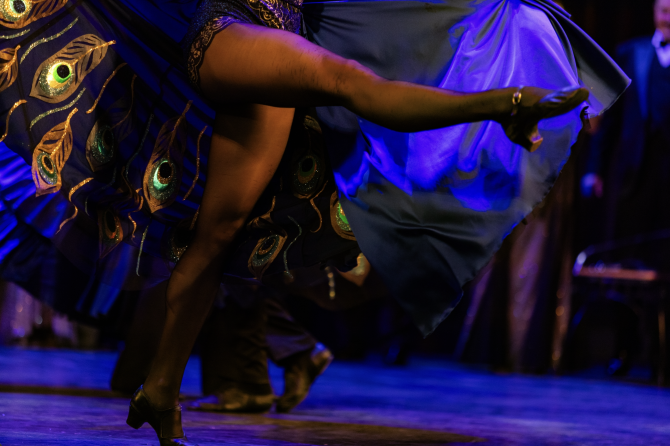

From feminist revolutions to transgender icons, via mandatory weigh-ins and stilettos, this is the weird and wonderful world of Parisian cabaret.
Frilly petticoats, French knickers and feathers. Stilettos as long as a forearm, lipstick redder than a London bus, and perfect buttocks dressed only in light and shadows. Cross dressing, drag makeup and a space to learn about gender transition.
All of these make up the diverse world of Parisian cabaret. It’s ironic that while many cabaret clubs have mandatory height restrictions and weigh-ins, there is no ‘one size fits all’ in this kind of show. Individual clubs themselves can be particular — take Crazy Horse Paris, for example.

When it was founded in 1951, dancers had to be between 1m68 and 1m72, with 21cm between the tips of both breasts and 13cm between pubis and navel. That’s eased up, but there are still rules in place. Performers may not have undergone any cosmetic surgery, and curly-haired dancers can keep their ringlets, but those with a wave must opt for poker straight, ironing board hair.
In spite of these stringent rules, cabaret has done nothing but break from tradition from the start. Born in the slums of Montmartre, cabaret’s iconic dance, the French Cancan, was originally a feminist revolt by Parisian washerwomen.

Fed up with the drudgery of their daily lives, and all the menial tasks they were obliged to carry out for their husbands, they showed their dissatisfaction through dance, transforming chores into dance moves like the corkscrew (uncorking drinks for their often inebriated husbands), washing clothes and even making mayonnaise.
The moves in Cancan are still known by the same names today. The dance was banned in 1831, and the church preached against it, which only served to enforce the idea that the Cancan was an act of rebellion. By 1860, legalised once more, cabaret was one of the few professions in which women were better paid than men, writes Nadège Maruta in L’incroyable histoire du cancan (The Incredible History of Cancan).
By the late 19th century, cabaret was booming, with the opening of Au Lapin Agile (1860), and Moulin Rouge and Le Paradis Latin (both 1889). In spite of its popularity, it was widely regarded as debaucherous, and cabaret clubs as places that promoted drunkenness, violence and prostitution.

Cabaret slumped during WW1, but in the post-war years, it found an unlikely hero who would become the most famous cabaret star of all time. Josephine Baker, a young black woman from Missouri, sashayed onto stages (most famously wearing a skirt made of strings of ornamental bananas at Folies Bergère in 1926). She became the highest paid entertainer in Europe, later renouncing her American citizenship and setting up permanent residence in France.
During the Second World War, the cabaret clubs in occupied France closed once again, but straight after the war, cabaret experienced an unlikely revival. Being transgender in 1940s France wasn’t easy. Being anything other than heterosexual wasn’t simple for that matter, but for Paris’s queer community, Madame Arthur was a haven.
Long before drag races graced our TV screens and Ru Paul preached self love before anything else, drag artists were performing in France’s first drag cabaret club, which opened its doors in 1946. Many of the first celebrities to publicly transition, transgender cabaret stars Coccinelle and Bambi among them, performed here. To this day, it has inspired other artists to come here to learn from their journeys.

“[Madame Arthur] is an establishment deeply rooted in French queer history,” says La Briochée, a current performer at Madame Arthur, when I meet her backstage. “I’d read all five volumes of Bambi’s autobiography when I was accepted here, and I felt like I could feel exactly what she’d lived, and imagine how the club was, the backstage areas, dressing rooms and everything, at the time.”
Although not exclusively a drag club (many of Madame Arthur’s ‘creatures’, as they refer to their performers, dress as the gender they were assigned at birth), this predominantly queer cabaret has served as a safe space for the LGBTQIA+ community in Pigalle for almost 80 years.
At the same time as Madame Arthur was providing a platform for the first openly transgender stars, Crazy Horse Paris, which opened just six years later, in 1951, could have been seen as extremely conformist.
When dancer Zelda Showtime shows me around backstage, she’s already made up and wearing a signature black bob wig. The ‘original’ stilettos worn by Crazy Girls, displayed in a glass case, are so high and pointed that they look like a Cluedo murder weapon, and retro scales tell a history of mandatory weigh-ins for performers.

“There are still weigh-ins,” says Zelda Showtime frankly. “But our target weight is tailored to each of us according to our height and body type. We also can’t drop below a certain weight.”
When I watch the Crazy Girls on stage, donning sleek, shiny black horse tails for one number and clip-clopping and shaking their perfect bottoms in unison, it’s so fluid that I forget I’m watching a troupe of almost naked women.
It’s true that while all the dancers have legs at least twice as long and twice as toned as my own, there’s nothing runway skeletal about these bodies, which don’t even look like bodies on stage, rather pure art. Cabaret is often critiqued as being nudity for the male gaze, but the audience around me is heavily female, and the show feels sensual rather than sexual.
“I become a different character, a different person,” says performer Liza Stardust, who travelled from Australia to join the team — the Crazy Girls are extremely international. All Crazy Girls are given a new name and new ‘identity’ when they join. “It’s like entering a different world.”

And cabaret continues to revolutionise. Le Cabaret des Vénus Noires, a black, queer troupe of 12, was formed in November 2023. They performed their first cabaret show together the following November.
“It’s crazy that in 2025 we still need to fight for visibility for black, queer artists,” says Michelle Tshibola, the founder. “We don’t want to be confined to stereotypical roles any more, we want to be poets, singers, artists and dancers. When I’m on stage, my gender doesn’t matter. I’m just me.”
The pandemic was detrimental to much of the entertainment industry, but with around 160 cabaret clubs in Île-de-France alone, the popularity of Parisian cabaret only seems to be growing. 200 years of feminism and revolution under its belt, it’s a look not just at where the city has been, but where it’s going, and you can be sure that cabaret will continue to challenge the norm.
See a show:
Madame Arthur: Paris’s original drag cabaret in Pigalle, where the party continues until the not-so-small hours.
Crazy Horse Paris: Enjoy champagne and canapés while watching matching red lips and stiletto heels in the slickest show out there.
Les Vénus Noires: Check the Instagram page for pop-up shows from this brand new cabaret club, which changes location.



REPLY