
Preserving a 600-Year-Old Lenten Tradition in Southwest France
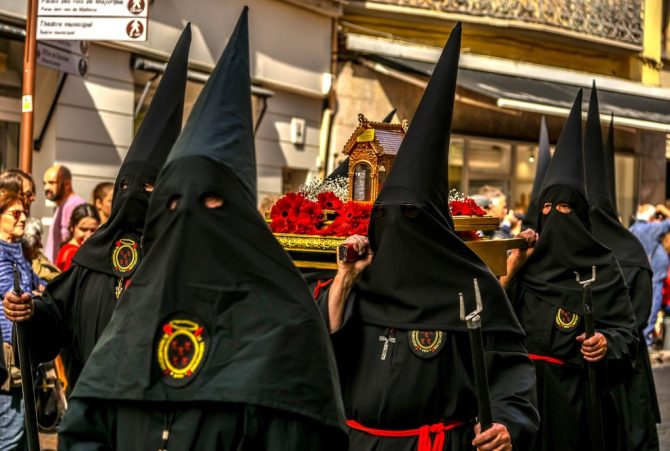

On Good Friday, a strange procession takes place in the heart of the Catalan city of Perpignan, that transports curious watchers back to the 15th century.
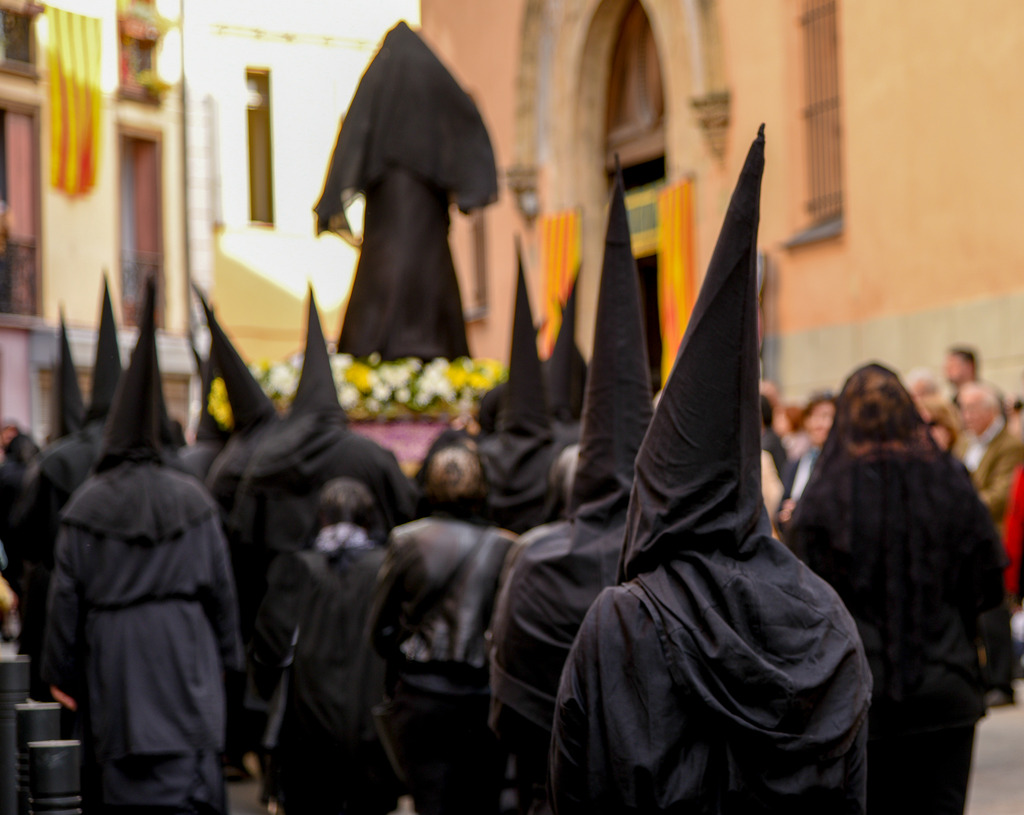
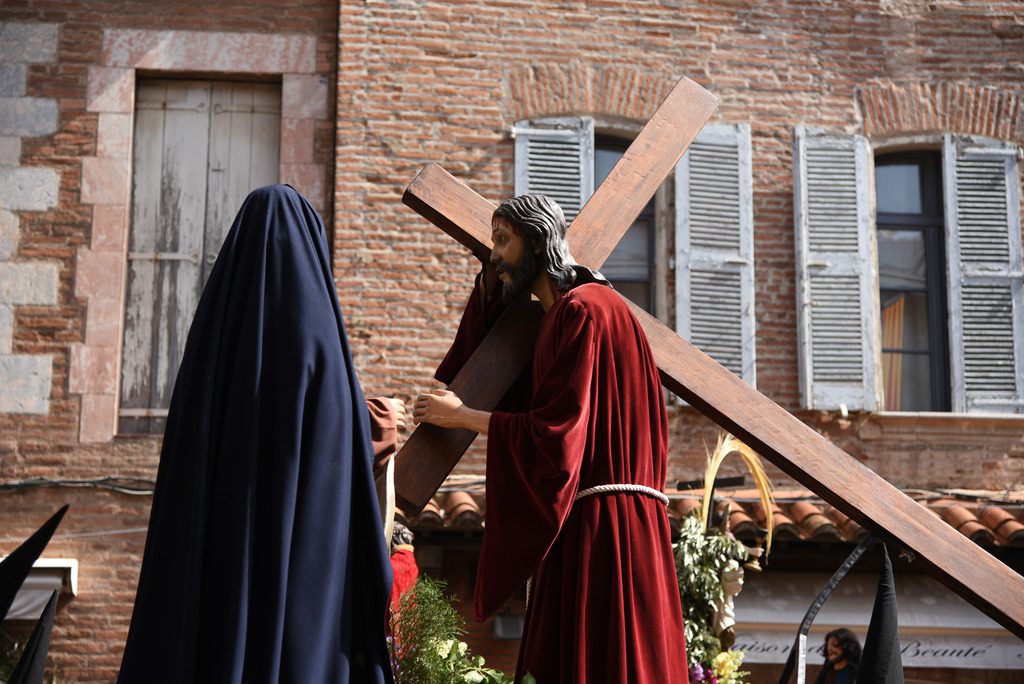
It is Good Friday. A hushed silence falls over the crowd of spectators as the head of the penitents, the Regidor, rings an iron bell to warn of the coming procession. The sound of the bell accompanies a mournful tambourine beating a slow cadence to the steps of the penitents solemnly walking into the square in front of the 14th-century Saint John the Baptist Cathedral in Perpignan, France. On the shoulders of the penitents lies a life-size statue, a misteri, in the language of Catalonia, of a crucified Jesus, heavy on the shoulders of the men, carrying the weight of as many as 100kg as penance. Some of the men are barefoot. Others carry misteris of Mary, mourning the suffering and death of her Son. Women dressed in black, both young and old, also process and carry life size statues of Jesus or Mary, also as a way of doing penance. La Sanch, meaning the blood, is a procession of penitents commemorating the Passion and Agony of Christ and takes place each year in Perpignan.
Those unfamiliar with La Sanch in Perpignan, a small city brimming with Catalan culture in southwestern France, might feel bewildered upon seeing the black and red tunics and the pointed headpieces worn by the penitents, but they may also feel they have travelled back in time to the 15th century upon seeing the Brotherhood of La Sanch and learning of its history.
© Ava Kabouchy
For 6 centuries, La Sanch has been part of the culture of Perpignan, and it attracts thousands of spectators each year. Both believers and non-believers can partake in the solemnity of the procession – more than just a procession; also a way of preserving a Catalan religious and historic ritual. For the 700 participants in La Sanch, this procession of penitents is real, believers atoning for sins committed over the past liturgical year. For the spectators, this historical, religious, and cultural event can also be a time for piety and devotion.
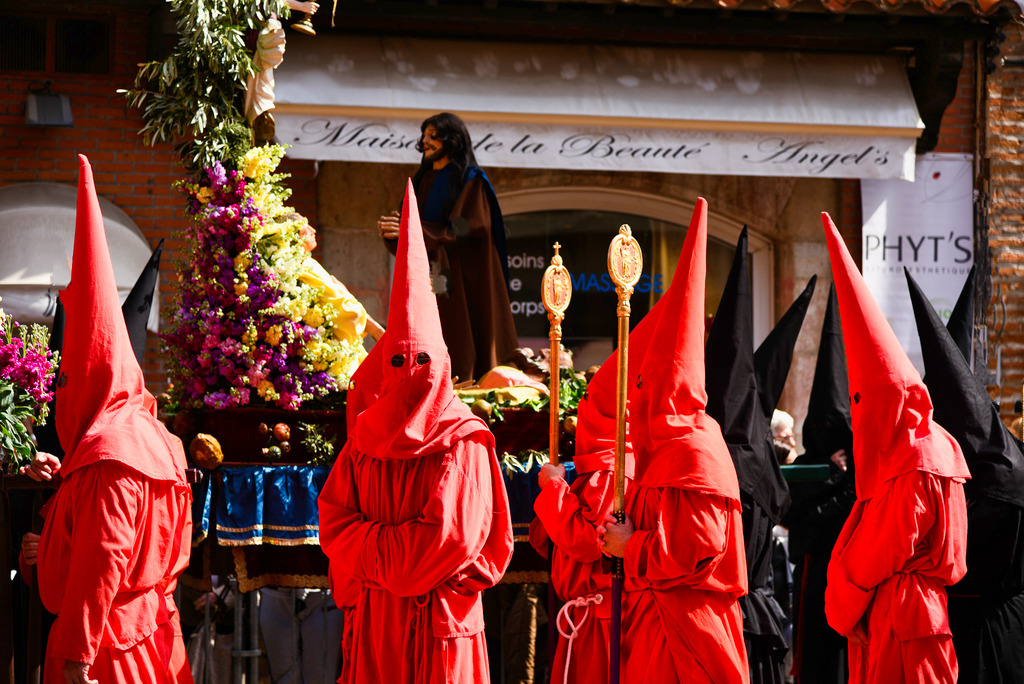
The red tunics and pointed headpieces, Caperutxa in Catalan, shining brilliantly in the Perpignan sun, worn by those leading La Sanch, symbolize blood. Penitents following wear black tunics and Caperutxa symbolizing death; only priests and children wear white, symbolizing the innocents and the saved. The Caperutxa worn by each man hiding his identity and revealing only his eyes date from the 15th century when Dominican monks led a condemned man to his execution. Hiding his identity and that of those leading him protected the condemned man from being beaten or even lynched by angry family members wanting revenge. Protecting the accused from retribution also assured him of a religious burial.
© Ava Kabouchy
Silence reigns among the participants of La Sanch in Perpignan on Holy Saturday, but the ringing of the bells of the Cathedral of Saint Jean can be heard throughout the city as celebration of Easter Sunday commences. Priests and acolytes process down the nave of the cathedral, hymns being sung, incense burning, creating an otherworldly, joyful atmosphere, so different from that of Friday’s solemnity.
The Brotherhood of La Sanch was founded in 1416 by Vincent Ferrier, a Valencian Dominican monk, at the 13th century church of St. Jacques in Perpignan after Vincent almost died by an attack of fever in 1398 but was miraculously cured by an apparition of Christ accompanied by St. Dominic and St. Francis. Vincent went on to convert thousands to the Catholic faith by his example and his preaching. “Wherever you go, think not of yourself, but of God” was a sentence for which he became known. He was canonized on June 3, 1455.
© Ava Kabouchy
Share to: Facebook Twitter LinkedIn Email
More in catalan France, folklore, local legends, South of France, traditions
Related Posts



By Ava Kabouchy
Leave a reply
Your email address will not be published. Required fields are marked *
REPLY