
The Soul of Châteauneuf-du-Pape’s Wine Region
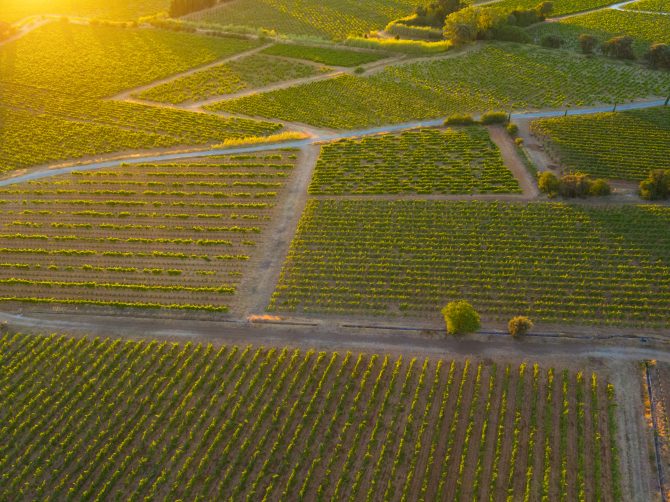
Galet-strewn vineyards shape Châteauneuf-du-Pape’s powerful wines amid fiercely protected traditions, as Dominic Bliss discovers…
Smooth, beige, oblong and ranging in length up to 20cm or so, they’re known as galets ronds or galets roulés. These stones, covering the soil in the vineyards, are what make Châteauneuf-du-Pape so different from France’s other wine-growing regions.
In the warmer months they soak up the sun’s heat, transmitting it back once night has fallen into the clusters of grapes hanging above, thereby accelerating the ripening process. They also stop the soil drying out during the mercilessly hot Provençal summers, and protect it from erosion by the Mistral. By causing rain to evaporate quickly, the stones also prevent certain vine diseases. It’s safe to say, without the galets, Châteauneuf-du-Pape might never have become one of France’s most famous wine-growing regions.

chai_barrique_ecusson Château de la Gardine
On a mild day in December, long after the grapes had been harvested, I wandered the vineyards on the edge of town. Even in winter, with the vines cut back and denuded of their leaves, it was bright and light, as the weak sun glistened off the slick, wet galets. In some vineyards, once the grapes have been harvested, winemakers allow sheep to roam between the rows of vines, to keep the vegetation in check through their nibbling. Many of the little flocks are guarded by burly dogs, as I discovered when I strayed too close.
RELIGIOUS BEGINNINGS
Châteauneuf-du-Pape is a small town in the Vaucluse department, on the western edge of Provence, close to the River Rhône. With a population of just over 2,000, it covers 10 square miles, with virtually every bit of available soil dedicated to growing vines. It was in the 14th century, when the papacy installed itself in nearby Avignon, rather than Rome, that the town got its name. Pope John XXII was rather keen on the local tipple, and under his reign and patronage, viticulture flourished. Once he had overseen the construction of a new castle (château neus) – now ruined and home to crows – on the town’s central hill, Châteauneuf-du-Pape was firmly placed on the map. Over the following centuries, the wine produced here grew enormously in reputation. Poets and writers such as Frédéric Mistral, Alphonse de Lamartine, Alexandre Dumas and Alphonse Daudet were all fans, becoming unofficial ambassadors of the brand.

Vue chateau et vigne©Guenhaël_Kessler
Then, after the First World War, under the leadership of winemaker Baron Pierre Le Roy de Boiseaumarié, the vineyard owners joined forces and, in 1933, succeeded in having their wine decreed as France’s first Appellation d’Origine Contrôlée, setting the prototype for all future AOC rules. The appellation included strict production rules over cultivation methods, minimum alcohol content, grape varieties and grape sorting. At the time, the baron declared: “May this policy of quality never be abandoned. We are not made for standardised production. No! We are unbeatable in the aspects where the artisan becomes an artist. Quality is the hallmark of French genius.” Nowadays, there are more than 300 winemakers plying their trade in Châteauneuf-du-Pape’s vineyards, some with large estates, others with barely a couple of hectares. Altogether there are 3,200 hectares of official Châteauneuf-du-Pape AOC vineyards, stretching across five communes, and producing 12m bottles in an average year. Up to 13 grape varieties can be used, with grenache dominating. Up to 93 per cent of the wine is red.

Jas des Papes
The official body that governs the production of AOC wine here is the Maison des Vins de Châteauneuf-du-Pape. “Red wines reveal a wide aromatic palette: ripe fruits, blackcurrant, blackberries, spices, roasted notes, liquorice, prunes and leather,” it explains. “While they can be enjoyed in their youth – starting at around two years, where they develop elegant fruit aromas they also assert themselves over time, unveiling a more significant tannic structure, intense and deep bouquets, and notes of undergrowth.”

Chef Jean-Claude Altmayer by Dom BLiss
And this is what the Maison says of its whites: “With their golden hue, they are rich in notes of white fruits and honeysuckle and narcissus flowers, which evolve towards subtle honeyed notes and toasted aromas with age, while offering a fresh, persistent, balanced and smooth sensation in the mouth.”

Jas des Papes
Another key aspect of these wines is the trademark emblem you find on each bottle. Featuring a papal tiara and the keys of Saint Peter, it is surrounded by the inscription “Châteauneuf-du-Pape contrôlé”, written in Gothic letters. There are plenty of ways to discover this great wine in its own back yard. At the Musée du Vin Brotte (www.museeduvinbrotte.com), on Avenue Pierre de Luxembourg, you can enjoy an educational tour and a tasting. At Vinadea Maison des Vins & Vinothèque (www.vinadea.com), on Rue Maréchal Foch, you can taste five wines from five local estates.

StPatrice
ESTATE VISITS
But much more interesting are the wine estates themselves. There are at least 60 of these open to the public, dotted around the town and its outskirts, some offering traditional tours and tastings, others where you can tour on bikes, electric scooters, Segways, 4×4 vehicles or Citroën 2CVs. I enjoyed tastings at Château la Nerthe (www.chateaulanerthe.com), Château de la Gardine (www.gardine.com), Le Jas des Papes (www.lejasdespapes.com), Domaine St Patrice (www.stpatrice.com) and Château Maucoil (chateau-maucoil.com).

Château la Nerthe
At Maucoil, which has 45 hectares of vines, wine has been the run-down restaurant in 2020, just before Covid, and renovated it alongside its accompanying hotel. The result is wonderful, as anyone who dines here and enjoys the views west over the Rhône Valley will discover. But it hasn’t been an easy ride for Belgian-born Strasser and his Parisian wife, Isabelle. Over a delicious dinner of turbot and pigeon, Arnaud told me he is still very much considered an outsider in this small Provençal town. “Fifty per cent of locals have accepted me and 50 per cent haven’t,” he admits before correcting himself. “Actually, I’m not sure. Maybe it’s more like 70 per cent, 30 per cent.”
LOCAL PRIDE
With such precious vineyards here, it’s no surprise the local viticulture has become something of a cabal. When you can produce wine this good, why would you allow outsiders or cooperatives in on the action? The other barrier to entry is the ridiculously high cost of land. Strasser told me vineyards are officially priced around €550,000 a hectare, before adding: “In reality, though, it’s more like €1.2m a hectare.” Add to this the fact that any parcels of land coming up for sale tend to be small and detached. No wonder the lion’s share remains under the ownership and operation of local families.
Determined to find out if Châteauneuf-du-Pape really was closed to outside investment, before I departed, I asked one local winemaker who had previously been president of the region’s young winemakers association: “There’s a joke in Châteauneuf-du-Pape,” he told me. “A winemaker would rather sell his vineyards to a cousin whom he hated than to a friendly outsider he didn’t know.” In the end, Châteauneuf-du-Pape’s character lives as much in its wines as in the locals and traditions that guard them so fiercely.

MereGermaine©VirginieOvessianPhotgraphe
CHÂTEAUNEUF-DU-PAPE ESSENTIALS
GETTING THERE
BY AIR
Marseille Provence Airport is linked to numerous UK cities by multiple airlines.
BY TRAIN
There are TGV stations at Orange and Avignon, with local connections to Sorgues and Courthézon.
BY CAR
Châteauneuf-du-Pape is close to the A7 and A9 autoroutes.
WHERE TO STAY & EAT
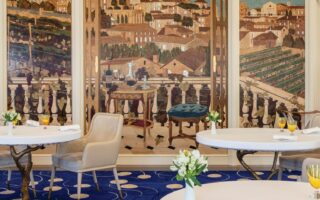
La Mère Germaine
There are two restaurants here one with a Michelin star – as well as an adjoining 12-room hotel. www.lameregermaine.com
L’Hostellerie du Château des Fines Roches
This four-star crenellated château was built at the end of the 19th century, but appears much older. There’s a hotel, a restaurant and a spa
CONTACTS
For wine tourism information, visit en.chateauneuf.com/oenotourisme
For general tourism information, visit the regional websites:
From France Today Magazine
Share to: Facebook Twitter LinkedIn Email
More in Chateauneuf-du-Pape, French vineyards, ine in France, wine
Related Posts
Leave a reply
Your email address will not be published. Required fields are marked *