Carnet de Voyage: Côte de Nuit

Travel notes from the real France. Carnet de Voyage is a weekly personal travel story in France sent in by readers. If you’d like to write a story for Carnet de Voyage, head here for details on how to submit.
When we retired, my wife and I knew that we wanted to travel. Being both organized and methodical people, we sat down to come up with a plan that would address our interests, resources and, just as importantly, our age. For different reasons we both came to the conclusion that we wanted to get to know one place really well rather than a lot of countries just a little. We each had some experience with Europe before retirement.
In a previous life, my first wife and I were gifted a six week-eleven country European bus tour (Actually, I only saw ten because, with my long hair, I was refused entry into Marshall Tito’s Yugoslavia) and Nancy had seen England and France. Our fascination with provincial French cooking and the country’s wine culture dovetailed nicely with my wife’s emerging French language skills making our choice an easy one, “Let’s do France!”
At first the plan was to, over multiple trips, touch every part of l’Hexagone but we didn’t expect to fall in love with la Bourgogne. It was on our second trip to France when we got our initial taste of Burgundian hospitality and were dazzled by the beauty of the whole region. Specifically, Côte de Nuit and Côte de Beaune, the breathtaking wine corridor along D943. For us, it was more than the famous domains that dotted the hillsides along the road. It was that area beyond what you can see from the D-route that dazzled. There were little villages, some whose names are well-known and some that are not, that must be experienced to fully understand what is so special about this lovely part of France. It was late summer 2024 and we were in the middle of our fifth visit to Bourgogne. This time we were going to do a deep dive into the Burgundian countryside.

This trip, wife and daughter had a fabulous birthday week together in Paris before I joined them on their last day there. We spent that one night in Paris and then took the train to Dijon. We were spending three weeks in Burgundy cuin two different locations; the tiny village of Curtil-Vergy and the ancient walled city of Semur-en-Auxois. Before returning to Chicago, our daughter left us a legacy – instructions on how to coordinate our iPhone and the car’s console to create a GPS system, something a person needs if they are to navigate the spiderweb of small, country roads that crisscross the hills and flatlands.
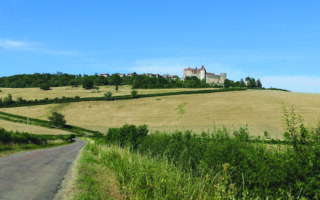
Our lodging in Curtil-Vergy was a big, ancient stone house (circa 1600s). It was just outside of Nuits-Saint-Georges, the eponymous village that is the heart of this famous wine area. Rural and rustic are appropriate descriptors for this spot. Almost every day we would take a walk and wander down narrow roads that bisected plowed fields and vineyards. Each rural road connected one small village to another. I am often asked why we like France so much and I’m not always sure how to answer, but these walks helped me understand why. The bucolic countryside we passed through on these hour-long walks were, in themselves, enough of a reason to love this place. There was no roadside advertising and few overhead power lines to interrupt our view. But more than what we could see, it was the absolute quiet that overwhelmed us. Other than the occasional bird song, there was nothing. The silence was a gift. Like vacations, those moments were fleeting but each time we walked, we were refreshed and happy.

Throughout this area’s many farming villages it is easy to find a boulangerie, a tucked away neighborhood restaurant or a winemaker offering dégustation (tastings). We took full advantage of these. We have a long list of familiar restaurants and wine domains in the bigger towns, like Beaune, Dijon and Nuits-Saint-Georges, but it was the ones we stumbled across in the small villages that pleased us the most. To wander into a local brasserie with an open grill in the dining room and limited seating felt cozy. We would watch as workers and families streamed in and filled every table. Little English was spoken in these places so I became an observer and let Nancy take charge. The food was always authentic and there was usually a little surprise on the menu, like homemade rum for the rhum baba cake or a planche of grand-mère’s pâté. With great pride they always offered a sample.
The tractor drivers, grape crushing machine operators and vineyardists who came in for their noon time meal fully appreciated their long lunch period but hustled off when they were finished. It was harvest time in Bourgogne. We were told that because of heavy rains and, in some places, destructive hail (like in Chablis) this past spring, harvest had to be delayed to match the time that the grapes would be perfectly ready. Not what the farmers wanted but a thrill for us to experience. Harvest time made driving our rented Citroën a bit of a challenge because the harvesting machines and motorhomes that carry workers were wide and the roads were narrow. Farm equipment always has the right of way in France. When we would meet a giant machine coming our way in one of the little villages with stone walls going straight up and no sidewalks I learned to hit the button that brought the side mirrors in. Still, experiencing the frenetic pace of harvest was beautiful. It was thrilling to watch the pickers as they moved among the vines, threw clusters of grapes into large plastic hods they wore like backpacks, climb a ladder and dump their burden into high-sided truck beds that were driven to the wineries and emptied into the crushing machines. If the pickers saw us watching them or taking their picture they always smiled, waved, and yelled out, “Bonjour”. The finest wines are grown on the sloping hillsides above the towns and the village wines are grown on the flat areas. It makes you realize that no matter what the quality of French wine you are drinking somebody has worked very hard to get it to you.

Almost every day of the week one of the small villages around us was having a market day. These are understandably smaller than the ones in Beaune or Nuits-Saint-Georges, but we had no problem filling our bags with the ingredients we would need to cook a dinner “at home”. Rarely are the kitchens in short-term rentals well appointed and our place was no exception: three pots but only one lid, no measuring cups or spoons, no spices or herbs, no mixing bowls, no bakeware and don’t even think about finding a kitchen appliance. Undaunted, we plowed ahead using two knives to cut butter into flour for a pastry dough, the palms of our hands to measure out ingredients and a wine bottle as a rolling pin. It always takes us about a half of an hour to figure out how to use European ovens and induction cooktops. When the near perfect fig tart, quiche or coq au vin is ready and we serve it up we feel particularly proud of ourselves.
Two weeks in this idyllic setting was not enough but all good things must come to an end. We had one more planned stop in Bourgogne plus an intervening side trip to Sancerre with visiting friends. That means many more adventures in this region and more exploring. This, of course, is what we had in mind all along. We are getting to know this one place very well.
Read our other Carnet de Voyage entries here.
Michael Harrelson is a 74 year-old retired ‘orthophoniste’ who lives and gardens in the small community of Jamul in California’s San Diego County. He discovered writing late in life and pursues it as a hobby.