
French City Break: Saint-Malo
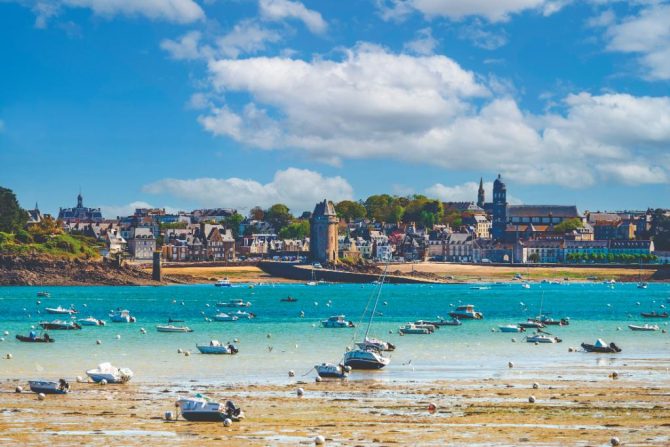
The history of the fortified city of Saint-Malo is woven through escape from religious persecution to seafaring adventures.
As the gateway to Brittany, Saint-Malo can easily be bypassed by those eager to get to their eventual destination in this vast region. But those who choose to linger a while will find a city with great natural surrounds to explore and an historical centre full of intriguing stories and characters.
From Welsh beginnings
Brittany has seven founding saints, and Saint-Malo owes its name to one of them. Saint Malo, also known as Maclou, was a Celtic monk who fled Wales in the 6th century to escape the invading Anglo-Saxons. Like many other Celtic Britons, he came to Brittany and settled in Aleth, a Gallo-Roman settlement on the Rance estuary, where it is believed he became the first bishop of Aleth.

Saint Malo statue with Jacques Cartier panels
The origins of Saint-Malo can be explored on La Cité d’Alet, an isolated inlet on the other side of the modern ferry terminal, where Maclou would have settled with the city’s first inhabitants. The episcopal seat was later moved in the 12th century to Saint-Malo Intra-Muros, which offered a more easily defensible position. The story of this Welsh monk is not widely known, but traces of his presence remain throughout the city. If you find yourself on the narrow and steep steps of Escalier de la Grille in the Intra-Muros (inner walls) part of town, look out for an old statue of Saint Malo mounted onto a wall. Next to him is a wooden panel etched with the faces of Jacques Cartier and his wife Catherine des Granches, which brings us to the next chapter of Saint-Malo’s story.

Jacques Cartier statue on the rampart
A mariner’s haven
Jacques Cartier is regarded as a hero in the maritime city of Saint-Malo, celebrated as the first European to journey into the interior of North America and the man who claimed Canada for the King of France. The city’s long-standing bond with the sea fostered its history of strong links with maritime explorers and privateers.
From its humble origins, Saint-Malo grew in inhabitants and wealth, and became heavily fortified against invaders. Partly thanks to its geography and the drastic tidal waves affecting its access, it slowly became both home to fishermen and a shelter to wealthy and noble families, whose mansions, now classified as Historic Monuments, can be seen around the city and its environs.

© Shutterstock
In time, Saint-Malo became so wealthy and powerful thanks to maritime trade that it was able to declare itself an independent republic in 1590, giving it free reign from the Crown. This gave the Malouins their motto: “Ni français, ni breton, malouin suis!” (Neither French nor Breton, I am Malouin!) It was perhaps this rebellious slogan which gave the Malouins their courageous and daredevil attitude. Although the independence lasted only four years, Saint-Malo forged itself a new maritime identify as a major port for corsairs, private sea adventurers known for their daring journeys and piracy, and the city experienced a boom during the time of European exploration and colonisation of the world.
Apart from Jacques Cartier, several privateers, such as Duguay-Trouin and Surcouf, also left their mark on history through their attacks on merchant and military vessels belonging to France’s enemies. As a result, Saint-Malo came to be known as “The City of Corsairs’, and statues of several of its notable figures, including Jacques Cartier, can still be seen along the ramparts.
A war-torn city rebuilt
Saint-Malo looks just as it did in the medieval days, a myriad of stone houses with slate roofs enclosed within its fortified walls. But as anyone who has read Anthony Doerr’s novel, All the Light We Cannot See, will know, huge swathes of Saint-Malo’s narrow streets and historical buildings were destroyed during the Second World War.
Its strategic port location led the Nazis to occupy the city in 1940 as part of their Atlantic Wall programme. In order to break though, the Allied Forces repeatedly attacked Saint-Malo, finally liberating it in 1944. With the exception of the city’s ramparts and the castle, 80% of Saint-Malo was destroyed by Allied bombing and fires towards the end of the war. Instead of razing the city to rebuild from the ground up, it was decided to restore Saint-Malo to its former blueprint, including the castle, in an effort to preserve its medieval character and history. Between 1948 and 1960, the city restoration used original materials, scavenged from the ruins of war, as much as possible. Walking around Intra-Muros today, you’ll notice many of the buildings have blocks of blackened bricks between newly-made surfaces, some more than others. Only a couple structures – including the cathedral – were fortunate enough to retain significant portions of their original architecture.

© Shutterstock
Beaches and islands
Although they may not be as famous as the beaches in the south of France, Saint-Malo does have a beach resort vibe along the Grande Plage du Sillon. This is where you’ll find the original sea-bathing hotels of the 19th century, each perfectly positioned for brilliant sunsets and a view back towards the fortified city.
Another thing Saint-Malo is famous for-like the neighbouring Mont-Saint-Michel – is the tides of the ocean. The large tidal difference off the coast of Saint-Malo dramatically alters the landscape, and those who time their visit well just outside the Intra-Muros will notice that low tide reveals a greater expanse of sandy shoreline to the west, providing access on foot to the tidal islands of Grand Bé and Petit Bé beyond. Accessed by a causeway at low tide, Grand Bé is home to French writer François-René de Chateaubriand’s grave and offers views of Saint-Malo from across the sea. Whether you are a beach person or not, spend time on one of Saint-Malo’s beaches, or stroll along the ramparts above at dusk for a brilliant sunset over the horizon and a perfect end to your day.

Facade at Hotel Chateaubriand
SAINT-MALO ESSENTIALS
GETTING THERE
BY SEA
Saint-Malo is the port of call of several ferries from the UK and the Channel Islands with Brittany Ferries. An overnight from Portsmouth takes 10-12 hours in a comfortable sleeper cabin.
BY TRAIN
Saint-Malo is around three hours by TGV from Paris Montparnasse.
BY AIR
The closest airport with international flights is Rennes. From Rennes, there are regular trains to Saint-Malo.
FOR MORE INFORMATION
Tourist Office:
Esp. Saint-Vincent, 35400 Saint-Malo
+33 (0)2 99 56 66 99
Brittany Tourism: brittanytourism.com
Lead photo credit : © Shutterstock
Share to: Facebook Twitter LinkedIn Email
More in city break, coastal town, north, port, seaside
Related Posts

Leave a reply
Your email address will not be published. Required fields are marked *
REPLY