
Where do France’s Cute Dry-Stone Huts Come From?
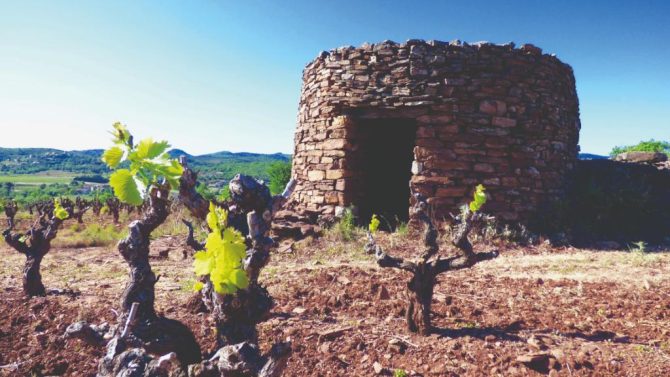
France’s charming dry-stone huts tell a fascinating story of rural craftsmanship, history, and regional identity.
I’m crazy about cabanes en pierre sèche. No seriously, where some see rudimentary dry stone huts (the literal translation) and pass by with barely a glance, I see rural architecture which has stood for centuries, blends beautifully into the landscape, and is emblematic of the south of France.
My passion for these curious constructions was sparked when I first clapped eyes on one whilst hiking in Hérault. Immediately, I was struck by how ‘cute’ it was, nestled amongst the vineyards. I loved its elegantly simple form, which reminded me of an igloo. However, on closer inspection I could see that it was the product of long hours of skilled labour.
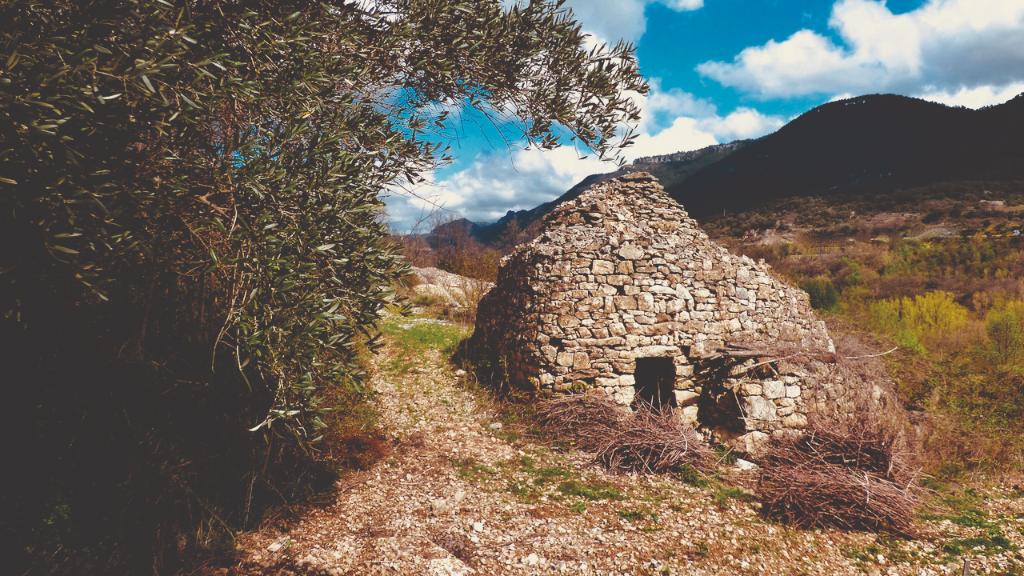
Capitelle near Pegairolles de l’Escalette, Hérault ©SteveTurnbull
Keen to know more, I began to dig for information on the internet. What I learned first was that the generic term, cabanes en pierre sèche, covers many different styles and names. In the Faugères area of Hérault, for instance, you’ll hear the term caravelles, but generally in the region they’re known as capitelles, from the Occitan capitèlo, meaning vine hut. In fact, many scholars believe the term originated in the Gard/Ardèche area and spread across Languedoc.
Midi Libre journalist Yves Vellas is something of an expert on the subject, having created the ‘Chemin des capitelles’ in the late 1990s on the slopes above Soubès, a small village near Lodève in northern Hérault. This walk links a cluster of capitelles and there are information plaques so you can learn about the story behind them. As Yves explains: “We don’t know for certain when the ones in our area were built, but we do know from historical records that it’s likely to have been the second half of the 19th century. We also know that in general they’re used for agricultural purposes, as a shelter and storage place for tools.’
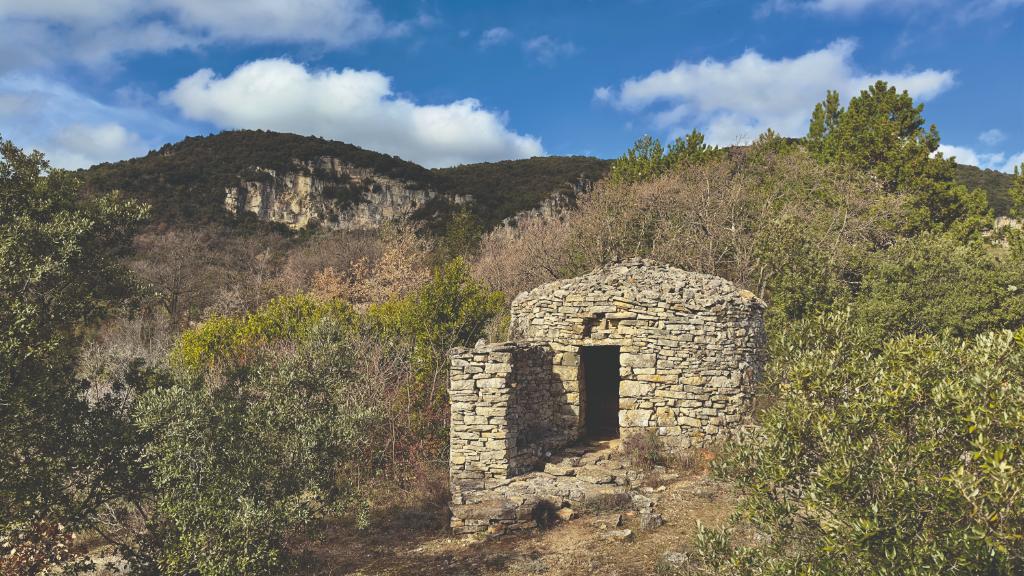
Capitelle on the plateau du Grézac, Hérault ©SteveTurnbull
So how are the cabanes built? “The construction techniques are both uncomplicated and ingenious based on dry stone erected without mortar and without any real foundations in the natural ground. The principle is always the same, despite the variations (square, rectangular or round base): a wall is built up to a certain height (2m-2.5m on average), from which the stones are corbelled (horizontally layered and carefully balanced) to form a funnel shape for the roof, which is closed by a terminal lauze (slate).”
We should also note that some cabanes are free-standing and some are built into walls, making them harder to spot. Of course, small stone huts go back to prehistoric times and can be found all over the world. You can also find cabanes en pierre sèche as far north in France as Burgundy and Brittany, but they’ve proliferated in the south of France, no doubt due to the sheer number of loose stones on the ground with which to build them. To put this point into context, the economic history of rural France was marked, from the mid-17th century onwards and especially in the 19th century, by the extension of cultivated land over the outlying areas of villages, as well as by the peasantry’s increasing access to land-ownership.
In the Grands Causses (causse means limestone plateau) to the north of Soubès the cabanes are known as cazelles. This probably stems from the Latin casa, meaning house, and the French suffix elle, meaning little. As Yves says: “Notably, the term was used by Edouard-Alfred Martel, the ‘founding father of modern speleology’, who pioneered tourism in the Cévennes in the late 19th and early 20th centuries through his writings and association with the Touring Club de France.”
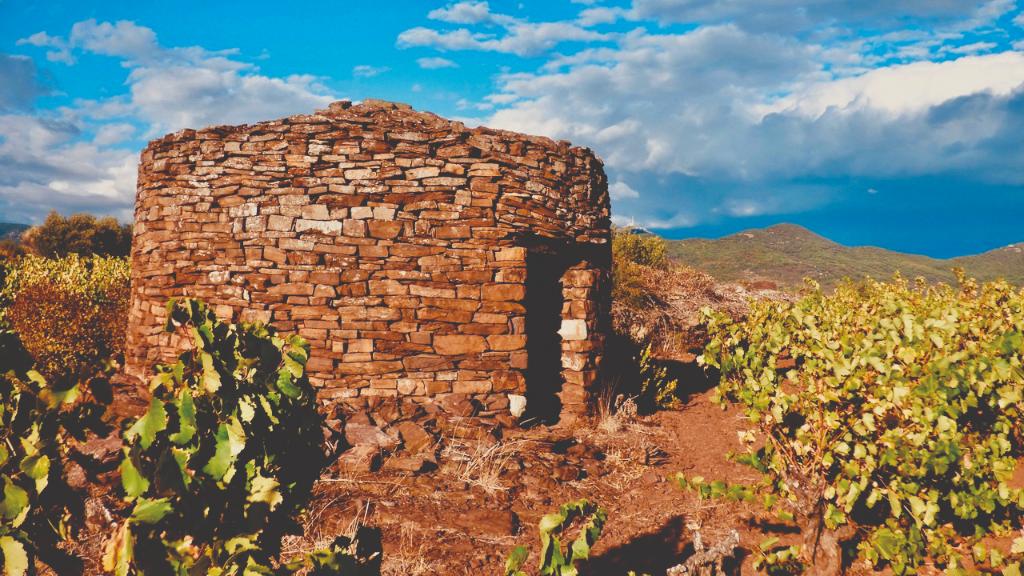
Sandstone (‘ruffes’) capitelle Hérault ©SteveTurnbull
Picturesque in Provence
Despite the bewildering terminology, there’s little doubt in my mind about what makes the cabanes in Hérault so special. As I hiked further, I discovered a whole range of them in different coloured stone. This reflects the remarkable diversity of the local geology – hence the development of the Géoparc Terres d’Hérault. Most commonly, they’re built from chunks of whitish limestone which have been cleared from the ground and assembled into piles (the local term is clapas) to create space for livestock grazing or the plantation of vineyards, the Terrasses du Larzac area being a prime example. But you’ll also find them in rust-red sandstone or ruffes, greenish schist (metamorphic rock) and greyish (volcanic) basalt. In fact, my favourite capitelle is built from the latter: it has a very distinctive pyramidic shape you could almost be in South America and is located on the Plateau de l’Auverne above the Lac du Salagou.
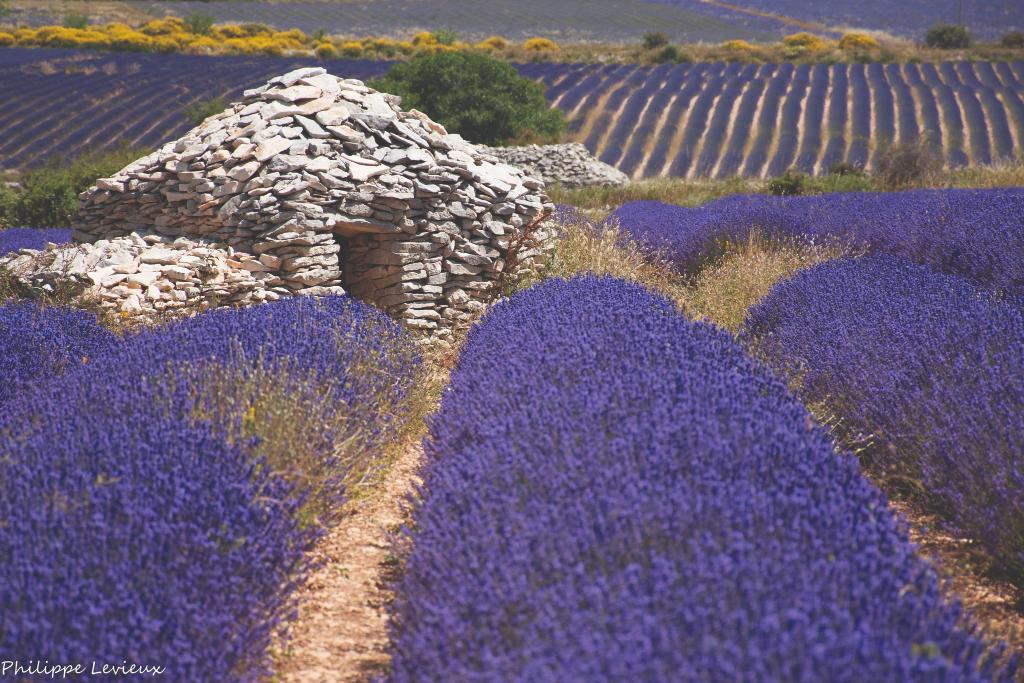
Cabane en pierre sèche in Provence ©Philippe Levieux
As much as I love the cabanes in Hérault, though, I’d have to agree that the ones in Provence, where there are around 6,000 in total, are equally picturesque, especially when they’re surrounded by gorgeous purple lavender in the summer. The conical ones, reminiscent of trulli in the Puglia region of southern Italy, are very beautiful too. You’ll find many examples of these dotted around the region and elsewhere in the south of France – but none finer than those found at Bonnieux and Saignon in Vaucluse.
The Lubéron, where most of the cabanes are concentrated, also boasts the Village des Bories just outside Gordes. Bories is the French equivalent of the Provençal term bori, which some experts claim is more synonymous with shanty or hovel, while others insist that it means farmhouse. However, there is widespread agreement on two things. First, the hamlet was previously known as Les Cabanes and originates from the beginning of the 17th century (although it may go back as far as Neolithic times). Second, over the course of the 20th century, it fell into neglect as the farming inhabitants either died or moved on and nature began to reclaim the site.
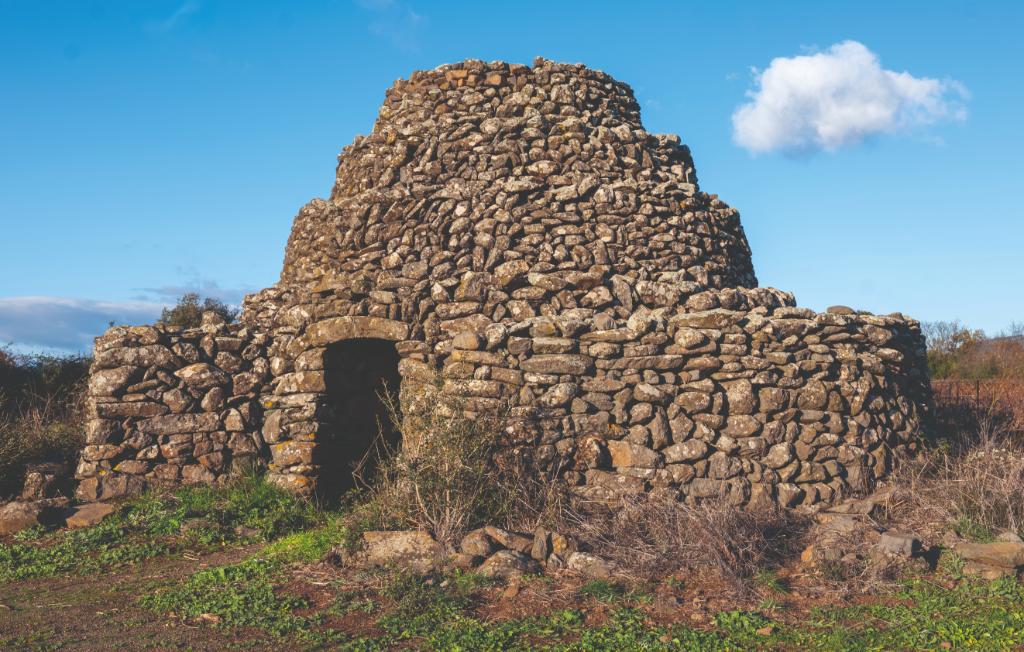
Pyramid-style basalt capitelle (Hérault) ©SteveTurnbull
Model conservation
The village owes its rebirth to Pierre Viala, a “poet, writer, comedian and globe trotter” (according to the Village des Bories’ website), who arrived in Gordes in the 1960s and fell in love with the area. In 1968, he learned that the buildings and land were for sale so he sold his own house and dedicated himself to the restoration. The work lasted eight years and was undertaken without any financial assistance but with the “precious help of the excellent masons from Gordes”.
Today, you can discover sheep pens, bread ovens and wine vats amongst the buildings, requiring on average about 180 tonnes of stones.
There’s also an excellent museum evoking the Gordes area of yesteryear through a collection of traditional objects and agricultural tools, as well as an exhibition of photographs showing different types of cabanes en pierre sèche spread throughout France and the world. The village became an historic monument in 1977 and the restoration (Yves describes it as a ‘model’ of cabanes conservation) was honoured by the French Academy of Architecture. Personally, I found myself in complete agreement on both counts and left totally enamoured.
So next time you venture off the beaten track in the south of France, look out for cabanes en pierre sèche. They’re an important part of its rural heritage and you never know – you might just become crazy about them too.
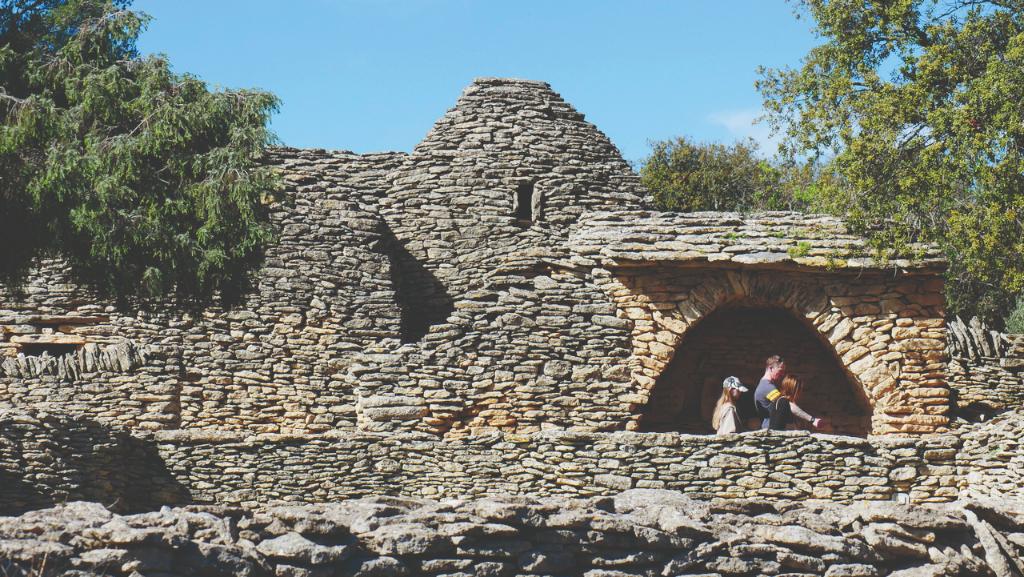
Village des Bories ©SteveTurnbull
CABANES ESSENTIALS
CONTACTS
- Hérault tourism
- Lodévois et Larzac tourism
www.tourisme-lodevois-larzac.fr
- Vaucluse tourism
- Village des Bories
ACCOMMODATION
- Les Bories & Spa (5°), Gordes
- La Ferme de la Huppe (4*), Gordes
From France Today Magazine
Lead photo credit : Capitelle near St Jean de la Blaquière, Hérault ©SteveTurnbull
Share to: Facebook Twitter LinkedIn Email
More in agriculture, architecture, French traditions, history, rural France
Related Posts

Leave a reply
Your email address will not be published. Required fields are marked *