
In the Footsteps of Edouard-Alfred Martel
We go underground to reveal the remarkable exploits of this little-known French cave explorer to whom we owe many of the caves and grottos open to visitors across France.
📢 As you scroll through the beautiful images, why not listen to our narrated article? It’s a great way for France Today Members to dive deeper into the story while enjoying the visuals. We hope you love this experience, and we’d love to hear what you think—feel free to share your thoughts in the comments below! Happy listening!
It’s a safe bet that few French people, let alone Francophiles, will have heard of Edouard-Alfred Martel. But he deserves much wider recognition, for not only was he an extraordinary explorer, but he is also credited with being the ‘father of modern speleology. Born on July 1, 1859 at Pontoise near Paris, Martel developed a love of the subterranean world at an early age. As a child of seven, he went to the Pyrenees with his parents and visited the Grottes (caves) de Gargas and Eaux Chaudes; and later, at school, he pursued his interest in geography and won first prize for the subject in the Concours Général (a national competition).
In his 20s, he began his professional career as a lawyer in Paris. In his spare time he went climbing in the Alps, developing much-needed skills, and devoured books by his contemporary, the adventure writer Jules Verne.
In June 1888, Martel embarked on his first major expedition at the Abîme de Bramabiau, situated in the Gard department between Mont Aigoual and the Gorges du Tarn. To the astonishment of locals, he and his team were lowered by rope ladder into the abyss (abime) and disappeared from view. As Martel noted of such ventures, the old women would cross themselves and mutter, ‘Of course you’ll go down there, gentlemen, but you’ll never come back”.
Nevertheless, seven hours later, the team emerged triumphantly from their underground trek along the labyrinthine Bonheur river system. It was a truly groundbreaking achievement that led to many more expeditions in the Grands Causses region (causse means limestone plateau), including the grottes de Dargilan and Aven Armand.

Explorer extraordinaire Édouard-Alfred Martel © SteveTurnbull
Brave new world
Today, thanks to the intrepid Martel and his colleagues, you can visit all of these sites. At the Abîme de Bramabiau you can also do a wonderful 9km walk, the Sentier des Morts, that connects with and circuits it. Starting in the village of Saint-Sauveur-Camprieu, it passes the visitor centre on the return leg, where you’ll find a commemorative plaque for Martel with a quote that captures the challenges he faced: “A whim of nature unlike any other known to man”. Martel went on to explore the length and breadth of France (he also travelled extensively abroad) but it was the south he kept returning to due to its proliferation of spectacular but uncharted sites. In 1889 at the age of 30, he undertook what was arguably his most challenging cave expedition of all at the Gouffre de Padirac, a huge sinkhole (known locally as the Devil’s Chasm) in the Lot region.
Armed with the usual equipment of hemp ropes, candles (including one attached to his hat) and rope ladders, he descended into the darkness and was awe-struck by what he found: “No man has gone before us in these depths, no one knows where we go nor what we see, nothing so strangely beautiful was ever presented to us, and spontaneously we ask each other the same question: are we dreaming?”.
However, he got a rude awakening on his third expedition a few years later -the collapsible boat carrying him and his two colleagues along the subterranean river they’d discovered capsized. Fortunately, one of their matches was still dry and it saved everyone’s life. Recounting the incident later, Martel said: “The sensation of cold was annihilated by the truly terrible experience of perfect darkness”.
Nonetheless, he persevered and in 1898 the site was opened to the public -the first of its kind in France. Following further exploration and development, the Gouffre de Padirac now offers a magical experience which includes a 103m descent and boat trip, as well as numerous geological marvels.
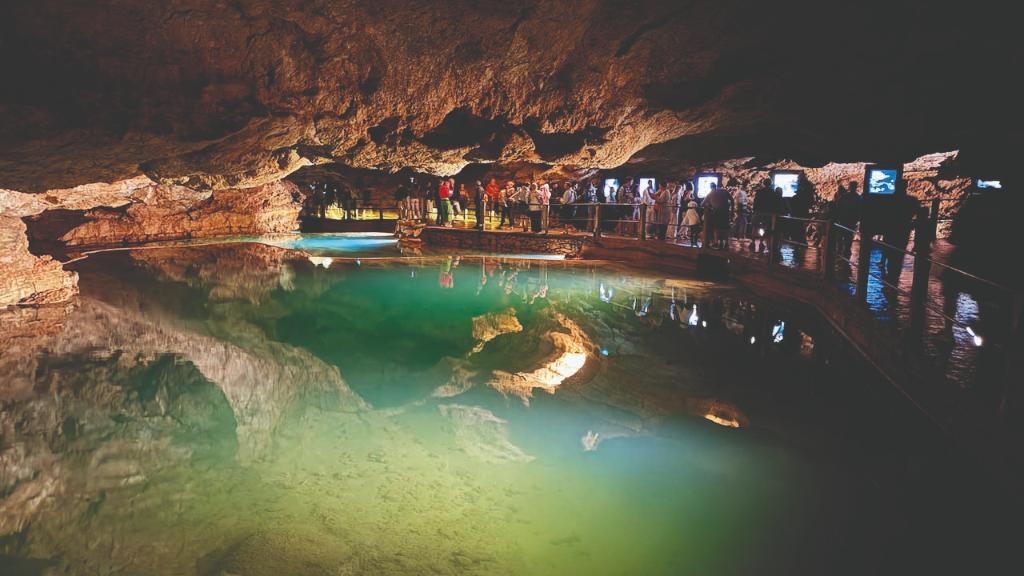
Gouffre de Padirac © SteveTurnbull
A unique career
Padirac proved a turning point for Martel: he left his job shortly afterwards and dedicated himself full-time to cave exploration, writing and associated activities. He later became president of the Société de Géographie and administrator of the Touring Club de France, a social club dedicated to cycling and travel. In July 1890, he married Aline de Launay. Her brother, Louis, was a professor of geology and became a member of Martel’s caving team as well as his academic collaborator. In 1895, Martel founded the Societé de spéléologie and its bulletin, Spelunca. In the same year, he visited the British Isles, going deeper at Gaping Gill cave in Yorkshire than anyone had dared before. Two years later, Martel returned to the Grotte des Demoiselles in the Gorges de l’Hérault another spectacular cave that’s well worth visiting – following a couple of exploratory trips. On reaching the bottom at a depth of 90m, he used a balloon to measure the height of the cathedral chamber. This typified his rigorously scientific approach. He was also meticulous in his preparation, routinely spending hours checking his equipment to avoid serious accidents (the Padirac boat appears to have been the only one he had).
In 1905, Martel was commissioned by the Ministry of Agriculture to find new water resources to supply Provence. Accompanied by a team of villagers including Isidore Blanc, a teacher and naturalist from Rougon, he became the first to traverse the full length of the Gorges du Verdon, the largest canyon in Europe, which spans the Var and Vaucluse departments.
In the 1930s, the Touring Club de France opened the trail to the public. Today, the Sentier Blanc-Martel takes you on a magnificent 16km hike from the Chalet de Maline to the aptly-named Point Sublime (take the shuttle bus to return to La Palud-sur-Verdon). This includes tunnels, bridges and wonderful views of the turquoise Verdon as it courses through the canyon. Martel also explored the natural wonders of the Fontaine de Vaucluse and Les Calanques near Marseille.
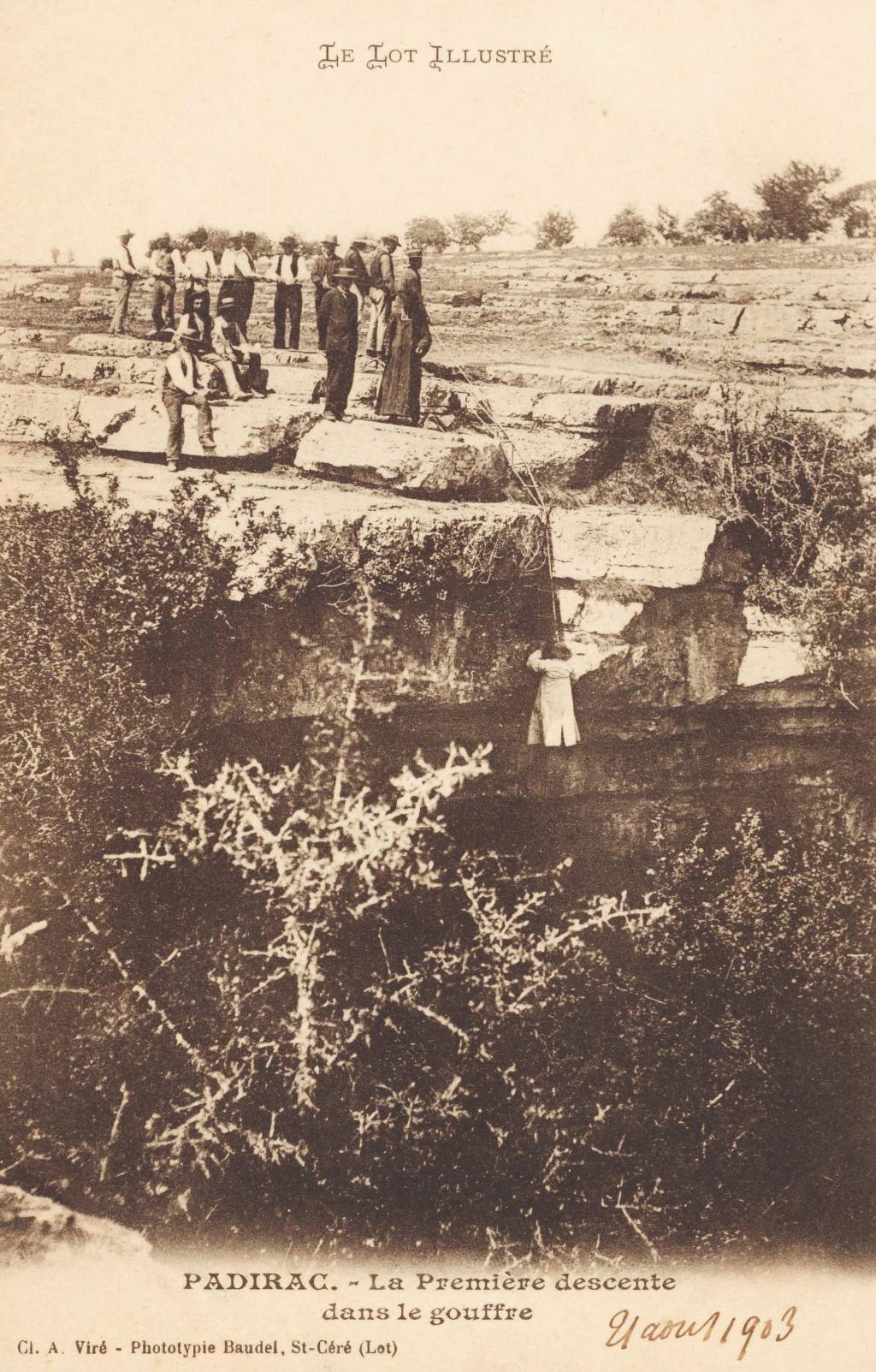
Gouffre de Padirac descent (the figure is believed to be Martel) © A. Viré, collection- indexés SES de Padirac
A lasting legacy
Over the course of his caving/potholing career, Martel chalked up over 1,500 expeditions. He also published nearly a thousand articles and 21 books, all with incredibly detailed illustrations. But his achievements went well beyond this. In many ways he was an environmentalist ahead of his time, and following his 1913 visit to the Yosemite Park in the United States, he published a study on national parks around the world with a clear definition: “a territorial reserve, with precise boundaries, within which an appropriate legal provision conserves and protects-against any destruction, deterioration or disfigurement caused by man the natural components, fauna, flora, picturesque sites and geological or hydrological features”. Thanks to this, the French government has been able to classify and protect hundreds of parks. He also contributed significantly to the promotion of public health. After drinking from a spring contaminated by livestock carcases and falling ill with typhoid, he researched the issue and lobbied for change, resulting in the Martel Law of 1902.
Having led by any standards a remarkably full and adventurous life, Martel died in 1938 at the age of 79 and was buried in Montmartre cemetery in Paris. His main legacy was rock solid, having laid the groundwork, both scientifically and technically, for modern speleology, and in doing so helping to create a multitude of sites for the public to enjoy. Follow in his footsteps and you’re sure to gain a whole new appreciation, both of France and the world beneath our feet.
From France Today Magazine
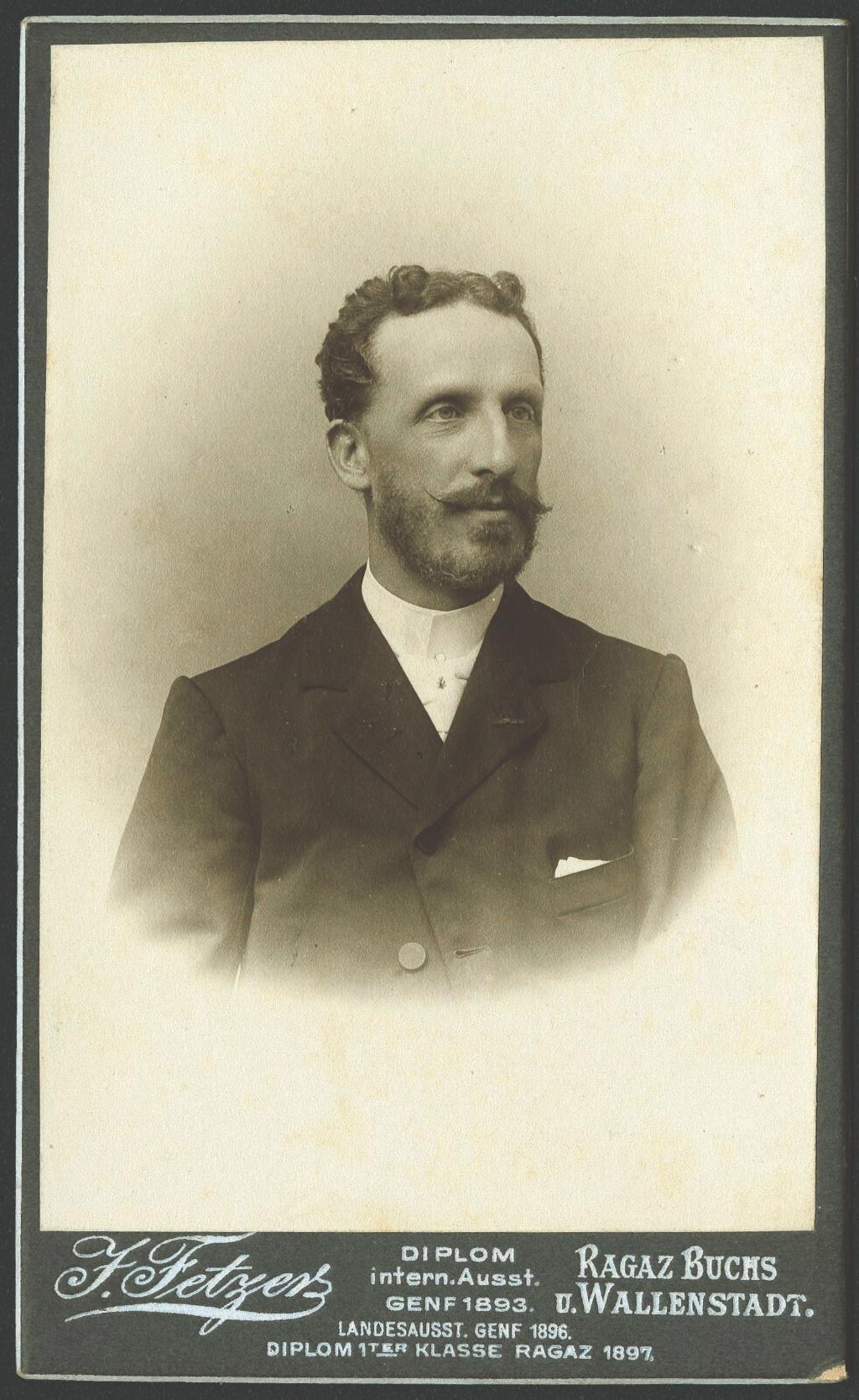
Portrait of Martel from around 1890 ©DR-SES de Padirac
Ohlala! It looks like you’re not a Member yet
Join to view this content!
(If you are a Member, log in or reset your password below or contact us so we can help)
- Log in
- Forgot password
Share to: Facebook Twitter LinkedIn Email
More in caves in France, explorers, France Today Membership, French history, underground
Related Posts



Leave a reply
Your email address will not be published. Required fields are marked *