
Why Thiérache’s Village Churches Are Northern France’s Heritage Gems
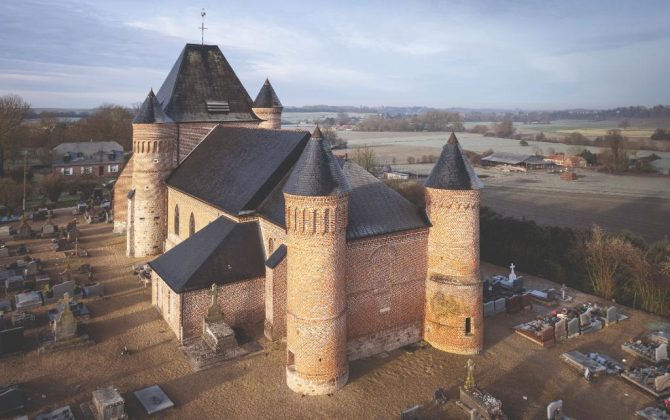

The fortified churches of the Thiérache reveal a brutal history and left marks on this natural region’s architecture.
You would have to forgive any visitor to the Picardy village of Beaurain who, on seeing the imposing church of Saint-Médard, asked themselves whether the edifice standing before them was a fortress or a place of worship.
The confusion is understandable because the answer, it turns out, is both. Saint-Médard is one of more than 60 fortified churches in the Thiérache region of the Aisne department that stand witness to the efforts of local people to protect themselves during the wars that ravaged these lands from the 14th to the 17th centuries.

Plomion church_Front view
A legacy of brutal wars
First it was the Hundred Years War of 1337 to 1453, a protracted period of fighting between England and France for the French throne which drew in many other European kingdoms. Next, the conflicting territorial ambitions of Francis I of France and Holy Roman Emperor Charles V (‘Quint’) resulted in multiple wars between 1521 and 1558. Any peace was short-lived as the French Wars of Religion, a conflict between Catholics and Protestants (Huguenots) over religious ideology and fears about threats to the monarchy, broke out in 1562.
With the ink barely dry on Henry IV’s Edict of Nantes that brought the Wars of Religion to an end in 1598, a new and even more terrible conflict, the Thirty Years War (1618-1648), erupted. This saw more fighting between the Holy Roman Empire and France over power struggles at the heart of Europe. The Thiérache, located in northeastern France at the cross-roads of major routes close to the borders of belligerent kingdoms, felt the full force of the plundering by armies that moved back and forth through these lands during three centuries of violent unrest.

Plomion church_staircase to refuge_sword hand
A unique region
To find out more, I met with Aurore Dineur, research officer at the Office de Tourisme for the Thiérache. With a Masters in tourism management and heritage promotion from the Sorbonne in Paris, she would be able to guide me through the region’s complex history. I began by asking her what makes it so special. “The Thiérache is unique,” she told me, “because of the concentration of fortified churches. Here, you have about 60 fortified churches in a small area, and that is unique.”
So which would she place on the must-see list? “First of all I would recommend Plomion,” said Aurore, “because it has a very complete defensive system. It was restored in 2023, and there is plenty of information there for the visitor.” Aurore had arranged a guided visit and we met up there later that day. “So, you can see that the church has a full range of defences,” she said, pointing out the details of castle architecture. “There are ‘passive defences’ including the donjon (fortified tower) with thick walls and a refuge on the upper floor.” Building a picture of an almost impregnable fortress-church, she added: “Then there are ‘active defences’ that allowed the villagers to fight back. Plomion was so well defended with loopholes and other features, that there were no angles morts (blind spots).”
Once inside, I was struck by the stark contrast reflecting the dual functions the church had adopted. Ahead, the airy nave presents a peaceful, sacred space. Then, turning around, the fortified western end conveys a powerful sense of the château-fort. Here, a door leads past reinforced loopholes, up a beautifully restored spiral staircase designed to give the defender using a sword the advantage with his right arm, to the refuge. Above, I could see the bells that once sounded the tocsins (warnings) to neighbouring villages. For emphasis, from one of the loopholes, Aurore pointed out the fortified church of Bancigny just across the valley.

Burelles church_refuge_painting
A vast rooftop refuge
Aurore’s next recommendation was Saint-Martin de Burelles. I had arranged a visit with Jean-Michel Vignez, president of the local community association that cares for the church. Once again climbing defensive spiral stairs, we crossed into the great oak-timbered roof space above the transept, and I recalled Aurore’s description of how the refuge would have been used.
“These wars were punctuated by episodic peace treaties,” she had reminded me. “Unpaid and hungry, groups of soldiers plundered the villages, stealing food, animals and money, burning the houses and killing anyone who resisted.”

Burelles church_Roof space refuge_Jean Vignez
I asked her what the people did when they saw these menacing groups approaching. “On hearing the bells,” she replied, conjuring an image of a fearful but practised response, “the inhabitants ran for the church, taking food, furniture, cows, chickens, everything of value they needed for a siege.
“There was room for a hundred people in the refuge at Burelles. They had a fireplace to cook and keep warm, and could stay for three or four days, maybe a week. Meanwhile, the menfolk would fight back with muskets and arquebuses, rocks dropped from the bretèches (machicolations) and swords if the enemy broke in.”
Next among Aurore’s must-see churches was Parfondeval. This lovely village is one of the Plus Beaux Villages de France, and on a short, marked walking tour, you can see fine brick farmhouses favoured by wealthier inhabitants, the timber framework infilled with mixed clay and straw (torchis) used in poorer homes, a beautiful lavoir, a Protestant ‘temple’ reminding us of the Wars of Religion, and a charming restaurant, Le Relais de la Chouette.
Once inside the church in the company of Benoît Gryson, treasurer of the Amis de Parfondeval et ses environs local association, we first admired the nave with its unusual timber pillars. Then, back on the defensive theme, we climbed to a tower strong room where an exhibition with a video illustrates a reenacted attack.

Parfondeval church_front view with portal
Protecting the churches
Pointing out that many of the 60 or so churches have parts dating back 800 years or more, I asked Aurore how these ancient buildings were being maintained. “It’s certainly a massive task,” she acknowledged. “You have seen Plomion; that cost €1.6m. Work is under way at Englancourt, and restoration of four more in the central area is planned, including Burelles. Then there is Montcornet to the southeast, a complex project that will cost around €7m.”

Parfondeval church_interior nave
Sourcing the necessary funding is clearly a key part of the process if this heritage is to be preserved. “First, approval is obtained from the Direction Régionale des Affaires Culturelles (DRAC),” Aurore explained, “then we seek funding: 80% comes from the state, region and grants, while the rest must be raised by the community. It’s tough, but there is a lot of determination to carry out this work.”

Montcornet church_interior
The priest and the artist
Fortifications may be the defining feature of the Thiérache’s churches, but there are other surprising discoveries lying in wait for the visitor.
In 1962, Pierre de Suasso de Lima, priest of Saint-Martin de Jeantes, asked a friend, the celebrated Dutch artist Charles Eyck, to decorate part of a wall. Eyck stayed for four months, creating frescoes on more than 400m² of the interior, along with five stained glass windows in work which is reminiscent of Modigliani and Chagall.

Jeantes_Charles Eyck mural_Jesus with disciples
If time allows, Aurore’s recommendations also include Église Saint-Martin de Wimy (two solid towers and inside a well and fireplace), Église Notre-Dame at Vervins (where votive panels from 1564-1590 were discovered in 1869), and Église Notre-Dame at Aubenton (with a beautiful ceiling donated by Mary of Lorraine in 1685). And finally, Montcornet, the largest and one of the finest of the Thiérache’s fortified churches. Hopefully soon to be restored, it has an unusual Croix des Templiers layout with nave and transept of equal length.

Macquigny church_turret_machicolations
The fortified churches alone justify visiting this often overlooked corner of France, but the Thiérache, which straddles the departments of Aisne, Nord and Ardennes, has many other compelling attractions too: verdant landscapes, culture, gastronomy and leisure. The tourist office’s motto is right: ‘Car, oui, la Thiérache, on s’y attache!’… ‘Because, yes, we get attached to the Thiérache!’

Vervins church_Votive panel
THIERACHE ESSENTIALS
GETTING THERE (VERVINS)
BY CAR
Take the Eurotunnel or ferry to Calais, then the fastest route is to follow the A26 to Junction 13, then the N2 in a northeasterly direction to reach Vervins (from Calais, around 250km, 2.5h, tolls).
BY TRAIN
Eurostar from London to Paris (arrives Gard du Nord), then train to Saint-Quentin (departs Gare du Nord), then bus to Vervins (about 3.5h from Paris).
BY PLANE
The nearest airport is Charleroi in Belgium (1h 20m from Vervins), or fly to Paris (Charles de Gaulle or Orly), or Lille.
WHERE TO STAY
Nigel stayed in an apartment in one of the original buildingsoftheremarkable Familistère at Guise, the social housing created by André Godin in the middle of the 19th century to house the people who worked at his nearby cast-iron stove factory. The beautifully modernised and well-appointed apartment was inexpensive and was arranged through booking.com.
CONTACTS
Tourist information and the fortified churches of the Thierache: The tourist office in Vervins is an excellent place to start any tour of the Thiérache, the fortified churches, and much else. www.tourisme-thierache.fr
Local association for Burelles church: (Jean-Michel Vignez): email: [email protected]
Local association for Parfondeval church: (Benoît Gryson): email: [email protected]
Note that the audio-visual displays and video in the refuge room are only available during summer months. All of the churches are free to visit, many are open every day and for all or most of the year, but check with the tourist office especially as some are undergoing renovation work.
Useful websites:
From France Today Magazine

Carte murale_©Office de Tourisme du Pays de Thiérache
Lead photo credit : Beaurain fortified church_DJI Air
Share to: Facebook Twitter LinkedIn Email
More in architecture, churches, French history, Thiérache
Related Posts
By Nigel Bruce
Leave a reply
Your email address will not be published. Required fields are marked *