
How to Be Parisian: Bah Humbug!
The French for party pooper is rabat-joie. Literally, it means someone who “closes down” joy. You can rabattre a shutter or the lid on a box, for example.
Fittingly, rabat-joie is one of those French composite nouns that can cause a linguistic dispute: is the plural rabats-joies, rabat-joies or rabats-joie? Of course, thanks to the internet you can quickly confirm that the plural is either rabat-joies or the invariable rabat-joie. It’s the same for the near-synonym, trouble-fête (party disturber). How nice of the French to make their grammar optional for once. Before Google, the French could argue for hours about this sort of thing. And in the past, arguing was more or less all there was to do in Paris on Christmas Day.
JE SUIS SCROOGE
People would usually celebrate on December 24 with a feast designed to propel diners towards death by cholesterol, pleasure or both, then next day quietly visit family members or stroll around the neighbourhood looking for a shop to sell them some mineral water.
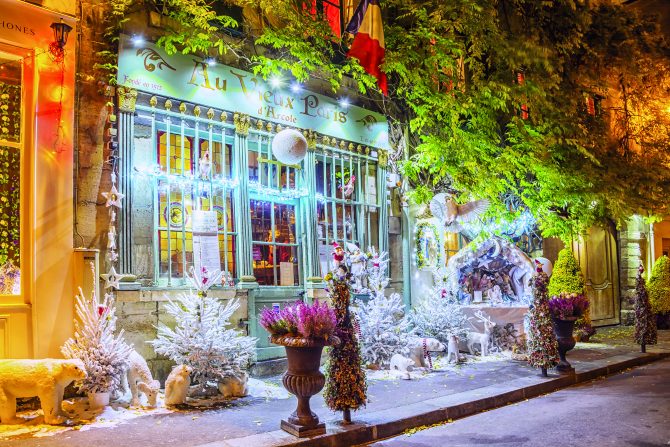
Nowadays, Paris has Christmas markets where (warning-party pooper alert!) tourists gather to drink cheap wine that has been ‘improved’ by overheating, and to get pickpocketed. (I can see why Scrooge spent so many years saying “humbug” – it’s such fun. Let’s try a bit more party-pooping…).
During the festive season, the Champs-Élysées (note the double plural) is sparklingly illuminated, allowing you to see designer-shop products under different-coloured lights. Meanwhile, the Galeries Lafayette (a nicely logical plural there) offers shop displays of spooky puppets, animated by far-too-visible wires, apparently designed to appeal to kids who have never seen a special effect, or to fans of the old Thunderbirds TV shows. I love Christmas carols, so I have been known to seek out a church or a tree where a nostalgic English singalong is happening. But that’s not very Parisian. The French don’t go in for carols. Ask any one of them what Good King Wenceslas did on the feast of Stephen total blank. Luckily, I usually have Anglo family and friends over at Christmas, so we brighten up December 25 by giving presents, trying on new pullovers, pulling crackers and cringing at jokes clearly written by AI.
I’d encourage Anglo visitors to Paris at Christmas time to do something similar. There will be plenty of brasseries open, and they will be happy to host a festive meal. You could even add to the fun by taking some cracker jokes along and trying to translate them for the waiters. Endless bemusement for all the family.
(NOT SO) GOOD KING WENCESLAS
Which gives me an idea. As an advance Christmas present, I’d like to offer you a little linguistic food for thought. It’s something that’s been bothering me since the start of this article: what’s the difference between a rabat-joie and a trouble-fete? It’s subtle. I would say (and this is a purely personal conclusion, born of decades of occasionally doing both in Paris) that the first prevents a celebration, whereas the second spoils a pre-existing celebratory atmosphere.
Let’s say it’s Christmas Day in Paris. You’ve been invited to a French carol service, a singalong of translations of all the traditional tunes. A rabat-joie will say, “I’m not going, it’ll be horrible, it’s impossible to translate the line ‘away in a manger.” A trouble-fête will suggest that you should go along, and tell everyone that Wenceslas, King of Bohemia and Germany in the 14th century, wasn’t really good at all. He was an alcoholic, and was once so drunk he missed an invitation from King Charles VI of France to a reception in Reims, no doubt to drink champagne, the local tipple. Yes, it’s true-King Wenceslas was a rabat-joie. Now there’s a nice seasonal irony for you.
Stephen Clarke’s latest book is Charles Worth, the Englishman Who Invented Parisian Haute Couture.
From France Today Magazine
Lead photo credit : Shutterstock
Share to: Facebook Twitter LinkedIn Email
More in column, humour, Life in Paris, Louvre, Paris museums, stephen clarke
Related Posts



Leave a reply
Your email address will not be published. Required fields are marked *