
Rennie Mackintosh’s Artistic Roussillon
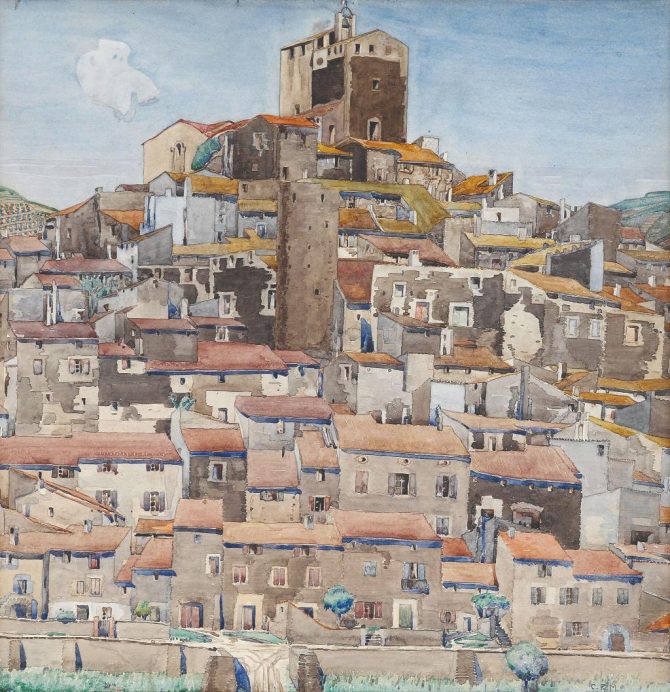
In the 1920s, the Scottish artist found fresh inspiration in French Catalonia. Steve Turnbull traces his artistic journey…
The beauty of French Catalonia – the Côte Vermeille in particular – has long been the inspiration for artists, most notably Matisse and Picasso. But the lesser-known watercolourist, Charles Rennie Mackintosh, left his mark here too in the 1920s. Today, walking the trails created in tribute to him offers not only a chance to explore his work, but an opportunity to venture off the beaten track.
Born in Glasgow in 1868, Mackintosh – “Toshie’ to his family and friends – made his name as an Art Nouveau architect and designer. Together with his artist wife, Margaret (née MacDonald), he created everything from furniture and lamps to wallpaper. Yet his work, including the design for the Glasgow School of Art which is widely regarded as his masterpiece, was never as admired in Scotland as it was abroad.
As tastes shifted from Art Nouveau towards Classicism and commissions dwindled, Mackintosh was forced to abandon architecture and design for painting. Making a living from art proved equally difficult, however, and in the summer of 1923 – helped by a modest inheritance from Margaret’s mother-the Mackintoshes left London for the south of France in search of rest and renewal.

The Rock – painting on the Port-Vendres trail
As Pamela Robertson and Philip Long note in their beautifully illustrated 2019 book, Charles Rennie Mackintosh in France, the French Pyrenees and province of Roussillon were not fashionable destinations at the time, but the Mackintoshes made an immediate connection. Their initial base was the attractive spa town of Amélie-les-Bains, where they stayed in a cheap hotel for at least two months (the exact chronology of their movements is difficult to establish as they left no diaries). They also rented a small house nearby and adapted it into studios, enabling Mackintosh to produce several paintings of the Vallespir area, which boasts the typically Catalan town of Céret and the majestic mountain of Canigou.
NATURAL INSPIRATION
In effect, these paintings established a blueprint for Mackintosh’s landscapes. They often featured local architecture (quaint villages and rural farmhouses in particular), while the style remained Art Nouveau/Modernist with sinuous lines, intricate patterns and bold geometric forms. At first sight, it echoes Cézanne and Cubism, but it is more reminiscent of the Viennese Secessionists Gustav Klimt (whom Mackintosh admired) and Egon Schiele. Mackintosh also produced several paintings of plants, including a delightful one (dated January 1924) of yellow mimosa flowers heralding the spring. Another painting from the same period shows the monumental rock formation of Héré de Mallet at the otherworldly Orgues d’Ille-sur-Têt, a remarkable geological site not far from Perpignan.

The Fort painting on the Port-Vendres trail
What began as a holiday turned into a series of sojourns, as the Mackintoshes became increasingly enchanted with the Roussillon region, the historic heart of French Catalonia that encompasses the Côte Vermeille and is now part of the Pyrénées-Orientales department. They also lived more comfortably than they did in England, albeit with very few francs in their pocket.

Summer Palace painting on the Collioure trail
But as much as they loved the hinterland with its rolling foothills and river valleys, the couple were particularly drawn to the coast. Here, not surprisingly, they fell for the charms of Collioure – Margaret described it as “one of the most wonderful places we have ever seen”. The fishing village offered a bohemian watering hole too (now the Hôtel des Templiers) at the foot of the Château Royal, which they frequented with their “arty acquaintances”, Rudolph Ihlee and Edgar Hereford.

Charming Collioure
There are three panels featuring reproductions of Mackintosh’s watercolours dotted around the southern fringe of the bay in Collioure. But many visitors to the area overlook Port-Vendres as they head for the Plage de Paulilles and the picturesque resort of Banyuls-sur-Mer near the Spanish border. This is a shame, because it’s where the most extensive trail of Mackintosh’s paintings (there are 13 in total) is located, not to mention various fish restaurants and fortifications. The trail, inaugurated in 2013, starts near the Poisson Rouge restaurant on the far side of the port coming from Collioure. It then snakes around a rocky outcrop guarded by the Redoute de Béar, a fort built by the celebrated military engineer Vauban in the 17th century. Listed as an historical monument in 1933 and recently restored, it houses a small museum on French colonial Algeria. There are seven paintings to find altogether in the area – you can pick up a helpful map from the tourist office.

Poisson Rouge restaurant at Port-Vendres
Mackintosh was meticulous, often making several visits to locations to produce the final artwork. But he also took artistic licence with many of his works: a good example of this is The Fort (number 5 on the trail) which repositions the lighthouse across the bay on the Redoute du Fanal (another fort by Vauban) to the upper left corner of the composition. The painting is also typical of Mackintosh’s very graphic sensibility, softened by washes of colour.

Craggy coastline at Port-Vendres
The trail continues around the marina then climbs to the craggy coastline for the final painting featuring Fort Mauresque. It also intersects with the Sentier Littoral, a splendid hike that runs the length of the Côte Vermeille from Argèles-sur-Mer to Cerbère at the border, offering wonderful sea views.
Of course, bustling Port-Vendres – a commercial and naval port originating in ancient times-is much-changed from the 1920s, not least because the quays were dynamited during the war by the retreating Germans. But the Hôtel du Commerce (now transformed into apartments) where the Mackintoshes stayed from 1925 onwards is still there, bearing a commemorative bust of Mackintosh on the façade. In his well-written and informative 2013 book, On the Trail of Monsieur Mackintosh, Robin Crichton describes how Toshie would sit on the balcony and watch the passenger liners and cargo ships docking from North Africa. He says this period was probably the couple’s “happiest time of their lives”, despite continuing money and health problems.
AN UNTIMELY ENDING
The Centre d’interprétation in Port-Vendres, run by the Association Charles Rennie Mackintosh, holds a permanent exhibition of reproductions, as well as a small section showcasing Margaret’s Art Nouveau work. The association maintains all five trails in the region (le Chemin de Mackintosh), comprising 30 paintings, and welcomes public support. The other centres at Bélesta and Amélie-les-Bains-Palalda are well worth a visit too.

Sadly, the couple’s four-year adventure in the south of France came to an end in May 1927 when Mackintosh developed cancer of the tongue (probably caused by smoking) and returned to London for treatment. He became seriously ill and died in December 1928 at the age of 60. After his death, Margaret returned to her beloved Port-Vendres every summer. It is here on the Mediterranean that she is said to have scattered her husband’s ashes, in accordance with his wishes. She died in 1933, aged 70.

Bustling Port-Vendres
Only a few of the 40 or so paintings Mackintosh produced in France were exhibited before he died, and only two were sold. Today, his artworks command six-figure sums. In fact, Mackintosh’s watercolour of the village of Bouleternère was sold at auction in April 2025 for more than $150,000. But while the wheel of the art world continues to turn, the distinctive beauty of French Catalonia, captured so eloquently by this Scottish artist, remains as timeless as ever.

The Centre d’Interprétation at Port-Vendres
ROUSSILLON ESSENTIALS
GETTING THERE
BY AIR
Ryanair flies regularly to Perpignan (nearest city) from London Stansted. Or you could also fly to Carcassonne.
BY TRAIN
Paris (Gare de Lyon) to Perpignan takes about 5-6 hours and there are approximately 14 trains daily.
CONTACTS
Charles Rennie Mackintosh Association:
www.crmackintoshroussillon.com
Pyrénées-Orientales tourism:
www.tourism-mediterraneanpyrenees.com
From France Today Magazine
Share to: Facebook Twitter LinkedIn Email
More in art, Rennie Mackintosh, Roussillon
Related Posts



Leave a reply
Your email address will not be published. Required fields are marked *