
The Art Nouveau Poster Boy


Czech artist Alphonse Mucha rose to fame in France with his distinctive Art Nouveau style thanks to a lucky meeting with another star.
📢 As you scroll through the images, why not listen to our narrated article? It’s a great way for France Today Members to dive deeper into the story while enjoying the visuals. We hope you love this experience, and we’d love to hear what you think—feel free to share your thoughts in the comments below! Happy listening!
The fate of up-and-coming illustrator Alphonse Mucha was set when he met actress Sarah Bernhardt: thanks to her, his works would go on to define Art Nouveau. As a young man, Mucha had bided his time as a court clerk in a small Czech town before applying for the Prague Academy of Fine Arts. The school, however, rejected him, advising him to “look for a job in an office and you will earn more”.
Undeterred, he designed anything and everything: stage sets, murals, altarpieces and tombstones. A sizeable commission and a stipend from benefactor Count Khuen-Belasi allowed Mucha the chance to receive formal art training abroad, first in Munich and then, in 1887, at Paris’ esteemed Académie Julian.
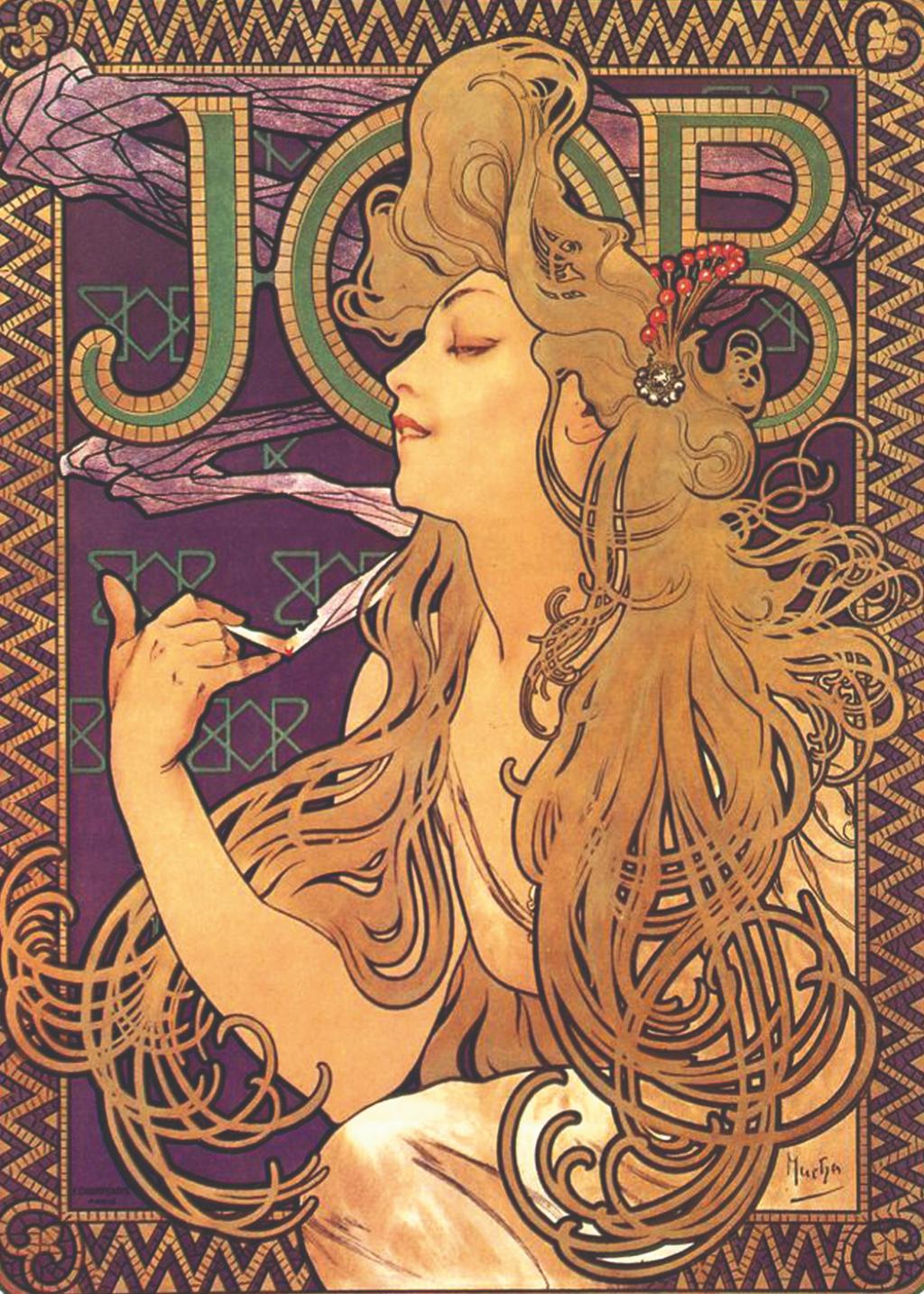
Job Rolling Papers by Alphonse Mucha © WIkimedia Commons
A last-minute request
But just two years later, financial support from his homeland dried up, and Mucha, now aged 29, battled cold and hunger in his Montparnasse bedsit, all the while filling countless sketchbooks with his sinuous, organic drawings.
Luckily, his unique style caught the eye of publishers, who soon had the industrious Mucha sketching costumes and illustrating books and magazines for them. He was now able to sublet a studio on the Rue de la Grande Chaumière, above Chez Charlotte, a café that was warm and welcoming to poor artists. The original tenant persuaded Mucha to take his job too, correcting lithographs at Lemercier’s printing press.
On December 26, 1894, Mucha’s new employer offered him a task that would prove life-changing. Sarah Bernhardt, the era’s greatest actress, had rushed in to the printing firm’s office requesting a new poster for the play Gismonda by New Year’s Day. Mucha was given the job. Sitting in the wings of the Théâtre de la Renaissance, he sketched Bernhardt as she rehearsed. From those drawings, Mucha created an image which elongated Bernhardt’s tiny form into an imposing figure, surrounding her with Byzantine-inspired mosaics. Lemercier’s manager was hesitant to show the draft to Bernhardt, but when she summoned Mucha to the theatre, she lavished him with praise. It was easy to see why the design had pleased her: the softness of the drawn line mixed with an intricate, iridescent background wove mystery around the enigmatic actress. In fact, the poster expressed her so well that she signed Mucha on for a six-year contract, comprising nine more posters plus designs for theatrical scenery, costumes and jewellery.
Shrewdly, Bernhardt ordered 4,000 of the posters: so popular were they with the Parisian public that collectors sliced them down from the walls as fast as they could be put up.
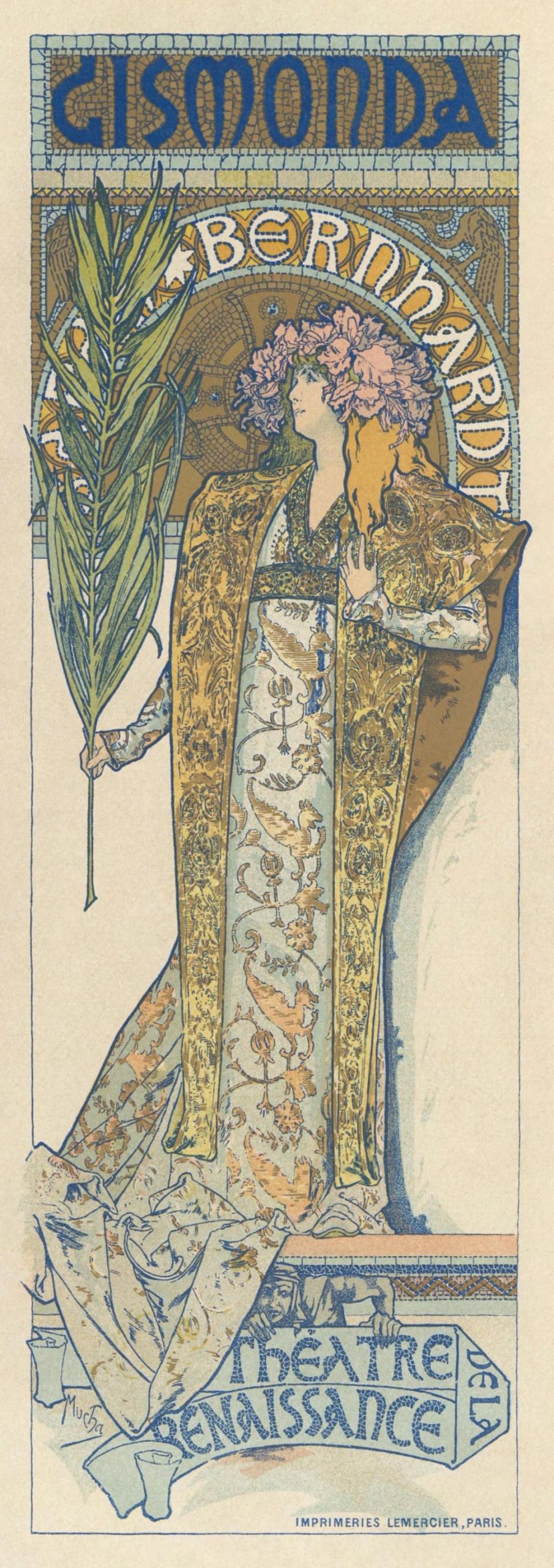
Poster for Victorien Sardou’s ‘Gismonda’ starring Sarah Bernhardt © Wikimedia Commons
This success led Mucha to design hundreds of posters and advertisements, all dominated by an ethereal, exotic female figure surrounded by stylised ornamental and arabesque patterns. By the time of the 1900 Paris Exposition, Mucha’s fame was widespread and the phrase “Style Mucha” became synonymous with Art Nouveau – although Mucha didn’t care much for the term: he believed art was eternal.
From France Today Magazine
Ohlala! It looks like you’re not a Member yet
Join to view this content!
(If you are a Member, log in or reset your password below or contact us so we can help)
- Log in
- Forgot password
Share to: Facebook Twitter LinkedIn Email
More in advertising, art, Art Nouveau, design, French culture, illustrations, Mucha
Related Posts


By Hazel Smith
Leave a reply
Your email address will not be published. Required fields are marked *