
Ancient Stones Meet Modern Souls in Saint-Paul de Vence


France Today editor-in-chief Guy Hibbert takes us on a tour of his home village in France the exquisite medieval hilltop beauty that is Saint-Paul de Vence, where a haven of art and history awaits.
📢 As you scroll through the beautiful images, why not listen to our narrated article? It’s a great way for France Today Members to dive deeper into the story while enjoying the visuals. We hope you love this experience, and we’d love to hear what you think—feel free to share your thoughts in the comments below! Happy listening!
The first time I visited Saint-Paul de Vence, I arrived just as the afternoon light began to soften. Walking through the ancient gate, I felt as though I’d stepped through a portal where centuries collapsed into a single moment. This medieval village perched on a hilltop in the French Riviera isn’t just beautifully preserved – it’s vibrantly alive in a way that few historic sites manage to be. What makes Saint-Paul de Vence truly unique is this seamless blend of past and present. The massive stone ramparts that once protected the town from invaders now cradle a community of artists, shopkeepers and restaurateurs. For part of the year, it’s also my home, so allow me to be your guide.
Belgian poet Henri Michaux, after visiting Saint-Paul de Vence, wrote: “The city is a book to be read backwards and forwards.” This perfectly captures how the village invites visitors to explore its layers of history from medieval fortress to Renaissance stronghold to modern artistic sanctuary. The village’s origins stretch back to the Middle Ages, when its hilltop position made it a strategic stronghold between the County of Provence and the Duchy of Savoy. The ramparts, ordered by King François I in the 16th century, remain among the best-preserved in the region – a testament to Saint-Paul’s former military importance.
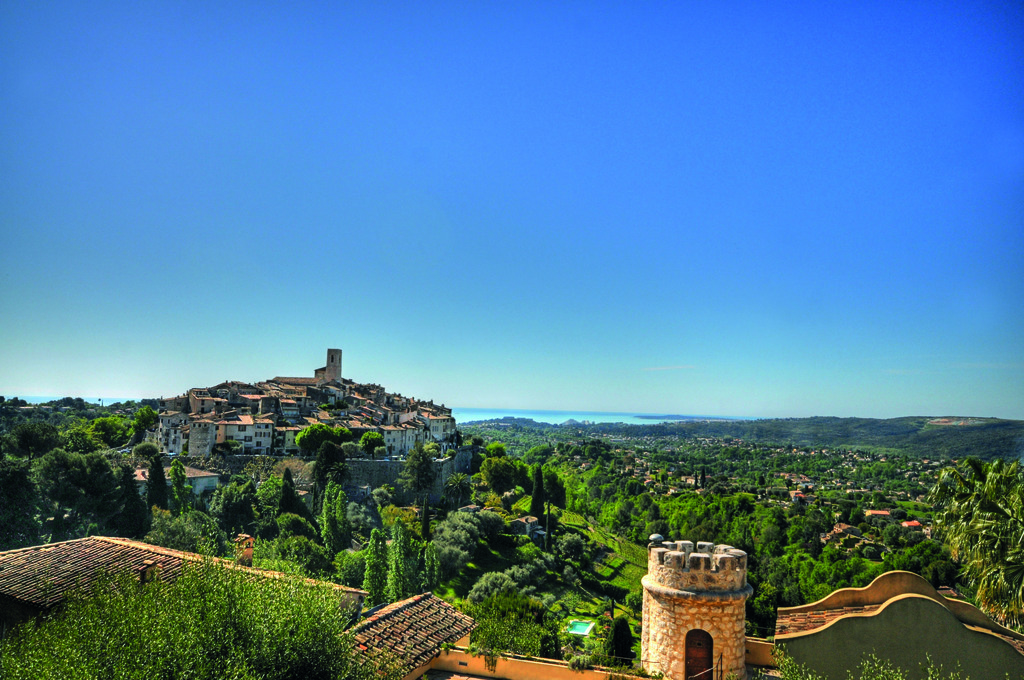
Saint-Paul de Vence © Elisabeth Rossolin
The transformation began in the 1920s when the rustic Café Robinson (later to become the legendary Colombe d’Or hotel and restaurant) attracted painters such as Picasso and Matisse. They often paid for meals with artwork, gradually creating one of the world’s most valuable restaurant collections. Paul Roux, the establishment’s founder, developed genuine friendships with Picasso and many other artists. His late son, Francis Roux, later recalled in interviews how naturally these relationships formed: “They came, they drank, they ate, they slept, they painted” – a remark which belies the extraordinary collection that resulted from these visits.
Today it is a unique pleasure to enjoy a summer lunch on the shaded terrace of La Colombe d’Or, admiring ceramics by Fernand Léger, or a cosy meal in the winter with the roaring fire casting shadows across walls adorned with works by Picasso, Braque and Miró. I wonder if the artists who once gathered here could have imagined their legacy. Marc Chagall was among the most notable artists who fell in love with Saint-Paul de Vence. He moved to the village in 1966 and lived here until his death in 1985.
In his autobiography, My Life, he wrote: “When I arrived in France, I was impressed by the light and atmosphere that I had never seen in my country.” The light of Provence and the Côte d’Azur, so different from his native Belarus, influenced his later works with their radiant colours and dreamlike quality.
The cemetery holds the graves of Chagall and many other artists who made the village their home. A visit there is always moving – sometimes a mysterious visitor leaves fresh flowers placed on Chagall’s simple grave where small stones are traditionally placed in Jewish custom. It reminds me how deeply the artists who found inspiration here are still cherished by locals and visitors alike.

Marc Chagall at the Colombe d’Or © Jacques Gomot
The labyrinthine streets of Saint-Paul de Vence reveal something new at every turn – an ancient fountain, an artisan fan maker, a family-owned perfumery, a wine shop in an ancient cave, or an art gallery tucked into what might have been a soldier’s quarters centuries ago. The architecture reflects its layered past: vaulted archways, sun-warmed stone walls, flower-draped balconies and weathered wooden shutters offer a visual continuity that links centuries. Narrow passageways lead to hidden courtyards, and the scent of jasmine often lingers in the air. One of the pleasures is to become a flâneur and lose yourself in the quaint backstreets – but it won’t be for long because you will soon emerge onto the ramparts with an impressive view of the shimmering Mediterranean or the snow-clad Italian Alps.
In the 1950s and 60s, the village’s allure extended to the silver screen. Yves Montand and Simone Signoret met, married and bought a home here. Signoret wrote about their love for the village in her memoir: “We bought a small house in Saint-Paul de Vence. A real toy, all in height, where one went from one floor to another by a spiral staircase.” The actress described how they would look out from their terrace “over a field of olive trees that went down to the sea”. Their presence helped cement the village’s reputation as a haven for celebrities seeking authenticity away from the spotlight. The American writer James Baldwin found refuge here as well. In 1970, he purchased a house called Chez Lucien on the southern slope of Saint-Paul de Vence, where he lived until his death in 1987. Baldwin wrote in a letter: “The great hill of Saint-Paul overlooks the sea, and on this hill is the house in which I live,” describing a place where he found both peace and productivity.
The British actor Donald Pleasance, who owned a home in Saint-Paul de Vence for many years, once told a reporter: “There’s something magical about the light here. It’s the same light that has attracted painters for generations. It’s almost tangible.”
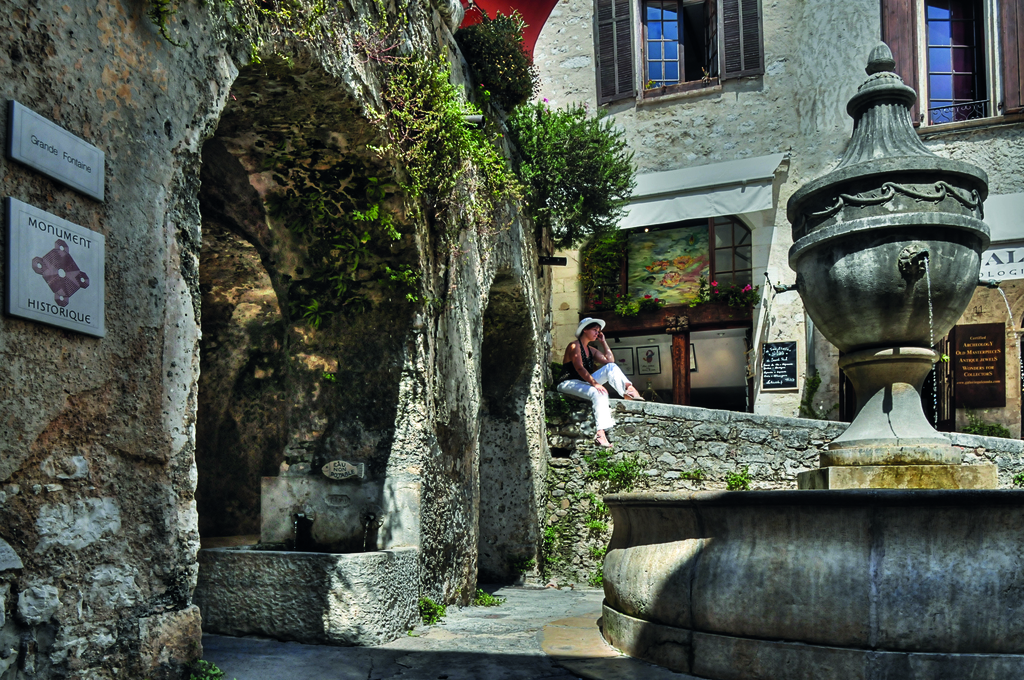
Place de la Grande Fontaine © Photographe Elisabeth Rossolin
An authentic way of life
Despite welcoming thousands of visitors, Saint-Paul de Vence maintains an authentic soul. Artists still live and work here. Boules players of all generations display their skills in front of visitors in the Café de la Place. Visit in the early morning and you’ll hear locals chatting as the market, shops and cafés open. Or stay for the evening when the day-trippers have gone, bask in that remarkable golden light beloved of painters and admire the swooping squadrons of swifts whirling past the church tower and out over the steep valleys which lead down to the coast.
The Fondation Maeght, just outside the village walls, exemplifies this marriage of old and new. This modern art museum with works by Giacometti, Chagall and Miró sits harmoniously in a landscape that has inspired artists for generations. The Fondation was born of deep personal loss – Aimé and Marguerite Maeght created it in memory of their son, Bernard, who died of leukaemia at 11. The artistic community they cultivated in response became a legacy of healing, one embraced by Braque, Chagall, Miró and Giacometti. Aimé Maeght worked closely with the artists themselves. Joan Miró collaborated on the labyrinth garden, while Georges Braque designed the stained-glass windows and pool. Miró said of the foundation: “This is a place where my works breathe,” recognising how perfectly the setting complemented his art. The permanent exhibition is one of Europe’s largest collections of 20th century paintings, sculpture and drawings. Summer 2025 will see an exciting new exhibition celebrating the work of Barbara Hepworth.

Historic streets in Saint-Paul de Vence © Thiebaut Agence Thuria
Where art lives and breathes
The creative pulse continues in the heart of the village to the present day. Alongside historic names, contemporary galleries such as Galerie Podgorny, Galerie Catherine Issert, Le Capricorne, Galerie Frédéric Gollong and Galeries Bartoux showcase emerging talent, ensuring that Saint-Paul remains not just a shrine to artistic history, but a living canvas where new visions still take root beneath ancient stone.
Saint-Paul de Vence reminds us that the most remarkable historic sites aren’t frozen in time but continue to evolve while honouring their past. Its ramparts have witnessed sieges and celebrations, wars and weddings, and now quietly observe as visitors from around the world fall under its spell.
Finally, try to find time to sit on the terrace of Les Remparts restaurant as the afternoon mellows into evening. Order a cocktail or a verre de rosé, watch the sun drop over the distant Esterel mountains, and observe how the village transforms as day-trippers depart and Saint-Paul de Vence reclaims its intimate character. This moment of transition – when the village seems to exhale and return to itself – captures the essence of what makes this fortress-turned-art-haven so uniquely captivating.

Montée de l’église Office © Elisabeth Rossolin
SAINT-PAUL DE VENCE ESSENTIALS
GETTING THERE
- Saint-Paul de Vence is just 7km from the Mediterranean Sea, inland of Cagnes-sur-Mer, and between the coastal towns of Nice and Antibes Flights from all major UK airports operate to Nice.
WHERE TO STAY
- A short drive from Saint-Paul de Vence brings you to Le Mas de Pierre, an exceptional hotel and spa set in 8 hectares of Mediterranean gardens. After a day’s sightseeing, relax in the lagoon pool, pamper yourself in the 2,000m² spa, and enjoy fine dining at the gourmet Table de Pierre or the Lis Orto bistro www.lemasdepierre.com
WHAT TO SEE
- Galerie Podgorny Contemporary paintings and sculpture, located right next to the Café de la Place. www.podgorny.fr Fondation Maeght 623, Chemin des Gardettes. Just a 10-minute walk from Saint-Paul de Vence village. Don’t miss the Barbara Hepworth: Art & Life exhibition, June 28-November 2, 2025. www.fondation-maeght.com
- Chapelle des Pénitents Blancs (Folon Chapel) Place de l’Eglise. Stunning mosaic decoration of the historic chapel by Jean-Michel Folon. www.saint-pauldevence.com/fiches/musees-et-lieux-de-visites/chapelle-folon
WHAT’S ON
- Jazz and Classical Festival July 19-27
- Fête Patronale de la Sainte-Claire August 7-10
CONTACTS
Tourism Information Office 2 rue Grande, 06570 Saint-Paul de Vence.
Tel.: +33 (0)4 93 32 86 95.
From France Today Magazine
Ohlala! It looks like you’re not a Member yet
Join to view this content!
(If you are a Member, log in or reset your password below or contact us so we can help)
- Log in
- Forgot password

REPLY