How Accessible is Paris?
Adele Heidenreich tackles the city on crutches, showing how Paris can be approached in manageable pockets to create a smoother visit for those who rely on obstacle-free accessibility…
Paris is a city of scale and age, where wide boulevards, soaring monuments and river views attract millions each year. For travellers with mobility challenges, though, the size can quickly feel overwhelming. Alongside the city’s splendour are practical hurdles such as broken lifts, uneven cobblestones and countless stairs.

Orsay Museum, Photo: Shutterstock
Encouragingly, staff at venues are attentive, guiding visitors with needs past queues and ensuring viewpoints remain accessible. Many reduce or waive admission fees for travellers with disabilities and a companion. At the busiest attractions, separate lines are generally in place, showing how the city reaches out to make its treasures accessible to those who need extra consideration.
Even so, the sheer scale of Paris is most rewarding when explored in smaller, concentrated sections, conserving both energy and time while still showcasing the grandeur that makes the capital unforgettable.
THE SPIRITUAL HEART
At the very heart of Paris lies the Île de la Cité, the island in the Seine where the city was first founded, and where its spiritual life has been centred for centuries. Crowned by Notre-Dame and Sainte-Chapelle, it remains one of the most symbolic locations in the capital.
Notre-Dame, which reopened in December 2024 after five years of restoration, rises with renewed splendour. The towers and flying buttresses remain as awe-inspiring as ever, and inside, the vast nave is softened by light streaming through tall windows. The forecourt is step-free, and a clearly marked wheelchair entrance allows visitors requiring accessible entry to bypass the crowds. Inside, there is ample space for self-guided audio tours, while access to the area behind the altar is provided by staff through a button that activates a ramp over three steps.

Notre-Dame de Paris
Sainte-Chapelle, 450m from Notre-Dame, dazzles with Gothic elegance. The upper chapel is an unforgettable sight, with stained glass rising like a kaleidoscopic roof of light, making it one of the most spectacular interiors in Paris. Although the main access currently involves a few steps due to restoration works, staff direct visitors with accessibility needs to a nearby step-free route; they can also provide access via a lift to the upper chapel, removing the need to climb the narrow spiral staircase.

Notre Dame – call button for ramp
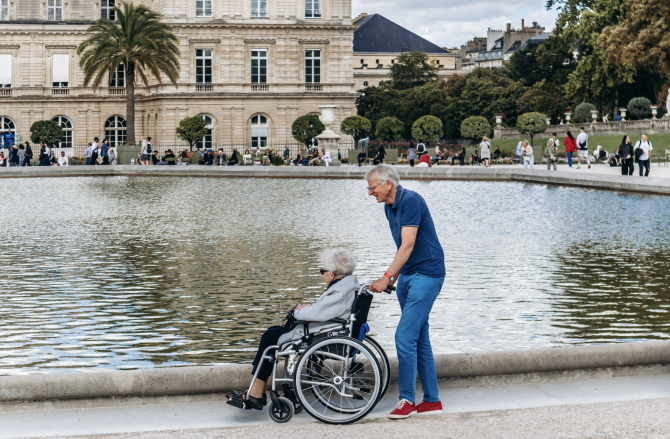
The Luxembourg Gardens, 1km further south, are one of the city’s most beautiful open spaces. Expansive, airy and carefully designed, it rarely feels crowded despite its popularity. Wide paths, shaded benches and seasonal flowerbeds invite visitors to linger, and step-free access at either end leads to the central fountain and basin; many paths are compacted gravel, though, which can be cumbersome for wheels.
The gardens sit on the southern edge of the slightly hilly Latin Quarter, which brims with bookshops and cafés and where many older establishments still have steps. The Panthéon, Paris’s famous mausoleum, crowned with a neoclassical dome, reveals a magnificent interior with sweeping arches, where Foucault’s Pendulum demonstrates the earth’s rotation. A ramp at the side entrance ensures the grandeur is within reach of all.
ART AND COMMERCE
North of the Seine lies a cluster of attractions that combine shopping, contemporary art and one of the world’s most visited museums. Forum des Halles, once Paris’s central food market, is now a lively shopping plaza filled with cafés and boutiques, and it has lifts and escalators. Beside it stands the Bourse de Commerce, home to the Pinault Collection. The circular building blends historic stonework with cutting-edge installations, and the striking dome ceiling alone is worth the visit. The galleries are arranged in three circular floors, compact in scale but entirely step-free with smooth surfaces and lifts, making it one of the city’s most straightforward museums to navigate. Some 800m further on, the Louvre is immense yet unmissable. Beyond its masterpieces, the architectural entrance through the glass Pyramid leads into a light-filled concourse that feels strikingly modern in contrast to the historic wings. All main galleries are served by lifts and wheelchairs can be borrowed at no cost. Staff are proactive in guiding visitors through accessible entrances, including a dedicated queue to see the Mona Lisa. While the crowds gather here, many other wings of the museum remain surprisingly quiet, offering a more relaxing experience.

Louvre
If energy allows, the nearby Pont des Arts is a scenic place to linger. Once famous for its love locks, this pedestrian-only bridge opens onto sweeping views of the Seine. Its flat wooden deck is accessible via steps or a gentle ramp, and at sunset it becomes one of the most romantic vantage points in the city.
BOHEMIAN HEIGHTS
Montmartre captures a different flavour of Paris, with winding lanes, artists at work and the gleaming white Sacré-Cœur Basilica crowning the hill. Its steps are famous, as is the view from the summit, stretching across the city’s rooftops and monuments. People-watching here is a popular pastime, with cafés and squares buzzing from morning until late at night.

Montmartre
Depending on where you begin, the summit can be reached via the accessible funicular railway, which offers a step-free alternative to the steep staircases. Cars can also drop passengers at the top of the steps near the main entrance. At the basilica, wheelchair access requires circling three-quarters of the way around to the Hôtellerie Ephrem, where a gate buzzer admits visitors to a lift leading directly to a side entrance.
Inside the hotel, accessible toilets are available, a welcome addition in such a busy area. The neighbourhood itself is richly atmospheric, filled with shops, cafés and narrow streets that reflect its bohemian past. Traffic on narrow roads and weekend crowds can be difficult to navigate, but Montmartre remains one of the city’s most distinctive and memorable districts.
VIEWS FROM ABOVE
Paris can be seen from many angles, but the most striking are from bus, boat and the Eiffel Tower. An open-top bus tour is one of the most efficient ways to cover ground. The low-floor vehicles have wide aisles, priority seating and wheelchair bays. The upper deck is only accessible by stairs, but the lower level offers excellent visibility through large windows. It’s a great way to conserve energy as audio guides add historical colour along the route, which covers key landmarks.
The bus stop at the Eiffel Tower is also a starting point for many river cruises, making it simple to combine the two. However, this is where the accessibility falters. Although vessels are frequently promoted as wheelchair-accessible, reaching them is a challenge. Embarkation points sit well below street level, reached by long staircases or distant cobbled inclines. For now, these cruises remain impractical for those unable to manage stairs.

Sign to indicate bypassing long lines – Eiffel Tower
The Eiffel Tower, by contrast, offers a far better experience. Accessible entrances and lifts carry visitors to fully accessible floors, offering jaw-dropping panoramic views that can be enjoyed even when seated. The grounds are extensive and although signage for accessible routes can be confusing, staff are on hand to help. The result is an experience that delivers both the thrill of height and a true sense of the city’s scale.
GETTING AROUND
Public transport is a challenge in Paris. The metro is largely impractical, with lifts only serving certain exits and many stations relying on escalators and staircases. Interchanges between lines often involve long underground passages and maze-like layouts, while escalator and lift breakdowns make journeys unpredictable. The bus network is modern and fully wheelchair-accessible, yet the size of the city means trips often require multiple changes, adding both time and complexity. Taxis and ride-hailing services provide a more reliable option. Bolt is affordable, while Uber is the only operator with fully adapted wheelchair-accessible vehicles. Keeping both apps installed is advisable, ensuring flexibility when moving between areas of the city.

Photo: Shutterstock
PARIS ESSENTIALS
GETTING THERE
BY SEA
Brittany Ferries offers crossings from Portsmouth to Caen or Le Havre. SNCF trains to Paris Saint-Lazare take approx two hours, or take the A13 motorway from Caen (145 miles) or the A131 and A13 from Le Havre (130 miles).
BY TRAIN
Eurostar connects London to Paris Gare du Nord in two hours.
BY AIR
Paris is served by both Charles de Gaulle and Orly airports, with a wide choice of international flights.
FOR MORE INFORMATION
Brittany Ferries Accessibility
www.brittany-ferries.co.uk/information/travel-advice/disabled-passengers
Eurostar Accessibility
www.eurostar.com/rw-en/travel-info/travel-planning/accessibility
Paris Tourism
Visiting Paris with a Disability
parisjetaime.com/eng/practical-paris/visiting-paris-with-a-disability-1053
WHERE TO EAT
Many Paris restaurants are housed in older buildings, so a few entrance steps are common, although staff are generally eager to assist Wheelchair-friendly toilets are rare.
A reliable tip is to dine in shopping centres and stores such as the upscale Printemps, where restaurants are fully accessible by default. Larger hotels like the Four Seasons and Mandarin Oriental also provide excellent, step-free dining options, though they tend to sit at the higher end of the price range.
Fully accessible dining options:
Tribeca Rue Cler – Italian-inspired dining, 36 Rue Cler, 7th, tinyurl.com/Tribeca-Paris
View this post on Instagram
IKE, Printemps Haussmann-French-Japanese seafood, 8th floor, 64 Boulevard Haussmann, 9th, www.printemps.com/uk/en
Le Meurice Michelin-starred, 228 Rue de Rivoli, Ist, www.dorchestercollection.com/paris/le-meurice
View this post on Instagram
From France Today Magazine