
A Taste of Land in Urban Paris
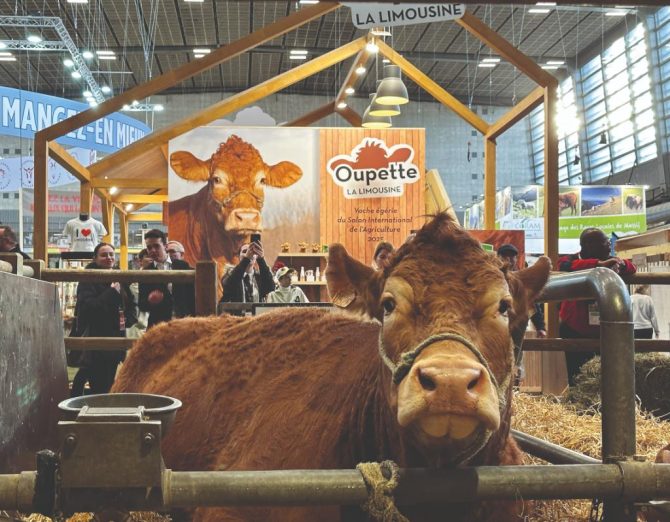
Caroline Mills visited the Salon International de l’Agriculture, the largest annual celebration of food and farming in France…
Meet Oupette. She, a Limousin cow, was chosen as the mascot for this year’s international exhibition of agriculture, held each year in Paris-Porte de Versailles. It’s a festive jamboree of all that’s fabulous (and, in politics, potentially not so great) about French food, farming and associated industries such as horticulture, viniculture, arboriculture and more. It brings together the entire French wine industry, beer, cider, fruit growers, cheesemakers and butchers, livestock and arable farmers, sector representatives and a showcase of the national forests and tourism organisations like Bienvenue à la Ferme.

Photo: Caroline mills
There’s a serious side to the event: it’s a chance for farmers to come together to discuss the politics of the day and how it affects them personally, as well as the industry as a whole. Discontent has been demonstrated in the past, depending on how urban or rural a current president is perceived to be.
When I visited 16 years ago, I snapped a fuzzy photo of then President Nicolas Sarkozy. There was little love lost between him and farmers at the time, and he famously had an altercation with a visitor at the show.
It has become traditional for the incumbent president to attend this year, Emmanuel Macron was there. Other ministers also show up, with varying degrees of popularity. I noticed a press pack awaiting the arrival of some dignitary or other, so, I thrust my camera into the scrum: it turned out to be the (now former) Prime Minister François Bayrou, there to meet and greet and take the occasional selfie with those confident enough to put themselves forward for a picture.

Photo: Caroline Mills
Business and politics aside, the event, which is open to the public, attracts upwards of 600,000 visitors, such is its popularity. Spending a day or two there is like taking a whistle-stop tour of France, without stepping foot outside the Porte de Versailles exhibition centre. The indoor show is grand in scale, covering nine pavilions. Greeting visitors arriving at the central atrium was a giant wellington boot and the sound of Alpine cowbells and clucking chickens pumped out into the Parisian environment of skyscrapers, trams and people piling out of the Metro. The noises had an instantly soothing effect.
HARVEST HIGHLIGHTS
Each pavilion hosts different sectors of the agricultural industry. First, I visited the one dedicated to crops, plants and, on a domestic scale, kitchen gardens. Here, Interfel, a cooperative promoting French fruit and vegetable production, was handing out ‘floral’ bouquets of fruit, giant buckets of elegantly prepared kiwis, strawberries, kumquats, mushrooms and more on sticks. Vergers Écoresponsables, an organisation representing fruit orchards dedicated to eco-friendly production, was offering juicy slices of fruit.

Photo: Caroline mills
An impressive model of the Eiffel Tower, or ‘La Tour FL (Fruits et Légumes), made entirely from leeks, pineapples and other fruit and veg, drew crowds for a view; those, at least, who were not taking part in Wine Bingo at the Pavillon des Vins, with a spin-the-wheel quiz and speaker discussing the variants of wine from Corsica, Bordeaux and elsewhere.

Photo: Caroline mills
On another stand was a striking array of colourful bottles for each of the dozens of alcoholic spirits made in France, along with petri dishes of botanicals to sniff, and a hands-on quiz making the link between farming and alcohol. The French cider and brewing industries were represented, too; not only the well-known Breton and Normandy cider but that from Limousin, Pays Basque and Pays d’Othe too. I paused as a chef pulled a fresh pear frangipane tart from an oven at the stand promoting French sugar, cutting up a plateful of warm slices for passers-by to understand, in edible terms, the link between this and the sugar beet plant. Next door, the cereals industry baked loaves of bread, made with 100% French wheat, and a gigantic, gleaming combine harvester stood by for visitors to sit in the cab on high.

Photo: Caroline mills
In a separate pavilion, government agencies and farming organisations showcased fishing, forests, the argument for transitioning to more environmentally friendly methods of farming and the latest tech, while colleges and universities specialising in agricultural courses attracted young adults contemplating a career on the land.

Photo: Caroline mills
So great is the desire to promote regional French produce, two pavilions are needed to showcase the 13 regions of mainland France and Corsica. It’s like one enormous French market, wandering from Auvergne-Rhône-Alpes to Nouvelle-Aquitaine, Pays de la Loire to Bretagne. Steaming pans of truffade are on offer in Cantal; in Île-de-France, fresh croissants are baked in full view; Grand-Est offers champagne by the glass (or bottle) and Kougelhopf, while the Drôme serves gigantic slabs of fresh nougat.

Photo: Caroline mills
There are many regional restaurants, too, serving up specially prepared show menus. Yes, you can grab a cornet of jambon or a crêpe for a gourmet rapide, but these restaurants are popular for a civilised sit-down meal with a bottle of wine. The noisiest pavilion was that showcasing food and farming on the world stage, with gastronomic trips to Italy, Switzerland, China and various countries in Africa. French overseas territories created a carnival atmosphere with neon-signed cocktail bars, Polynesian dancing and countless stalls selling rum from, among others, Martinique, French Polynesia and Guadaloupe. There was, indeed, lots of rum! But by far the most popular and the largest – pavilion is devoted to French livestock, where Oupette, with her calf snuggled in the straw beside her, resided for the event. Pigs with their piglets, rams that are how does one put it politely? – well-endowed (more on that later), goats, and beef and dairy cattle are all showcased here. It’s a chance to get up close and see just how enormous prize bulls are, and how hairy playful piglets can be.

Photo: Caroline mills
ALL CREATURES GREAT AND SMALL
The animals are displayed by breed – and alongside well-known ones, such as Limousin, Charolais, and, in the dairy sector, Montbéliarde, are lesser-known breeds, some on the rare breeds list and potentially in danger of extinction: cattle like the Gasconne des Pyrénées and Ferrandaise from Puy-de-Dôme, the Tarantaise from the Vallée de la Tarantaise in Savoie, and the Villard de Lans, named after the tiny ski resort in the Vercors.

Photo: Caroline mills
Likewise, there are the Mouton d’Ouessant, a traditional Breton sheep breed, Le Noir de Bigorre pigs from the Pyrenees, and the gorgeously spotty Porc de Bayeux from Calvados. It’s like being transported to the mountain meadows of the Pyrenees, or the orchards of Normandy. The importance of plot to plate is evident.
Alongside the cattle are regional societies promoting – with the aid of free tastings – the meat of, for example, Aubrac and Salers cattle, or cheese from Savoie, Normandy, and, my new favourite, Le Lozère from Fromagers de Lozère.
Visitors could watch and learn about chickens as bedraggled chicks hatched from eggshells, naturally exhausted from the ordeal before they are placed under a heatlamp for warmth and become fluffy bundles. Comb-hatted gents – representing the village of Loué, in Sarthe, which is famous for its poultry production – provided explanations to enthralled onlookers about the life of a chicken.

Photo: Caroline mills
BEST IN SHOW
But the livestock are not on show purely for visitor entertainment. There’s the serious business of the Concours Génerale, the General Agricultural Competition. First held in 1864, the competition recognises and rewards France’s best regional products and breeding animals.
There are competition categories for local produce – dairy products, in particular and wine and to showcase French livestock breeding programmes. Hence the well-endowed rams, and bulls, too: for a livestock farmer to win first prize at the Paris show is a big deal and should add significantly to the income of a farm.

Photo: Caroline mills
The animals are judged by breed in the various showrings (there are also competitions for cats, dogs and horses in separate pavilions), with livestock judged on how well it corresponds to the traditional characteristics of the breed.
I watched on as Rouge Flammande dairy cows were judged – a rosette hanging around the neck of the show champion as the entire farming family stood proudly beside their prize cow.

Photo: Caroline mills
And that was what was most evident throughout the show, particularly within the livestock pavilion: the importance of family and the next generation of farmers. Children helped parents keenly to lead ‘their’ cow to the ring; they helped at the milking parlour – where cows were on view so everyone could watch the process; and they stood by, ready to shovel the cowpats. With young farmers eager to get involved, the future of farming in France appears to be in safe hands.
TRAVEL ESSENTIALS
The Salon International de l’Agriculture is held at Paris Expo Porte de Versailles. The next event will be held from February 21 to March 1, 2026. Tickets may be purchased in advance or at the gate.
GETTING THERE
Metro Porte de Versailles (line 12) is directly opposite the entrance to the exhibition site, with easy connections to Gare du Nord for Eurostar and Paris Charles de Gaulle airport. Alternatively, Tramway Line T3a and Line 2 at Porte de Versailles provide convenient access.
From France Today Magazine
Lead photo credit : Photo: Caroline mills
Share to: Facebook Twitter LinkedIn Email
More in Agriculture Festial, French Farming, French food, Paris
Related Posts


Leave a reply
Your email address will not be published. Required fields are marked *
REPLY