
France’s Scottish Stronghold and its ‘Stuart’ Festival

A small French town tucked away in the Berry embraces its Scottish roots and pulls out all the tartan stops during a yearly summer festival.
The D940 road from Gien on the Loire River to Bourges 70kms south is an almost perfectly straight line through the ancient French region of Berry. If you happen to be driving down it around Bastille Day (14th July) don’t be surprised when, about a third of the way down in the small medieval town of Aubigny-sur-Nère, in the Cher department, you are greeted by the sound of Scottish bagpipes, see men strolling around in full Highland gear featuring Aubigny tartan (green, yellow, red, blue), see the Saltire (aka St Andrews cross) floating from flag poles and notice tartan on almost every shopfront.

Auld Alliance Monument and the chateau des Stuarts which now serves as the town hall © Christina Mackenzie
There is a very good reason for this sudden eruption of Scotland in the heart of France. It lies latent most of the year but rises to the surface for three days every summer during the “Fêtes Franco Écossaises” when the town celebrates with gusto its centuries-old link with Scotland, and this year the 730th anniversary of the signature of the Auld Alliance (known as such even in French).
The treaty signed – and never formally revoked – in 1295 between the kingdoms of Scotland and France stipulated that if either were attacked by England the other would invade the attacker… a sort of early version of Article 5 of the NATO treaty!
So, what drew the Scots to Aubigny-sur-Nère? Well, during the Hundred Years War (1337–1453), the Dauphin (future Charles VII of France) took refuge in Bourges, about 50kms due south of Aubigny-sur-Nère, where, invoking the Auld Alliance, he called on his Scottish allies for help. Between 1419 and 1424 as many as 15,000 Scottish troops fought in France, amongst them 6,000 led by Sir John Stewart of Darnley, (or Jean Stuart de Darnley as he’s known locally). The Scottish troops together with the French forces decisively beat the English at the Battle of Baugé in 1421, marking the turning point of the Hundred Years War. Although the Scots were later defeated, the remnants of the Scottish force continued to serve the French king and when a permanent French army was formed in 1475, they became the Garde Écossaise and remained as the sovereign’s bodyguards until 1830. Its last Scottish commander was Robert Stewart in 1512.
To thank Sir John Stewart for his support, Charles VII granted him that year the lordship of Concressault and then in 1423 the lordship of Aubigny-sur-Nère just 10kms west. Today, Concressault is a village of just 200 inhabitants with no shops, its once renowned Witchcraft Museum permanently shut and its castle in ruins. But Aubigny has thrived.
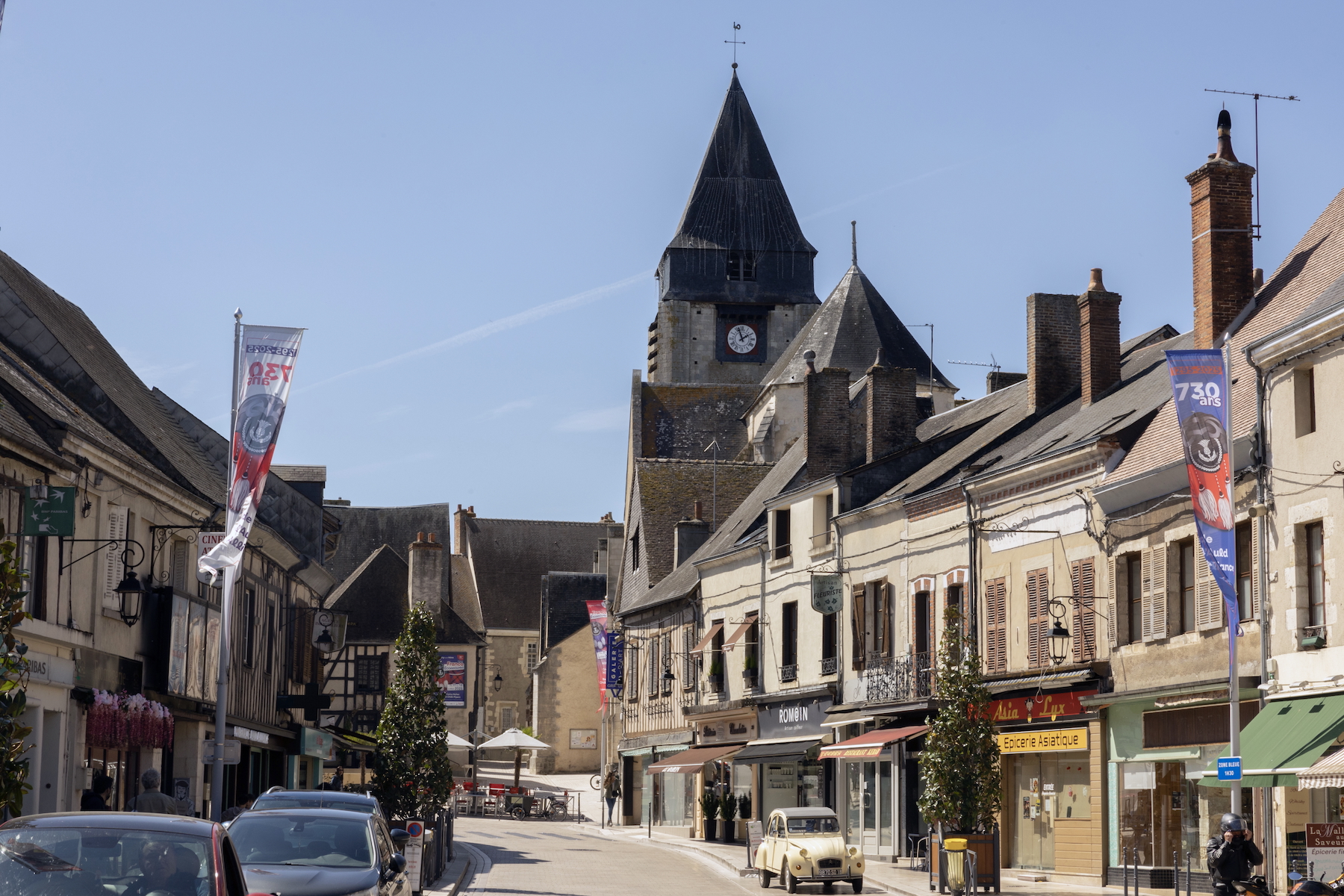
Rue du Prieuré © Christina Mackenzie
In the 16th and 17th centuries, it had a flourishing textile industry producing cloth for soldiers’ uniforms and then, from 1892 to 1967, it had a shirt-tailoring workshop which employed up to 450 people making shirts sold in chic Parisian department stores.
Today it has a population of almost 6,000, a library, a cinema, three butchers (none of which sell haggis sadly, although haggis will be available during the festival), three bakeries, four hotels and as many, if not more, guest-houses, nine restaurants and six bars, two pharmacies (one of which is called, of course, Auld Alliance!), and a shopping scene with stores bearing names which often include the name “Stuart” (which is how the French spell the clan name, as do modern Scots) or make some reference to the Highlands such as “Les Bruyères” (heather)!
The town is also home to three or four highly specialised small and medium engineering enterprises: sub-contractors to the now booming aerospace and defence sectors which are busy recruiting engineers who, with their young families are giving the town a real boost.

The festival has market stalls selling Scottish products ©Tourisme Sauldre et Sologne
Although the town’s roots reach back to the Romans who called it Albiniacum, the oldest vestiges found are 12th century when the town belonged to the Saint Martin de Tours monks. In 1189 King Philippe Auguste made Aubigny a royal town organised around the church (dedicated to St Martin) and fortified the city ramparts (two towers are still standing). He also had a castle built but it was destroyed by the English. It stood on today’s Market Square.
In 1512, a fire which, as so often in the Middle Ages, started in an oven, totally engulfed the town except for one house, the Maison du Pont des Foulons which is, as its name suggests, right by the bridge on the rue des Foulons. But the Stewarts came to the rescue, Robert Stewart gifting wood from his surrounding forests to help with the rebuilding effort.
So Aubigny-sur-Nère was Scottish for the 249 years between 1423 and 1672 when it belonged to the Stewarts. When Charles Stewart, 3rd Duke of Richmond, 6th Duke of Lennox, 12th Seigneur d’Aubigny died, the chateau and town returned to France as stipulated in the original royal decree… but only for 11 years. Because on 18th March 1673, Louis XIV granted the nearby Chateau de la Verrerie to King Charles II of Britain’s French-born mistress Louise Renée de Penancoët de Kérouaille, Duchess of Portsmouth (1649-1734), and created for her the hereditary Duchy of Aubigny. But the letters patent creating it were not properly registered so became extinct when the Duchess died. However, Louis XV restored the peerage in 1684 to her grandson Charles Lennox, 2nd Duke of Richmond (her son, the 1st Duke of Richmond, fathered by Charles II, had predeceased her). Today that title is held by Charles Gordon-Lennox, 11th Duke of Richmond, 11th Duke of Aubigny, though the family no longer owns the chateau de La Verrerie, the 5th Duke having sold it in 1842 to Léonce de Vogüé whose descendants still own it (their cousins own the somewhat grander Vaux-le-Vicomte), while the town bought the chateau d’Aubigny and its gardens in 1812.
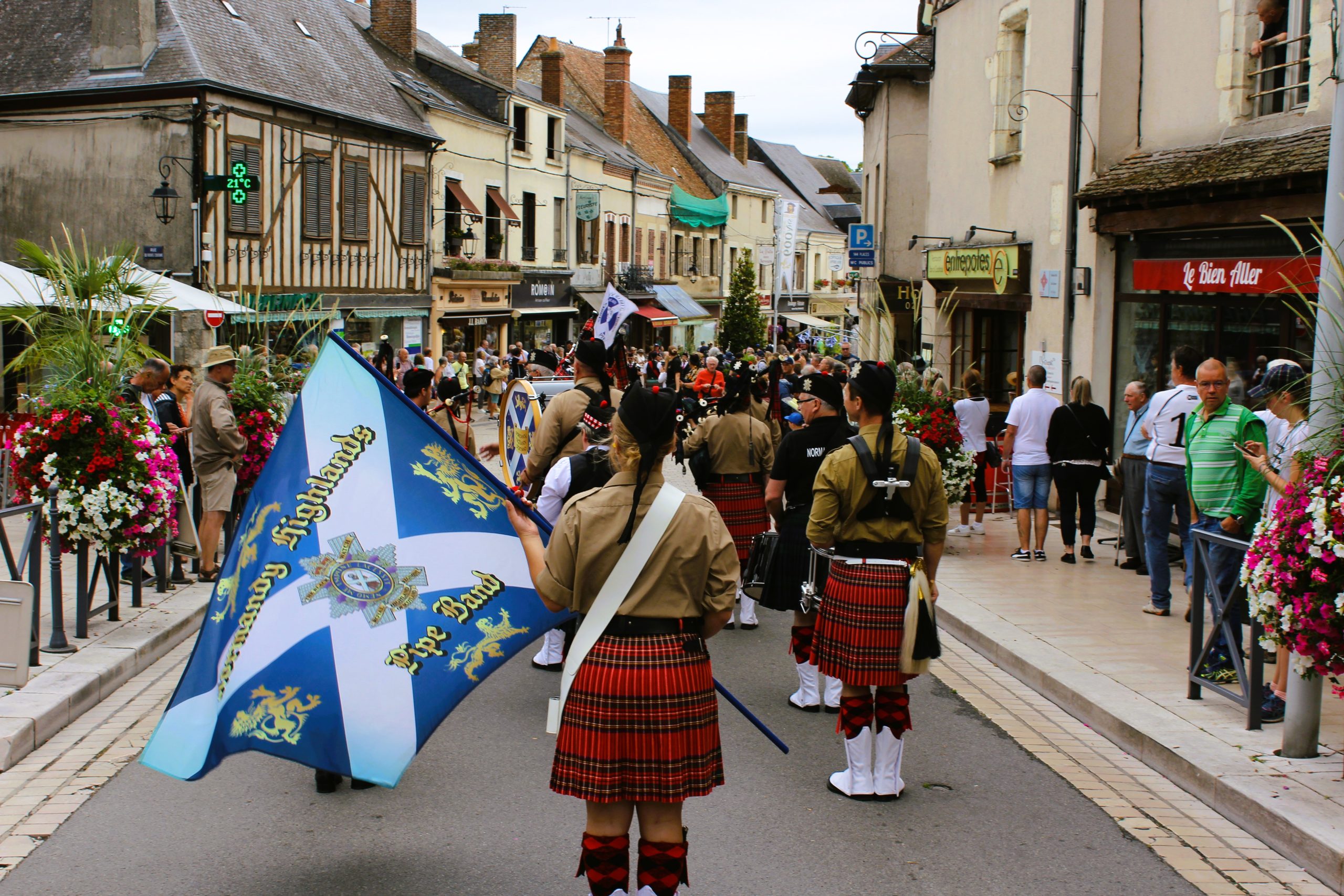
La Cité des Stuarts ©Tourisme Sauldre et Sologne
Aubigny-sur-Nère has been celebrating its Scottish roots (“la cité des Stewarts” is its motto!) every year (except during the Covid pandemic) since 1990 with a summer festival which goes ahead come rain or shine: “Like the Scots, we can handle rain!” laughed the Tourist Office when I called to check.
So this year, the 33rd Franco-Scottish Festival (detailed programme here) will kick off at 6:30 pm on Friday 11th July with a ceremony opposite the entrance to the Stewart chateau at the Auld Alliance monument: a large sword planted in a rock paying homage to the thousands of Scottish soldiers who gave their lives for the Kingdom of France. This will be followed by a free concert in the Duchess of Portsmouth park adjoining the chateau by the electro-Celtic group Noon from Brittany. Whilst you’re listening, admire the two giant sequoias in the park labeled “remarkable trees.”
At 9:00 am the next morning the Scottish and medieval markets will be welcoming customers, the Clan Village will awaken and music be supplied by various Pipe Bands. At 3:00 pm there’ll be a Grand Tattoo in the town centre followed by Massed Bands in the park and, in the same venue at 9:00 pm there’ll be a show you can see for a fee of €20 (tickets to all concerts can be booked here).
The morning of Sunday 13th July will have similar activities to those of the Saturday except that at 10:00 am the French Pipe Bands Championship will drum up enthusiasm in the park. At 3:00 pm there’ll be a grand parade in the town centre followed by Massed Bands in the park. Return there at 9:00 pm for a concert (€15) by the Red Hot Chilli Pipers.
If you don’t have a kilt, no worries. There’s a solid, life-sized kilt (with legs adorned by kilt hose) in the chateau courtyard that visitors can stand behind for a photoshoot!
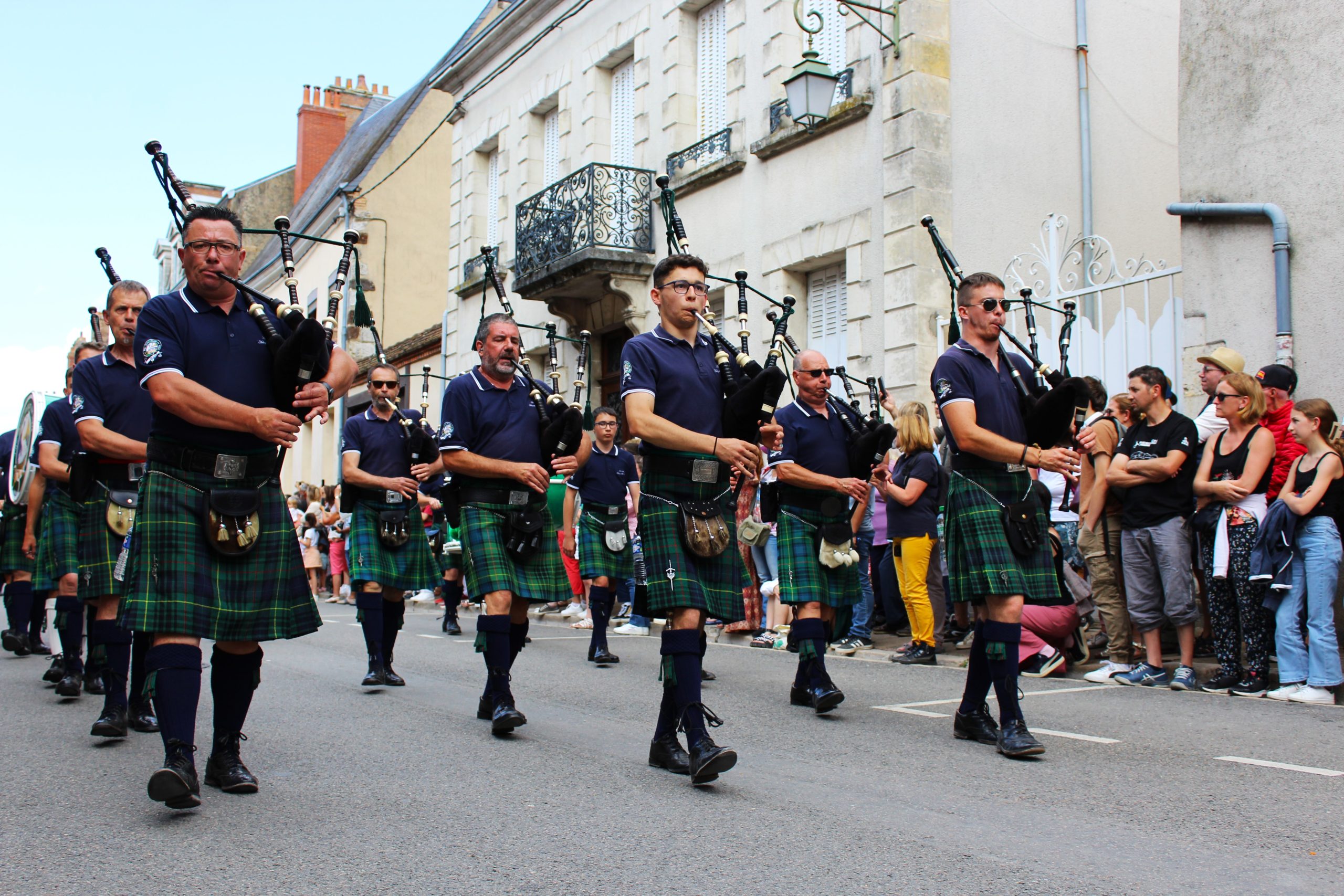
Bagpipes and kilts galore ©Tourisme Sauldre et Sologne
There’ll be plenty of time between the musical events to visit the town and admire its lovely half-timbered houses.
- Pick-up a map from the tourist office (just in front of the church) and start with the Maison Victorine just behind it, the venue for an annual exhibition (open from mid-May to end of September) organised by the town’s historical society. This year’s theme is “Post-war Aubigny 1945-60”.
- At n° 7 rue des Dames, the 16th century house known as “Jeanne d’Arc’s” house is owned by Francis Grange who has spent a colossal €612,000 since 2014 to renovate the house as closely as possible (with modern amenities of course!) to what it looked like when it was built in 1513 complete with mouth-blown glass windows on the ground-floor.
- At n°s 1 and 1bis rue des Dames (just opposite the tourist office) you’ll notice a house whose second floor is made up of unusual, small, lozenge-shaped half-timbering filled with brick. This is the Maison des Dames as it’s believed the nuns who looked after the sick and indigent at the Hotel-Dieu (hospital/hospice) lived here. And on the other side of the road you’ll see the Maison dite François 1er, one of the most beautiful half-timbered houses in town. Built in 1519 its name refers to an idea that King François 1er once slept here but there is no record of him ever having set foot in the town, let alone spending a night here!
- At the chateau-end of the rue du Prieuré, you’ll notice a grand brick and plaster building on the right as you look towards the chateau. This is the former priory. At the opposite end of the rue de Prieuré the brick house with strange protuberances on its roof is the Maison Bourdoiseau built in 1818 by Henri Bourdoiseau, a local master carpenter.
- Look out also for the remarkable half-timbering of the Maison Saint-Jean and Maison du Bailli opposite each other at n°s 18 and 15 rue du Bourg Coûtant. The former was built as an inn and you can still stay in it today for a very reasonable €100 a night for two, breakfast included. You can also stay in the Maison du Bailli for €75 a night.
- Don’t forget to look inside the Saint Martin church whose oldest segments date to the 12th century. This lovely early Gothic building has some remarkable stained-glass.
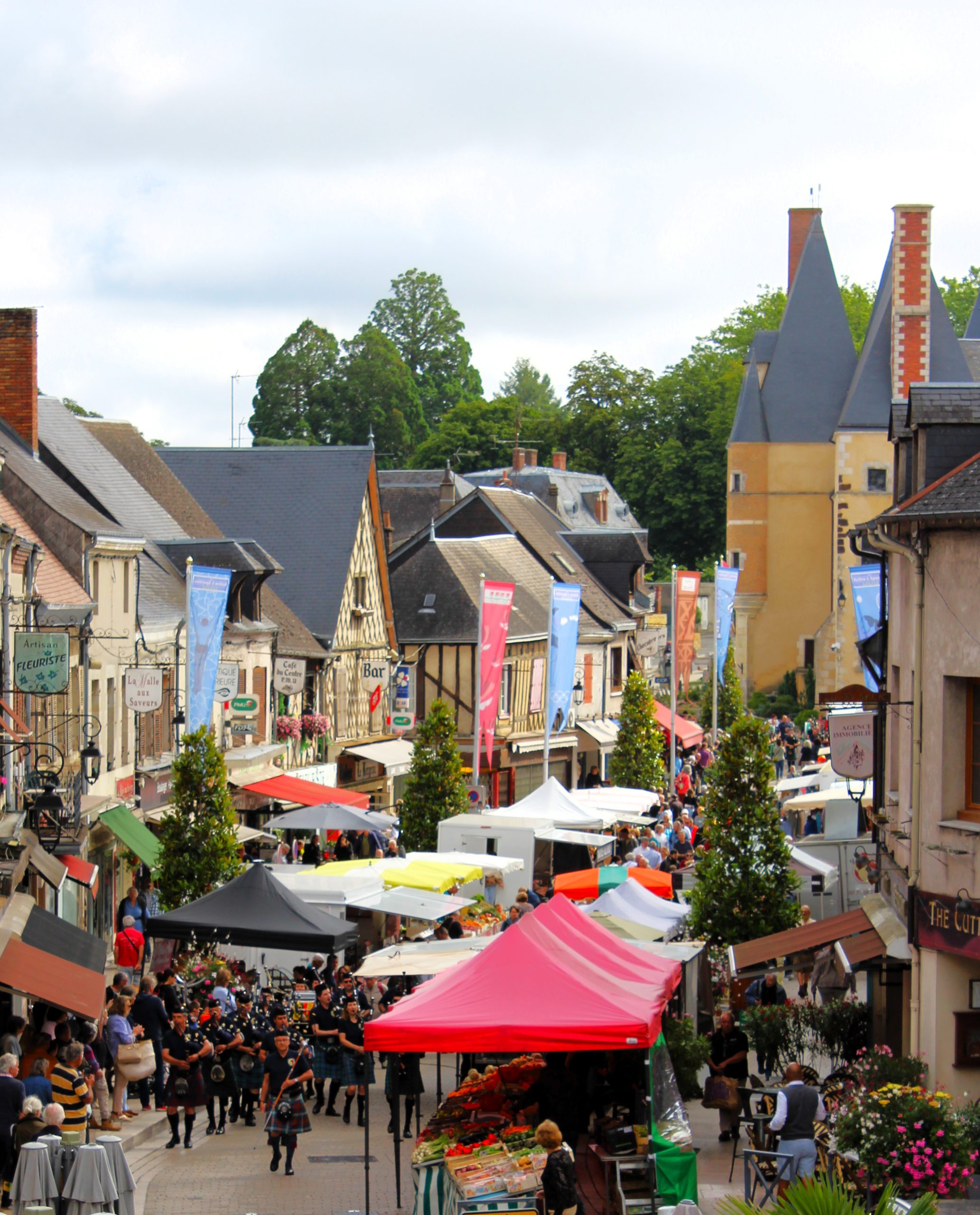
Street food and markets during the festival ©Tourisme Sauldre et Sologne
Accommodation is frequently booked by fans from one year to the next and rooms go quickly. The tourist office website is keeping track of accommodation availability so check it out if you’re having trouble finding somewhere to stay.
There are four parking areas for camper-vans, three of which are free and function on a first-come, first-served basis only: one (for eight vehicles) is on the D7 road just SE of the town, one (for about 30 vehicles) also serves as the Aldi supermarket parking (6 bis Le Mail Guichard) and the town is putting the car-park of the Collège Gérard Philippe (27 ter Avenue de l’Hippodrome de Vogüé) at the disposal of camper-vans for the duration of the festival. The paying option (€12 a night) is inside Les Étangs campsite but it’s already almost fully booked. You can also try the Domaine de Gorgeot guest-house which hosts camper-vans for €10 a night (and you can empty your grey waters at the new Intermarché petrol station at 10 rue George Sand). If you have no luck then don’t hesitate to look further afield. There are a number of campsites in the region too. The roads in this region of France are all pretty much ramrod straight so driving is easy!

Maison dite François 1er © Christina Mackenzie
A short history of the Stuarts, Seigneurs d’Aubigny
The title Seigneur d’Aubigny was granted to John Stuart 1st Lord of Aubigny (1380-1429). It was inherited by his second son (the older, the 2nd Seigneur d’Aubigny was killed in battle) also called John (?-1482), 3rd Seigneur d’Aubigny. His son Bérault (1452-1544) became the 4th Seigneur d’Aubigny. Bérault’s only child, a daughter, Anne Stuart d’Aubigny married her cousin Robert Stuart d’Aubigny (1470-1544), he who gifted the wood, the 5th Seigneur d’Aubigny. They had no children so the properties and title were inherited by Robert’s grand-nephew John Stuart (?-1567) the 6th Seigneur d’Aubigny, then by his son Esme Stuart (1543-1624) 7th Seigneur d’Aubigny, and by his eponymous son Esme Stuart (1579-1624) 8th Seigneur d’Aubigny. The latter had 11 children amongst whom three sons Henry (1616-1632), George (1618-1642) and Ludovic (1619-1665) who became respectively the 9th, 10th and 11th Seigneurs d’Aubigny. Ludovic, or to give him his full title: Cardinal Lord Ludovic Stewart, 11th Seigneur d’Aubigny was a Catholic priest so had no descendants. But he had a nephew, George’s only son Charles who became the 12th Seigneur d’Aubigny but when he died in 1672 with no male descendants that was the end of the Stuart line in Aubigny
Ohlala! It looks like you’re not a Member yet
Join to view this content!
(If you are a Member, log in or reset your password below or contact us so we can help)
- Log in
- Forgot password
Share to: Facebook Twitter LinkedIn Email
More in Berry, festivals in France, markets, Scotland
Related Posts


Leave a reply
Your email address will not be published. Required fields are marked *
REPLY