
In the Footsteps of Charles Garnier
Marian Jones looks at the career of the visionary architect and the creation of his life-defining masterpiece…
2025 is most definitely Charles Garnier’s year, marking both 200 years since his birth and the 150th anniversary of the opening of his most famous architectural project, the Opéra Garnier in Paris. His legacy lives on in the building which attracts 350,000 spectators a year, plus a million other visitors from all over the world who want to see its magnificent interior and perhaps pose for a photo on the grand staircase against the backdrop of gold, many-coloured marbles and glistening chandeliers.
Although he was born to a relatively humble Parisian family in Rue Mouffetard in the 5th arrondissement, Garnier’s artistic talent soon became evident, and by the age of 17 he had gained a place at the prestigious École des Beaux-Arts. At 23, he won the Grand Prix de Rome, a scholarship which allowed him to study in Rome for several years, leaving him with a taste for classical architecture and a love of marble and mosaics. Further inspired by travels in Greece and Turkey, he realised his vocation was architecture and at 36, he returned to Paris where he came to public attention in a spectacular way.

Charles_Garnier_by_Nadar_-_Leniaud
On December 30, 1860, Emperor Napoleon III announced a competition to choose the designer of a new state-funded opera house for Paris Garnier was one of only seven finalists selected from 170 entrants and the judges were unanimous in choosing his design for its ‘rare and superior qualities’ and the ‘monumental aspect of its façades’.
Garnier’s imposing design for an opera house with 2,000 seats became the epitome of Second Empire style, flamboyant and highly decorated, yet also incorporating new techniques such as the use of iron structures to support the building. He was to spend the next 14 years on the project, and after the opera house opened, he remained the official architect in residence for a further 23 years until his death in 1898. It really was his life’s work.
A UNIQUE VISION
When the foundation stone was laid in 1862, France was ruled by an emperor, Napoleon III, who saw the new Opéra as a way to project his power and wealth. However, by the time the building opened in 1875, France had become a republic and the new government saw the Opera House as a proud symbol of their city, somewhere to show off when entertaining visiting heads of state.
Garnier led the project through all this turbulence, commissioning many dozens of architects, sculptors and painters to realise his vision and overseeing the building’s façades and its lavish interior with equal attention to detail. He was known throughout as le grand chef, admired equally for his vision and his leadership skills.
The opening night was spectacular. France’s President MacMahon led the festivities and the 2,000 distinguished guests from across Europe included King Alfonso of Spain and the Lord Mayor of London. After a lavish programme of entertainments, including Rossini’s William Tell Overture and extracts from opera and ballet, the audience lined the grand staircase to give Garnier a standing ovation as he descended the sweeping marble steps. Records show he had in fact been asked to pay for his seat in the Upper Circle.

© shutterstock
He had recently been made a Member of the Académie des Beaux-Arts and would later be named a Grand Officier of the Légion d’Honneur, but nevertheless, on this occasion, no one thought to give him pride of place in the auditorium. The Opera building, which still bears Garnier’s name, was unique in style. It mixed the pillars and classical lines of the architecture he had admired in Greece and Rome with an exuberant Baroque style of decoration, where statues and carvings abounded, silver and gold gleamed, the panelling was made of exotic woods and 24 different varieties of marble were used.
The Empress Eugénie is said to have asked what style it was supposed to be, remarking that it was neither ‘Greek, nor Louis XVI, nor even Louis XV’. Garnier replied that they were all out of date and this was ‘Napoleon III style’ and she should not complain! One critic’s description of Garnier’s bold approach was that it mixed ‘a structured world which reassures’ with ‘a shimmering, ethereal world that charms’.
Garnier was technically adept, using the latest ideas to design a framework of metal girders to support the structure, even despite the tonnes of marble and other heavy materials used in the decoration. He consulted a range of engineers, including Gustave Eiffel, and also made a special study lasting many months of the science of acoustics. He researched this vital aspect in depth and wrote that, “I read works in all languages that I knew, I had translated those published in languages that I did not know, I conversed with one person, discussed with another”.
ESCAPE FROM REALITY
Garnier wanted the new opera house to be ‘an enchanted world’ which would take the audience away from the mundanity of daily life. It should be a dramatic setting, a place to see and be seen, and he designed the grand staircase as a setting for the finely dressed to parade up and down. He imagined them then taking their seats and looking out over the auditorium from box to box in order to catch glimpses of each other in all their finery.
He chose red velvet for the auditorium, commenting that the colour would enhance the skin tones of the ladies. Every detail he designed was carefully considered to contribute to the glamour and opulence of an evening spent at the opera house.

© shutterstock
Garnier did design other buildings, such as the Monte Carlo Casino Concert Hall and the Mont-Gros Observatory in Nice, along with the Théâtre Marigny in Paris and a number of Italian villas. But it is the Opéra Garnier for which he is most remembered and it is here that the 150th anniversary of its opening in 1875 has been celebrated with a year-long programme of events. They have included gala performances, exhibitions and a residency programme which saw an artist invited every month throughout 2025 to work with the cast and musicians to create a new piece referencing the special atmosphere of the Garnier. The exhibition ‘Palais Garnier: 150 Years of a Legendary Theatre’ can be visited at the Garnier’s Library Museum until February 15, 2026. Entry is included in the cost of a ticket to visit the Opera House.
A FITTING MEMORIAL
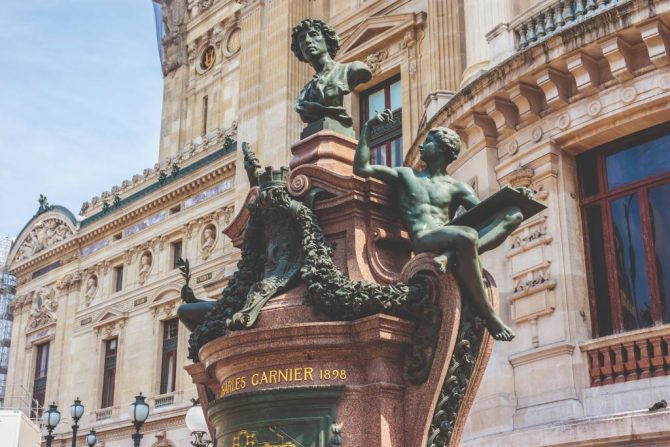
A bust of Charles Garnier sits outside the main entrance of the Opéra Garnier and there is another inside, in pride of place halfway down the Grand Foyer. Portraits of him include one by his friend, the artist Jean-Léon Gérôme, which was painted in 1877. You can also visit Garnier’s grave in Montparnasse Cemetery. Beside it there is a succinct biography, written in gold lettering on a bronze plaque, which ends by recording the huge crowd which gathered at the Saint-Séverin church in Paris for his funeral in August 1898.

DP-BnF-Exposition-Le-Palais-Garnier
But more than any of these, the true memorial to Garnier, his spectacular legacy, is, of course, the Opera House itself. Think of him next time you walk towards it up the Avenue de l’Opéra or take your seat for a performance in his globally renowned auditorium.
From France Today Magazine
Lead photo credit : © shutterstock

REPLY