Monument in Focus: Exploring the Château d’Angers and Its Apocalypse Tapestry
Explore the formidable Château d’Angers, where medieval ramparts, the magnificent Apocalypse Tapestry and a new exhibition bring centuries of history vividly to life.
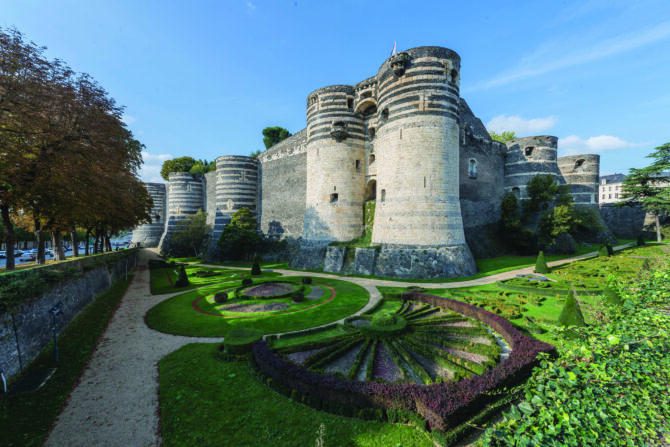
Rising above the River Maine, the Château d’Angers is one of the most formidable medieval fortresses in France and also one of the most surprising. Behind its 17 towers and impressive ramparts lies a unique cultural landmark, home to a masterpiece of medieval art as well as a vibrant programme of exhibitions.
A fortress built for power
While the site has been fortified since Gallo-Roman times, the château took shape in the 13th century under Blanche of Castile and her son, Louis IX. Between 1230 and 1240, they raised the massive curtain wall and its 17 towers, rising over 40m and capped with pointed roofs. An entire district of the city was demolished to enable the construction.
Later, Duke René of the Anjou-Valois house transformed the fortress into a princely residence, with a chapel and royal lodgings added. The towers were shortened during the Wars of Religion to accommodate artillery, giving the castle its present, slightly stockier silhouette.
It was occupied by German forces during the Second World War and severely damaged by Allied bombing. Extensive renovation works began after the war and, in 1948, the monument welcomed its first visitors. The Apocalypse gallery opened six years later and brought back the famed Apocalypse Tapestry after 500 years away from the château.
From September this year, the Tour du Moulin reopens after 20 years of closure and almost five years of restoration. Visitors can climb its 83 steps to a platform 40m high, offering a 360-degree panorama over Angers and the surrounding area. The visitor experience also includes a virtual orientation table and an evocation of the miller who once occupied the tower.
Two other towers will open to the public for the first time, one exploring the medieval fortress and the other games played during the reign of King René.
The Apocalypse Tapestry
The château’s true treasure, however, is textile rather than stone: the UNESCO-listed Apocalypse Tapestry, commissioned in 1373 by Louis I of Anjou and woven after designs by the painter Jean de Bruges. At roughly 100m in its surviving form (it was originally longer), it is the oldest and largest medieval tapestry cycle still in existence. It represents a vast illustrated meditation on the Book of Revelation, filled with dragons, angels and apocalyptic beasts rendered in vibrant reds and blues against a backdrop of gold and blue squares.
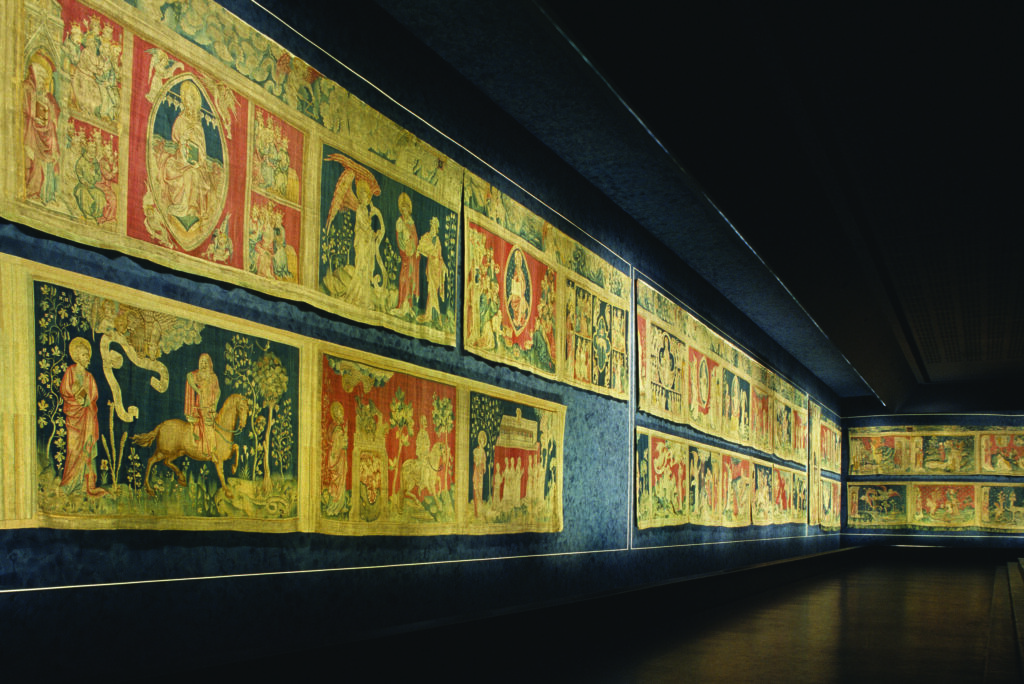
Housed in a purpose-built, dimly lit gallery that protects its fragile dyes, the tapestry rewards slow looking: its 70-odd surviving scenes unfold like a medieval graphic novel. It’s all the more impressive when you realise it has survived war, revolution and six centuries of handling, largely intact.
Medieval marvels to fantasy
Running from July 2026 to January 2027, the château’s current exhibition, ‘HeROIc. Du merveilleux médiéval à la Fantasy’, draws a direct line between medieval legend and contemporary pop culture. Staged in the royal lodgings, it traces how kings, knights, dragons and quests for treasure such as the Grail have been continually reinvented, from Renaissance tournaments through the 19th-century medieval revival to today’s novels, films and video games.
Curated with two historians, known as Les Geekstoriens, the show displays swords, armour, grimoires and potion bottles alongside analysis of their historical roots, and closes with Respawn, an installation by Floryan Varennes offering an unconventional take on heroism. It’s a fitting end to a visit: proof that the château’s medieval imagination is still very much alive.
Useful information
Château d’Angers, 2 Promenade du Bout-du-Monde, 49100 Angers, France
Opening hours:
- May 2 to September 4: 10am–6.30pm
- September 5 to April 30: 10am–5.30pm
For more information, visit the official Château d’Angers website.
Lead photo credit : The Porte des Champs, ramparts and gardens in the former moat at the Château d’Angers