
Laughing in Two Languages: A Q&A with Comedian Tatty MacLeod
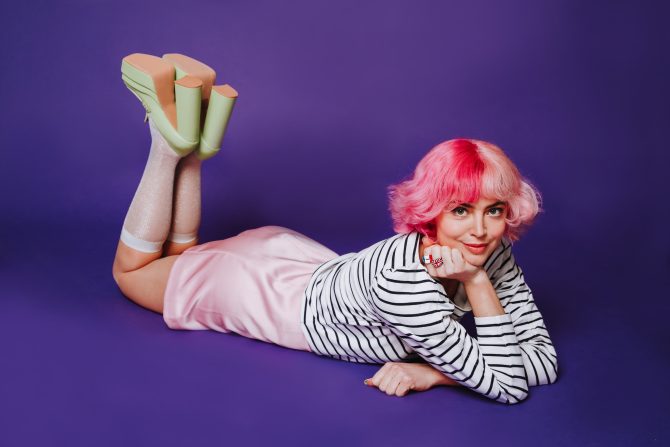
Bilingual comedian Tatty MacLeod shares insights on identity, humour, and life between cultures.
Tatty Macleod is having a moment. The French-British comedian and social media star has wrapped her first European stand-up tour, FUGUE, culminating in sold-out shows at Le Théâtre des Variétés in Paris. I was lucky enough to get a ticket and, with a gang of Irish, British and US expat pals living in France, headed to the capital to catch her in action.
Let me tell you we could not have been more excited if we were off to see Beyoncé. Tatty’s razor-sharp observational humour, hewn from her own experiences growing up in a British family in Brittany, hits with pinpoint accuracy; making us roar with laughter and feel, at last, seen.
“Yes! Finally someone has said it out loud and understands,” we cry.
Tatty gets it. She articulates the culture shocks, nuances and contradictions of life (and love) between France and the UK with clarity, humour and empathy. FUGUE explores themes of belonging and identity in unexpectedly moving ways — a celebration of all that is magnifique and all that is pas possible about la vie en France.
I caught up with Tatty to talk about her overnight success — a decade in the making.

© Rachel Sherlock
Tatty, can you take us through the journey that brought you to the Théâtre des Variétés in Paris?
It’s been a long one! I actually started out studying law at Sussex University, but I had a sort of reconversion moment and decided to follow a long-standing love for performance. I trained at the Royal Central School of Speech and Drama in London and quickly realised that the romanticised idea of acting wasn’t quite the reality. So, I began creating my own work—writing plays, then doing sketches, and eventually creating my stand-up show at Edinburgh. That path, along with the social media content I started during the pandemic, gradually led me to where I am now.
How did FUGUE come about?
I wanted to create a live show that resonated with the audience who knew me from social media. I didn’t want there to be a disconnect. Around that time, I also began feeling this weight of representing France or French people, even though I didn’t have a French passport. It made me question my right to France—to Frenchness. That led to deeper questions of identity and belonging. What does it mean to belong somewhere? Is identity defined by bureaucracy or by experience and emotion?
That really comes through in the show, especially in the final moments. Can you tell us a little about the title, FUGUE?
Musically, a “fugue” is a composition where different melodies run away and return, but it also has a psychological definition: a flight from one’s home, often involving a loss of identity. That really struck me. At the time of writing the show, I wasn’t planning to move back to France. I was dealing with the emotional aftermath of Brexit and what it meant for someone who identified deeply as European. Writing and performing FUGUE became a way of processing that sadness, that feeling of being shut out from a place that had always felt like home.

© Rachel Sherlock
Your song at the end of the show was so moving—a real surprise in a comedy performance.
Yes, it catches people off guard. It’s not there to offer resolution, but rather to express the melancholy, the nostalgia, and the confusion that comes with shifting borders—not just literal ones, but emotional and personal ones too. I’m not interested in getting into a political conversation around it, because it’s not about the politics that led to it. It’s about how it made me feel as an individual who identified as European having the borders of her own sense of identity changed in the course of my lifetime without me having any participation in it.
What was it like performing the show in different cities across Europe?
Fascinating! Each audience brought something different. I added an improv section at the beginning of the show to assess the room—what languages they speak, where they’re from, what cultural references will land. Performing in Glasgow, Paris, Zurich, Cardiff—it all required little tweaks. But that’s what keeps the show alive. It has to breathe and shift. I think all good comedy does.
Do you think social media has helped you reach those more diverse audiences?
Absolutely. Social media has changed the game. It gives you direct access to your audience, bypassing traditional gatekeepers. And yes, it builds a sense of familiarity; people feel like they know you. That intimacy can be really powerful. It also gives creators more control over how they present themselves.

© Rachel Sherlock
What comedians have influenced you?
Hannah Gadsby’s Nanette really impacted me. It showed me how comedy could be deeply personal, powerful storytelling. Comedy as therapy almost. That merging of theatre and comedy is something that really speaks to me.
You recently moved from London to Paris. What made you take the plunge?
After the shock of Brexit wore off, I realised if I wanted to re-establish my connection with France, I had to act. I was in my 30s, single, no kids, and I thought—this is the time. I hadn’t lived in France since I was 18, and even though I talked about it a lot in my work, my relationship with the country needed an update. I didn’t want to become some sort of “Hilaria Baldwin” of France!
What do you miss most about France when you’re away?
It’s funny because it’s quite sensorial and driven by childhood memories. I miss the soft sandy beaches in Brittany where I grew up—the smell, the sand, the sound of it all. I find myself listening to French music and podcasts to reconnect.

© Rachel Sherlock
How has living in Paris changed your perception of France?
I really love Paris. I love living here, and I love the lifestyle of Paris, but it is interesting because I grew up in Brittany, where we hated Paris! Growing up, we had a bit of a chip on our shoulder about Parisians—they came in summer, bought the expensive homes, and there was this sense that they turned their noses up at us provincials. So what’s funny about Paris is that not only do I have to manage the fact that I’m English in Paris, but also a Bretonne!
Parisians have a reputation for being a tough crowd. True or false?
I’m so proud of the fact that they come to my show and they still laugh. I think that’s actually how open minded they are, because you wouldn’t get that many English people going to see a show in French. So I’m really like, wow, you know? They’re respectful! Maybe a little too respectful. They listen intently, they dress well, they arrive expecting art. It’s lovely, but sometimes I need to reassure them, “No, that joke was meant to be silly! You can laugh!”
You’re working on a book as well. Can you tell us more?
It’s autobiographical, about growing up in French and English, but it’s not a straight memoir. More of a self-fiction, a non-fiction. It’s coming… once I write it!
And finally, for anyone thinking of moving to France post-Brexit, what would you say?
I think just go for it. The paperwork can be a challenge, but if you feel that calling, don’t wait. The window isn’t going to get wider. I think that it feels like we are going towards a trend of hankering down and closing borders as opposed to opening them up. So I don’t think it’s going to be easier in five years to move to France than it is now. Especially if you’re someone who works in culture. If you’re in a place in life where you can, then I’d say take the gamble.
Follow Tatty Macleod:
Substack: Tatty en Terrasse
Instagram: @tatty_macleod
Tik Tok: @tatty.macleod
Keep an eye out for Tatty’s upcoming book and more updates on tattymacleod.com
Lead photo credit : © Rachel Sherlock
Share to: Facebook Twitter LinkedIn Email
More in bilingual, comedy, humour, interview, Paris, stand-up comedy
Related Posts


Leave a reply
Your email address will not be published. Required fields are marked *