City Focus: Carpentras in the Heart of Provence

With a splendid new museum and a heritage all its own, the ancient city of Carpentras is a must-see on a trip to Provence at any time of year. By Jennifer Ladonne
On a glorious Friday morning in early March, the Carpentras market at the edge of the old town is in full swing. Today, it is refreshingly spare, relieved of the ubiquitous lavender sachets, rainbow-coloured savon de Marseille and other Provençal stalwarts designed to please the summer crowds. Cheesemongers, bakers, and spice, olive and seafood sellers line the square offering all the products needed for daily life in Provence. At the far end, I spot what I came for – a lone vendor proffering half a dozen jet-black, golf ball-size spheres – the last of the winter truffles.
Carpentras’ marché aux truffes d’hiver has brokered the precious tuber since the 17th century and likely well before. From mid-November to early March the region’s truffle farmers gather at Place Aristide Briand to engage in a highly regulated ritual where brokers, restaurateurs and home gourmets pay up to €1,500 a kilo depending on quality and yield. Expensive, to be sure, but far less than one pays shaved over pasta at a restaurant or bought at a Parisian gourmet shop, where some of these truffles are no doubt headed.
At €60-€80 apiece they’re pricey for me, so from under the table the dealer whisks out a box of the ungainly orbs in smaller sizes. I settle on a plum-sized one for €40 that, he explains, I can keep handily in the freezer for months, pulling it out to shave over pasta, an omelette, or simply toast drizzled with olive oil.

Tuber melanosporum is not the only delicacy Carpentras is famous for. In late March, the first succulent Carpentras strawberries arrive, celebrated in mid-April at the annual Carpentras strawberry festival. In May, ruby-red cherries appear fresh from neighbouring Venasque, and in late spring and summer, when the bustling Friday market extends from the old town down to the leafy Platanes car park, locals and visitors alike flock here for the prized Cavaillon melon and the local apricots, figs and plums used to flavour France’s oldest bonbon: berlingots de Carpentras, a sweet deeply entwined with the local history.

The berlingot was a major economic engine for Carpentras in the 17th century. By the mid-19th century, when its popularity exploded in France, the hard candy was manufactured by 20 confectioners operating in the city.
Tracing the lineage of the tiny striped sweet, we arrive at 1309, when the chef to Pope Clement V created fruit-flavoured candies in the shape of his employer’s pointed hat (berlingot is said to derive from Clément’s real name, Bertrand de Got). A transformative period in Carpentras, Avignon and all of Europe, this was when Clement V, a Frenchman by birth, shuttled the papacy from Rome to Avignon. His successor, John XXII, established Carpentras as the capital of the Papal State from 1320 onward. Thus began five centuries in the history of France, the Catholic Church and the French Jews that lasted until the French Revolution, when Carpentras and this tiny, ancient enclave of Provence called the Comtat Venaissin finally became part of France, in 1791.

For nearly 500 years, and after various expulsions, the French popes provided rare safe haven for the region’s Jewish population (resident here since the first century AD), known as the Papal Jews, with communities in Carpentras, Avignon, Cavaillon and L’Isle-sur-la-Sorgue. Carpentras’ 14th-century synagogue, the oldest in continuous operation in France and among the oldest in Europe, bears witness to this time.

Today, the synagogue’s unassuming exterior offers no hint of its history, and that is by design. The modest façade of the 660-year-old structure, which has sections dating to the 6th century, belies a constant flux in response to ever-changing attitudes and conditions. Restricted to a small area within the city gates, the inhabitants of the Jewish quarter were forced to build upwards to accommodate a growing population. Traces of the on-site quarry that provided the building material can be seen in the basement, the oldest section, alongside a vaulted meeting room, a deep ritual bath and a bakery. The upstairs worship room’s ornate 18th-century Baroque-style interiors still serve the local congregation. Now a museum, the synagogue of Cavaillon – 27km away via the D31 – is also a must-see.

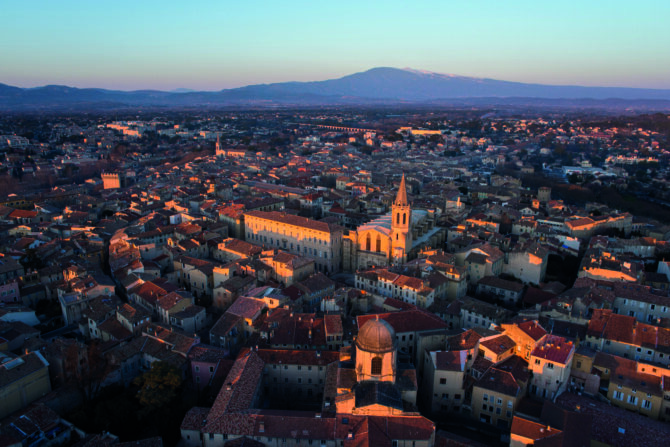
Impression of Carpentras, a commune in the Vaucluse department in the Provence region in southeastern France
You’ll learn about this fascinating period, and the history of cosmopolitan Carpentras and the entire Provence region, at the splendid new L’Inguimbertine museum and library. Reopened in 2023 after an impressive 15-year restoration, the 18th-century

Hôtel-Dieu, which served as a hospital from the 18th to the late 19th century, now houses a vast collection of artefacts, artworks, France’s oldest intact apothecary, a superb Baroque chapel and the exceptional library of its well-travelled founder, Dom Malachie d’Inguimbert. Highlights of d’Inguimbert’s extraordinary collection of 14th- to 18th-century manuscripts are on display, with interactive screens to peruse them in detail.
CENTURIES OF HISTORY
As Bishop of Carpentras, d’Inguimbert presided over the Cathédrale Saint-Siffrein, a curious mix of architectural styles built between 1409 and 1514 over three earlier churches. Designed mainly in the Gothic style, if the façade seems incongruous that’s because of its remaining 12th-century tower, 17th-century classical doorway and 20th-century bell tower. Inside, exceptional wrought iron gates, gilded statues, a 17th-century marble altar, fine classical paintings and valuable relics hint at its rich past. All can be viewed on your own or on a guided tour (check with the tourist office for times).
Against the cathedral’s northern end, the 1st-century Arc Romain triumphal arch, built to commemorate the victory of Rome over the barbarians, is the last vestige of this once-thriving Roman metropolis, where Romans and the earlier Phoenicians cohabited in relative peace.
It’s easy to forget that this thriving metropolis is also a hilltop town. The city’s medieval fortifications were destroyed in the 19th century, but the 14th-century Porte d’Orange remains and is the best spot for panoramic views. Aside from these major monuments, the city’s picturesque old town is filled with things to see and do.
A visit to Maison Jouvaud, a Carpentras institution, is a must for delicious local specialities, including the candied fresh fruits native to Provence. All of the pastries, chocolates and artisanal breads are made here, and the charming boutique is the ideal spot for teatime.
Under the medieval vaults of Carpentras’ Les Halles marketplace, Fromagerie Mercy champions the small-producer cheeses made in the Luberon, Vaucluse and Alpilles that you won’t find easily in commercial shops. A gourmet section features local wines, craft beer, olive oils, confits, confitures and truffles to complement your cheese plate.
Across the arcade, historic glass-roofed Passage Boyer unites some of the city’s higher-end boutiques. If books are your thing, you can relax over an illustrated novel and a coffee or tea in Librairie Gulliver’s adorable tearoom.
To watch the elaborate process by which the berlingot is made, head to the Confiserie du Mont Ventoux, a short walk from the city centre. Founded in 1946, it’s the oldest artisanal berlingot manufacturer with a Living Heritage label to prove it. Along with the flavoured candies, you’ll find local nougat, biscuits and pralines made from centuries-old recipes.
Maps of the city and all the information you’ll need for your visit are readily available at Carpentras’ tourist office, which can be found on Place Aristide Briand, an easy 10-minute walk from the train station.
CARPENTRAS ESSENTIALS
GETTING THERE
BY AIR
Fly EasyJet or Air France from London Gatwick to Marseille Provence airport; it’s 1 hour and 50 minutes by train from the airport to Avignon TGV.
BY TRAIN
From Paris, take the TGV direct (2 hours and 45 minutes) from the Gare de Lyon to Avignon; then it’s a 20-minute local train to Carpentras centre.
WHERE TO EAT & STAY
Brasserie É.TOQ serves unfussy and well-priced regional and Mediterranean dishes, with plenty of fresh salads and specials to choose from. The spacious terrace overlooking the Inguimbertine and the Place Aristide Briand is great for people watching on market days (you can buy truffles here in season) and it’s right next door to Confiserie Clavel if you fancy an ice cream.
Maison Jouvaud, founded in 1948, is famous in Provence for its delicious pastries, handmade chocolates, candied fresh fruit and artisan breads all made on the premises. The Carpentras branch, the original, simply oozes charm and is the best spot for coffee and a morning pastry or a scrumptious teatime.
Cercle 85, a top gastronomic choice in town, is set in the former residence of the Counts of Toulouse, though you wouldn’t know it for the contemporary decor. It’s a favourite for its convivial atmosphere, reasonable prices and pretty terrace, and the bar is especially popular for its craft cocktails.
www.provenceguide.com/restaurants/mont-ventoux/cercle-85/provence-5311031-1.html
Hotel de Garlande, in Avignon, is as comfortable a hotel as you could wish for at a price that’s hard to beat. Set on a charming backstreet, it’s quiet too.
La Mirande, an Avignon landmark set in a lovely 18th-century building behind the Palais des Papes, offers quiet luxury and sumptuous rooms filled with period antiques. The secluded garden feels a world away and the gastronomic restaurant, helmed by young chef Michele Donvito, is a standout in the region.
TOURIST OFFICE
97 place du 25 août 1944
84200 Carpentras
Tel. +33(0)4 90 63 00 78
From France Today Magazine
Lead photo credit : VENTOUX PROVENCE TOURISME, C LEROI, BIBLIOTHÈ QUE-MUSÉ E INGUIMBERTINE, VILLE DE CARPENTRAS, SHUTTERSTOCK, JENNIFER LADONNE