Finding Silence on France’s Via Francigena
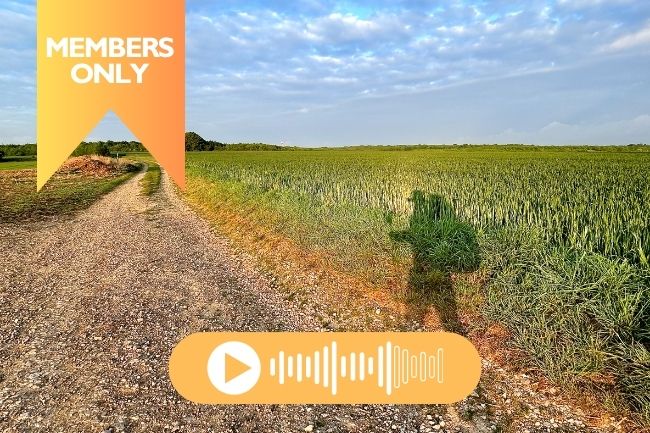
On the Via Francigena, an ancient pilgrimage route to Rome that traverses France, silence isn’t absence, it’s the point. Walking here means trading noise for wind, footsteps, and the slow return to your own thoughts.
📢 As you scroll through the beautiful images, why not listen to our narrated article? It’s a great way for France Today Members to dive deeper into the story while enjoying the visuals. We hope you love this experience, and we’d love to hear what you think—feel free to share your thoughts in the comments below! Happy listening!
In Calais, the road to Rome begins at a locked church. Notre-Dame de Calais is shut behind its railings. Ferries cough out lorries and day-trippers. Rome is more than a thousand miles away on foot.
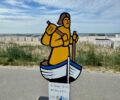
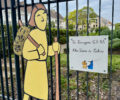
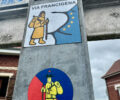
On the church gate, a yellow pilgrim figure marks the route. Underfoot, a metal marker set into the pavement points the way.
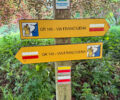
On Spain’s Camino de Santiago, pilgrims are rarely far from yellow arrows, cafés or other walkers. The Via Francigena, the pilgrimage route from Canterbury to Rome, feels less arranged, less certain of being noticed: stickers on lampposts, small arrows at crossings, marks that barely announce themselves.

Outside Calais, the road straightens and the noise begins to fall away.
Not completely. Vans pass close. Dogs bark from behind gates and farm walls with a persistence that becomes part of the day’s weather. Farm machinery starts up somewhere beyond the houses. Gates clatter. The quiet is not an absence of modern France, but something threaded through it.

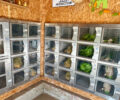

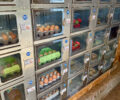
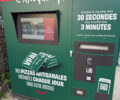
The route passes closed tabacs and machines selling potatoes, milk and eggs. At the edge of one village, a green Le Kiosque à Pizzas promises hot pizza in three minutes.
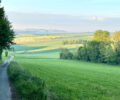
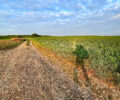
For hours, the same things return with small variations: wheat fields, church towers, farm traffic, birdsong, the occasional Angelus bell. The tarmac hardens underfoot, and by midday the pack has found the same sore place on my shoulder. Rain darkens the road. Wind hums through power lines and tall grass.

In the villages, bicycles lean against low brick houses, flowers spilling from their front baskets. Outside the occasional boulangerie, handwritten signs advertise tarte au sucre and jambon-beurre wrapped in paper for passing workers. Roadside calvaries appear at crossroads. Small painted Madonnas sit behind glass, their faces faded with age.


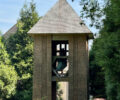
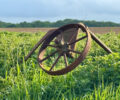
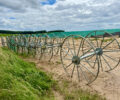
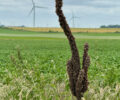
Some mornings begin before sunrise, with the roads still wet from overnight rain and mist low across the fields. Rabbits vanish into hedgerows. Young deer stand motionless beside the tree line. When the weather lifts, butterflies drift across the path. Towards sunset, the beet fields hold the light long after the départementales empty, wind turbines turning on the flat horizon, tractor lines running through the crops to distant poplars.

Nobody asks where I started that morning. By the time I stop, I am sometimes not entirely sure myself. The roads were quiet long before my thoughts were.
A lorry passes too close. A dog throws itself against a gate. A minute later, the road has closed over the noise.

Until Wisques, silence has been something that returns by accident. There, it has rules.
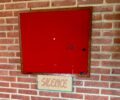
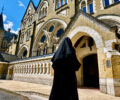
At the Benedictine abbey of Saint-Paul, bells organise the day. Matins at 5.15am. Lauds at first light. Compline at 8.25pm, followed by ‘night-time silence to be kept until Prime’. Beneath an almost empty red noticeboard, a handmade sign carries a single word: Silence.

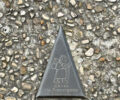
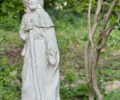
In the grounds, a statue of St James stands among the trees, staff in hand. Scallop shells ring the base of the plinth.
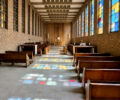
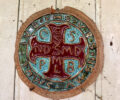
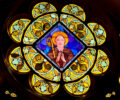
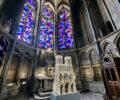
Inside the chapel, coloured panes of glass throw pools of red and blue light across the pale stone floor. As the sun shifts, the colours move slowly across the tiles. Benedictine crosses hang over doorways. Somewhere beyond the nave, monks chant in Latin.
Doors close softly. Conversations pause for the next office.

At Matins, I sit half-awake while the voices rise and fall beyond the choir stalls. After days of walking alone, it is the first stillness that feels shared rather than empty.
Later, in the corridor outside the chapel, a monk asks why I have come to Wisques.
‘For the silence,’ I say.
He gasps, then smiles.
For a moment, neither of us speaks.
On the opposite slope, at Abbaye Notre-Dame de Wisques, organ music drifts through the chapel while a sister, somewhere out of sight, pauses, repeats a passage and begins again.
At Wisques, silence is not distance. It is discipline. Kept, broken, resumed.


Footsteps echo briefly along the abbey corridor, then fade. Somewhere a door closes. Nothing else moves.
Beyond the abbeys, the route returns to the beet-and-wheat country of the north: faded mairie buildings, narrow churches, coalfield slag heaps softened by birch and grass. Near Amettes, it passes the birthplace of Saint Benoît-Joseph Labre, the wandering pilgrim later named patron saint of the homeless. Further south, villages gather around war memorials, names cut into pale stone. For generations, miners descended before dawn into the coal beneath this landscape; now the old heaps rise beyond the fields like low dark hills, their slopes taken back by scrub, trees and weather.

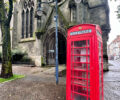
In Arras, a red British telephone box stands in Place d’Ipswich outside the Church of Saint-Jean-Baptiste. A plaque explains that medieval trouvères once filled these streets with songs and poems. One of them, Jehan Bodel, wrote of being ‘reduced to silence’.
I carry the phrase south.
Beyond Arras and towards the Somme, military cemeteries begin appearing beside roads and wheat fields. Some stand so close to the verge they seem almost accidental. White stone beyond hedges, flags hanging motionless in the still air. Tractors continue moving through the surrounding farmland as though the interruption belonged to another century. Here, silence felt less like peace than aftermath.


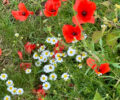
Towards Péronne, rows of headstones stand behind low walls. Poppies and thistles push through the grass by the roadside. Names weather slowly beneath trees.
Near La Fère, the canal runs straight towards the woods. A grey heron stands on the far bank, still enough to seem part of the towpath. For a long while, only the water moves between us. When it finally lifts, the reeds close behind it and the path feels emptier than before.
Beyond the Somme, the steeper climbs towards Laon, its cathedral visible above the plain long before the town itself appears. It waits there for hours, fixed on the horizon while the route moves through fields, villages and short stretches of shade.


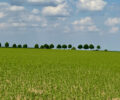
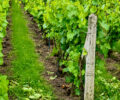
Further south, the land begins to rise into Champagne. Vineyard rows cross the chalk slopes in tight green lines, leading the eye towards villages better known for bottles than pilgrims. Around Reims and Épernay, tour groups gather beneath cathedral towers and Champagne-house façades, glasses bright in the afternoon light.
Within an hour, the route slips back into tractor tracks and vine leaves, past chalky walls and cellar doors breathing out cool air from tunnels beneath the hills.
In a village boulangerie, the woman behind the counter pauses after hearing where I am walking.
‘Roma?’ she asks, glancing towards the street outside.
She stamps my pilgrim passport beside the till. By the time I leave, she has turned back to the next customer.
Beyond the vineyards, the first climbs arrive abruptly after the flat roads of the north. By afternoon, I am watching my boots rather than the horizon.

Wet paths and tree roots take over from stickers and church towers. Sound changes too. It no longer travels across open fields, but returns quickly from water, stone and trunks close to the path. Streams gather beside moss and exposed limestone before sinking into the porous ground.
In the Loue Valley, around Ornans, the river threads between steep cliffs below villages built tightly against its banks. It narrows into channels and small falls beside bridges, old winegrowers’ houses and shuttered balconies. The route keeps returning to it below walls, beside troughs, under bridges, then briefly out of sight.
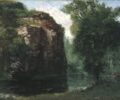
Courbet painted the Loue often. In Bords de la Loue avec rochers à gauche, water disappears beneath rock and foliage. Beside the river, the same darkness lies under the cliffs and trees.
Villages such as Lods lie pressed between water and forested slopes, their stone houses drawn close to the banks. The walking feels different here, less like crossing open country than being channelled through it. Paths narrow into steep lanes beside walls and gardens before climbing again into trees. Once, the river powered forges; now damp leaves and mud cling to the boots, and cowbells knock higher up the hillside.

Higher up, stacked timber dries beside barns and the air carries the scent of wet stone and pine.
Near Pontarlier, Château de Joux rises above the narrow pass leading towards Switzerland and, beyond it, Italy. For centuries, the road beneath it carried pilgrims, traders and armies through the gap. The slopes close around the trail before opening again towards distant hills.
Evening lowers itself through the branches while I walk between stone walls and isolated farmhouses half-hidden among the trees. Smoke drifts from a chimney beyond the woods. Its scent lingers long after dark.
After enough days on the road, silence no longer feels unusual.
Silence isn’t found.
It waits.
Ohlala! It looks like you’re not a Member yet
Join to view this content!
(If you are a Member, log in or reset your password below or contact us so we can help)
- Log in
- Forgot password