
Travel the World Without Leaving France: 5 Sites that Resemble Global Icons
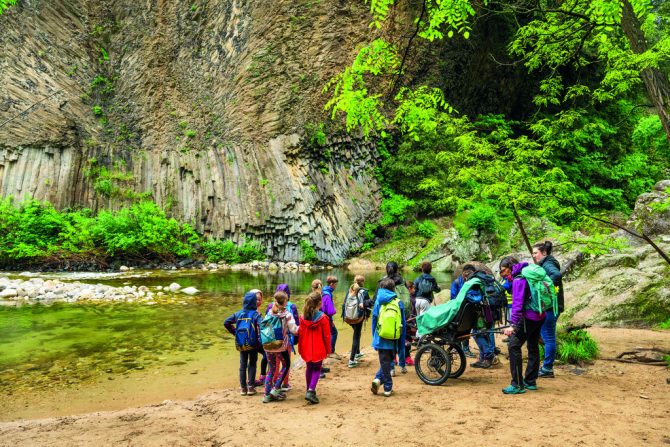
Next time you visit France, you can also explore other continents by proxy, thanks to l’Hexagone’s impressive array of ‘foreign’ wonders, both geological and man-made.
France is so blessed with diverse topographical and geological features that for many, it appears to be a dozen countries rolled into one. Consider the multiplicity of her eye-pleasing earthly delights: from the sweeping, pine forest-fringed beaches of the Landes coast to iconic, snow-topped Alpine peaks; from the snaking Loire’s endlessly attractive riverside vistas to the dizzying heights of sheer cliffs in Etretat and the Calanques near Marseille. The sheer range of natural options is abundant enough to ensure that even the most widely-travelled Francophile can find something new to marvel at, year after year. But did you know that there are specific places dotted around the country where one might imagine oneself in another country, continent even, entirely?
Here we round up some of the most impressive reminders of foreign soil – some entirely natural, others thanks a horticulturalist’s helping hand to be discovered right here in France…
1. Colorado calling in Aveyron
One would not expect such exoticism in southern Aveyron: the desert-like landscape of Le Rougier de Camarès provides a stunning contrast to the blue summer skies. The unique hue of the crumbly clay comes from its rich iron oxide content; and a related, equally eye-catching natural phenomemon here sees the River Dourdou (a tributary of the Tarn) turn red ochre during heavy storms. Le Rougier de Camarès is a geological curiosity which also provides a superb backdrop for biking and hiking – Rando Grands-Causses has plotted a 1km family walk as well as a 9km loop from Gissac. For a fine panoramic view head to Château de Montaigut.
Download signposted trails from Rando Grands-Causses: rando.parc-grands-causses.fr/en
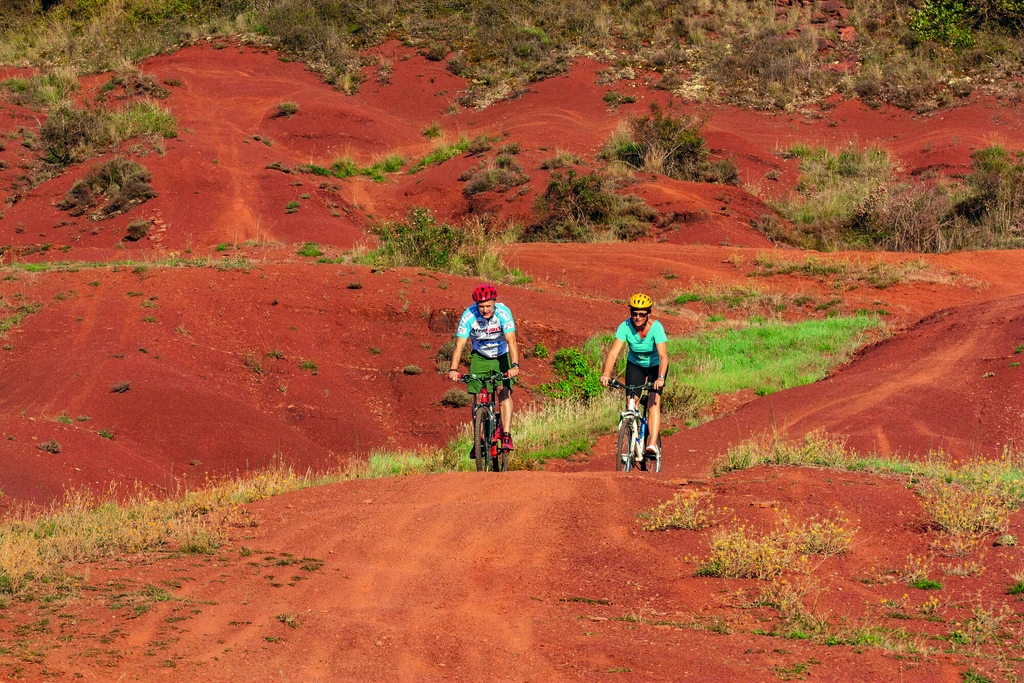
VTT dans le rougier de Camares, Aveyron-© J. Tomaselli – Tourisme Aveyron
2. See Scotland in Limousin
Plateau de Millevaches does not, as its name might suggest, mean ‘land of a thousand cows’ a logical presumption if one pictures pretty Limousin cows grazing this wonderfully remote wilderness. Rather, the most likely origin is the combination of the Gallic word ‘melo’, meaning ‘high place’, and the Latin adjective ‘vacua’, meaning empty or abandoned. Spanning parts of three departments – Haute-Vienne, Creuse and, principally, Corrèze – this natural park boasts moody moors, forests, peat bogs, countless tiny streams and even purple heather (called bruyère in French) it’s like stepping into the heart of the Scottish highlands.
If you love wide open spaces and fauna/flora spotting, the region is truly rich, with hundreds of specially laid-out trails to follow on foot, mountain bike or horseback. A comprehensive website called Rando Millevaches has hundreds of hiking trails – fully searchable by theme or location (and in English) – totalling over 6,600km² to choose from: rando-millevaches.fr/en.
For a truly spectacular panoramic view over the plateau, head up to the observation tower at Mont Bessou, which, at 978m altitude, is Limousin’s highest point.
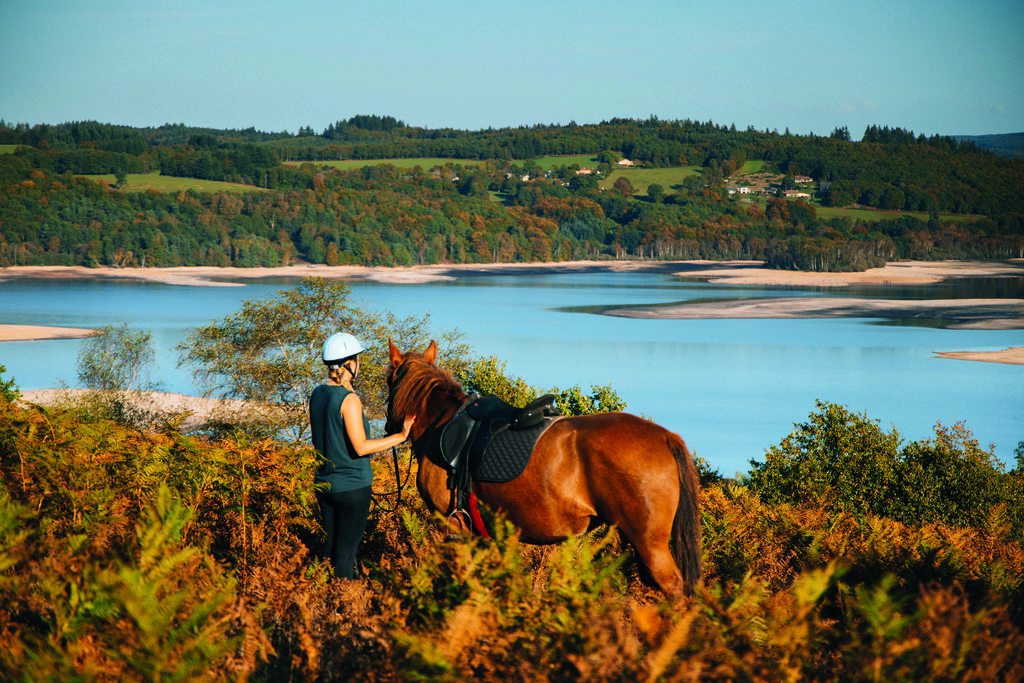
By pont de senoueix photographe Clara Ferrand
3. Tour Tuscany in Tarn
La dolce vita in the Tarn, you say? Its resemblance to the central Italian region is striking: think sweeping vistas of rolling hills carpeted in centuries-old vines; back-in-time hilltop villages such as the remarkably eye-catching Puycelci and Cordes-sur-Ciel; valleys and plateaux of the Causse, heaven-sent for a little hiking and biking. The similarities are such, in fact, that even the local tourist office has given it the name “The Occitan Tuscany’.
The good life, Occitanie-style, is epitomised by the Gaillac vineyards, where aesthetic appeal via a patchwork of colours shifts seasonally, and where sociability comes via passionate and welcoming winegrowers who provide tours and tasting sessions. May we recommend the Pass Vigneron, just €22 for a guided estate visit and complimentary bottle?
The area has superb walking trails to discover – try the testing Vignoble et Châteaux path at Cahuzac-sur-Vere (17.5km, duration 4 h 30m) – which find their reward in bountiful gastronomic offerings and superb accommodation.
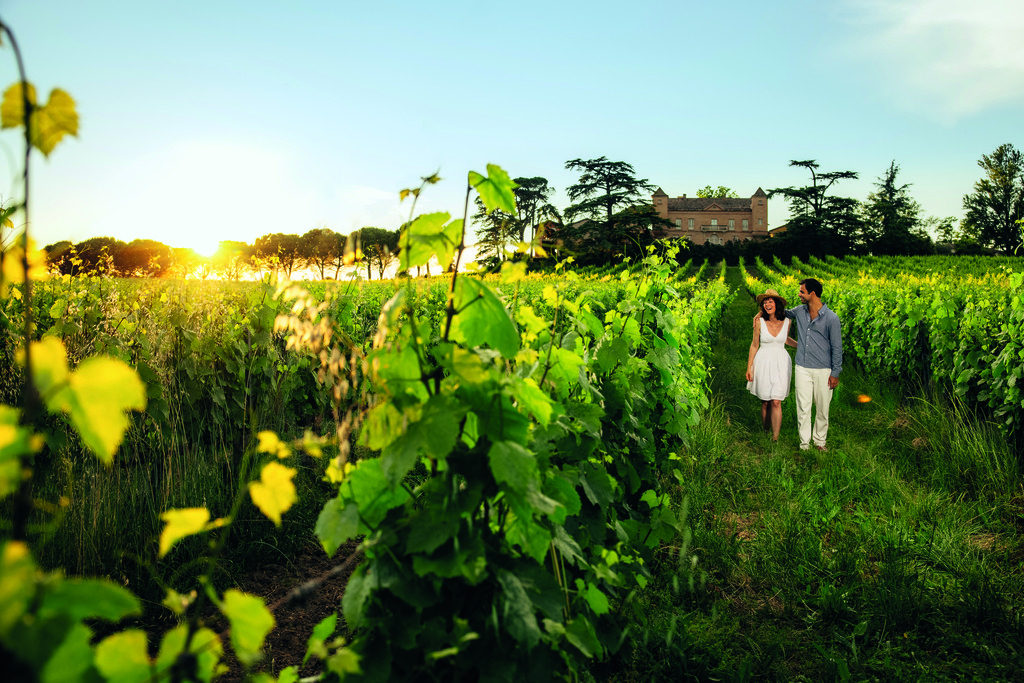
Decouverte_du_Vignoble_en_amoureux-©Buchowski_Photography
4. Enjoy Japan in the Cévennes
Created in 1856 by passionate botanist Eugène Mazel, the Bamboo Grove in the Cévennes (also known as the Bamboo Grove of Anduze) is an exotic garden located in Générargues, Gard. Designated one of France’s most beautiful gardens, it is home to more than 1,000 varieties of bamboo – some up to 25m high-as well a magnificent sequoia-lined path, a reconstructed traditional Laotian village, an aerial walkway (no under-sixes) and a truly splendid Japanese-inspired garden. As well as bamboo, the garden is home to Japanese maples, camellias and Ginkgos biloba. Importantly, La Bambouseraie is committed to reducing its impact on the environment, notably in its use of organic methods, recycling and the setting up of an LPO (bird protection league) refuge site.
Take a memory of this unique garden home with you by finishing your tour at the brilliantly-named Bamboutique, which sells locally-made bamboo objects. It is located an hour from Montpellier, and 50 minutes from Nîmes.
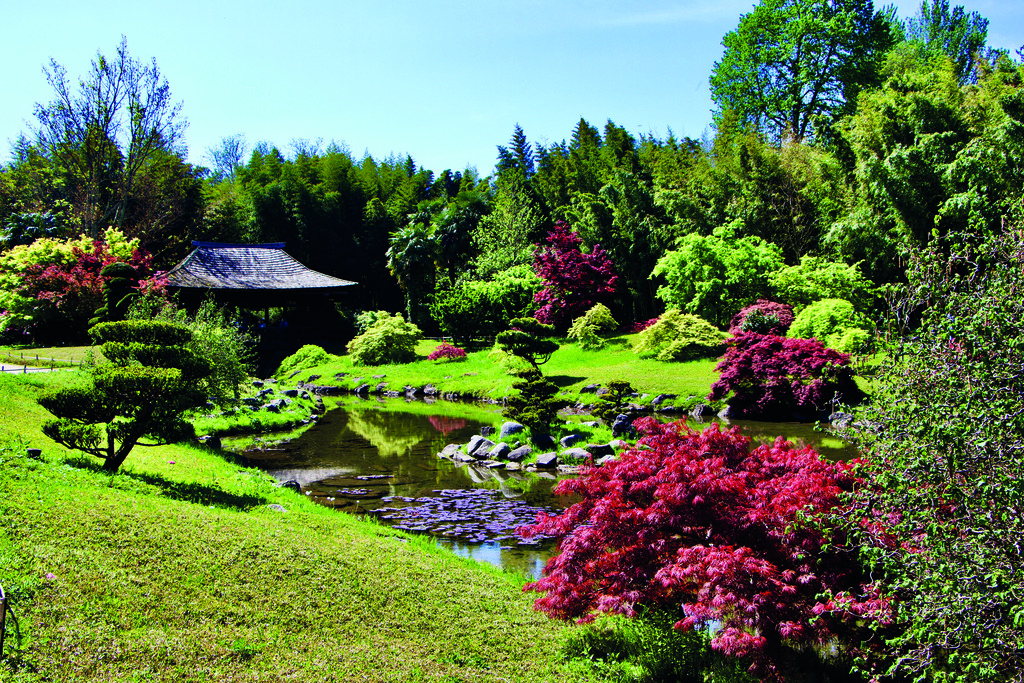
Photo: Shutterstock
5. Go to Iceland in Ardèche
It may not be quite as chilly as Iceland, but thanks to the geological imprint left by lava rivers and the subsequently cooled magma rock, the stunning Ardèche department in Auvergne-Rhône-Alpes is littered with similarly spectacular basalt sculptures.
“These unique curves along our rivers are among the most beautiful and highest in Europe in Jaujac, Thueyts, and at the Ray pic site in Péreyres,” proudly states the local tourist authority, Sources & Volcans, of these splendid ‘flows’ or ‘organs’. They were created by what are known as ‘young’ volcanoes of the Ardèche, which erupted relatively recently in the scheme of things between 120,000 and 47,000 years ago..
A standout is the Coupe de Jaujac, whose flow formed a 3.5km long cliff of prisms, the result of erosion by the river Lignon. The volcano’s basaltic flow is considered to be one of the most beautiful in Europe.
Also unmissable is the village of Fabras, 9km away, which stands 450m high, between the valleys of the Ardèche and the Lignon. For a truly breathtaking vista, head to the Plots de Fabras lookout point from the Pont de l’Echelette.
From France Today Magazine
Lead photo credit : ёR.Dupont-Passerelles_Patrimoines-ADT07-Sejour_Jaujac
Share to: Facebook Twitter LinkedIn Email
More in hikes in France, natural wonders
Related Posts
Leave a reply
Your email address will not be published. Required fields are marked *