
Touring the Gardens of Normandy
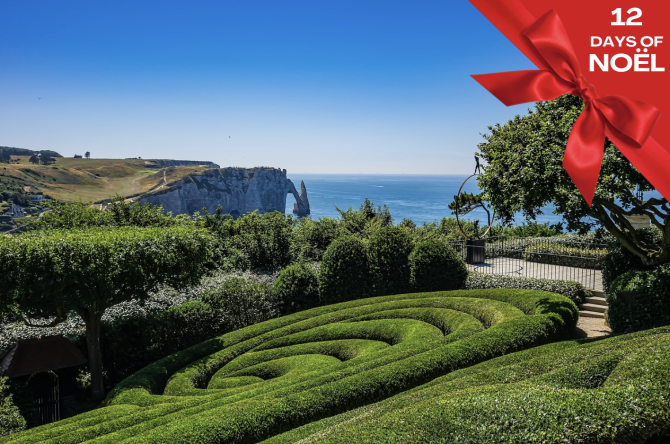
From rose gardens to arboretums, some of France’s finest parks and gardens can be seen in Normandy.
📢 As you scroll through the beautiful images, why not listen to our narrated article? It’s a great way for France Today Members to dive deeper into the story while enjoying the visuals. We hope you love this experience, and we’d love to hear what you think—feel free to share your thoughts in the comments below! Happy listening!
Eric Pellerin dunks a sablé biscuit into his black coffee. “Very British,” I muse. But then, very French, too. We’re sitting in the dining room of his 12th-century Château de Vauville, where he is, in effect, telling me his family’s life history.
It’s a tale of plant collecting and inheritance, the handing down of a love for gardening through the generations. It’s family stories like Eric’s that showcase the social history of Normandy on a tour of parks and gardens open to the public. They’re endearing – the gardens and the stories.
A tale worth telling
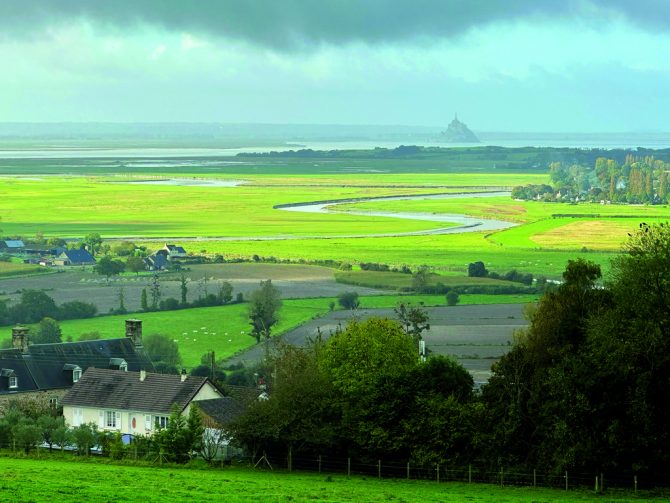
I begin my tour in Avranches, at the Jardin des Plantes, with its spellbinding view over the Baie de Mont Saint-Michel. The public park is centuries old, though redeveloped in 2005 to create 12 gardens, linked to Église Notre-Dame-des-Champs via flower-lined Allée de Crediton (its twin town, in the English county of Devon). But it’s the view, where the River Sée snakes its way towards the ocean, that is the focus, one that inspired writers like Victor Hugo.
I had expected hilltop Avranches to be the only vantage point over Mont Saint-Michel, but Bernard Legal, owner of Château de Chantore, surprises me with the view from his period drawing room. “It is the only château to have a view of Mont Saint-Michel,” he says, a resolve of the religious seigneur who built the 18th-century property.
Bernard guides me round the 19-hectare Romantic-style park, which includes streams, cascades and pools, specimen trees and, reputedly, the largest camellia bush in France. “I love this view, it’s so beautiful,” he says as he shows me where the ruddy château falls into the mirror pool beside a giant cedar of Lebanon.
As we pass beneath an avenue of beech trees, where cyclamen litter the base of the trunks, I ask Bernard how he acquired his plant knowledge. “I was a biologist studying the brain in Paris,” he says. “But my passion is 18th-century France, so I moved here with my husband, Inaki, 11 years ago to refurbish the château with authentic period furnishings and then restore the parkland. Inaki and I are the gardeners.” It’s maintained using organic and low-carbon techniques; a rare breed of native Breton sheep mows the grass! Bernard also makes honey and apple juice from his beehives and orchard.
In Granville, another life story emerges. Fashion designer Christian Dior spent his early years in the town; the Musée Christian Dior, housed in a pink villa that was his childhood home overlooking Granville’s vast beach, highlights how Dior’s love for its gardens influenced his haute couture. He designed the fish pond, but it’s the rose garden that draws my attention, flushes of pink draped around an avenue of arches, jewelling the ultramarine ocean like little sea urchins.


The landscape of history
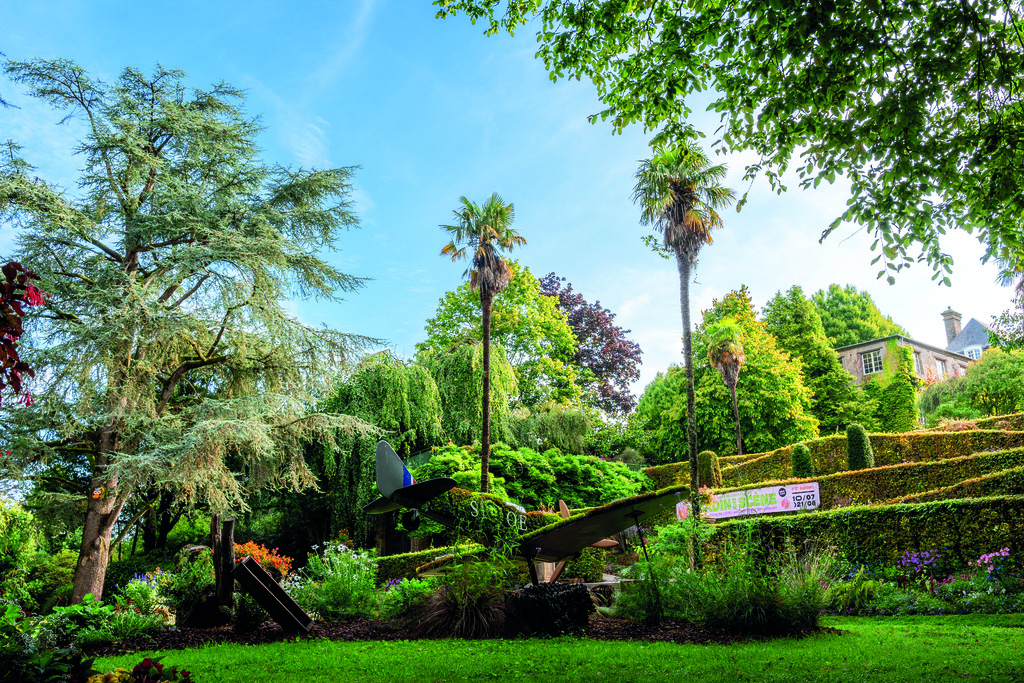
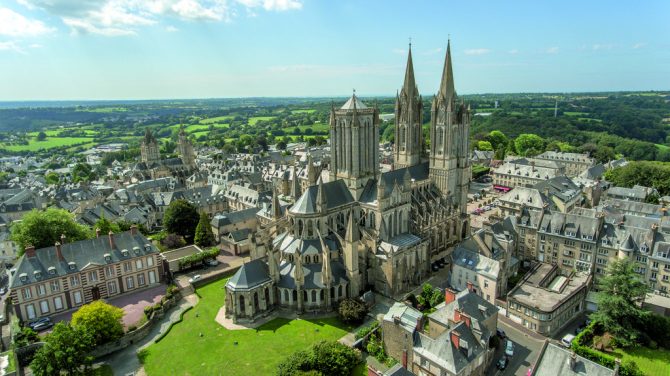
In nearby Coutances, the story unfolds that land was gifted to the town in 1850 on the understanding that it became a garden for the enjoyment of others. It was watercolour artist JS Minel who designed the subsequent Jardin des Plantes, combining playful beds of colour-rich flowers with English-style parkland trees and Italianate terraces with neatly clipped formal hedging. By far the loveliest view in the garden is that of the colourful flower borders that lead the eye towards the town’s twin-spired cathedral.
Near the northwestern tip of the Cotentin Peninsula, as I’m learning the history of the Jardin Botanique de Vauville with Eric Pellerin, I discover it was his father, Guillaume, a landscape architect, who redesigned the rose garden I’d admired at the Musée Christian Dior. Eric’s parents also continued developing Vauville’s botanical garden, created originally in 1948 by Eric’s grandfather.
“My grandfather was a perfumer working at Roger & Gallet and, consequently, fascinated by plants,” says Eric. “When he married my grandmother, he came to live with her at Château de Vauville, the family home. He wanted to create, foremost, an evergreen garden, one that included species from the southern hemisphere. It is a traveller’s garden,” he says pointing out species from Australia, New Zealand, Uruguay and Vietnam.
The château was occupied by German troops during the Second World War. Within the garden is a pathway, created to carry sand to make bunkers, which has been kept as a reminder of the occupation.
Today, it is Eric who tends the microclimate garden, which sits so close to the coast, the roar of the surf adds ambient soundbites. Other than natural regeneration, Eric adds up to 100 plants per year to the officially recognised botanical collection “but they must be varieties we don’t have,” he says. Above all, he explains thoughtfully, “the garden must retain features created by my parents and grandparents”.
I’m shown into a garden bothy where metal watering cans, seed advertisements and historical gardening implements are displayed. “My father loved to collect gardening tools; he accumulated around 15,000 items… which I’m now cataloguing,” he says rolling his eyes affectionately. It is an important historical record of France’s love of gardening. I cross the Cotentin Peninsula from west to east, catching the amphibious boat from Saint-Vaast-la-Hougue to I’lle Tatihou, the whole island a protected natural site.
Though it’s almost possible to touch the island from the harbour, there’s an excited sense of heading somewhere exotic on the ten-minute crossing of the cerulean blue bay. On approach, I spy a deserted sandy beach. Boat capacity, with only a few crossings a day, means l’ile Tatihou remains exclusive. Most day visitors wander around the gardens, visit the maritime museum, which tells the Battle of the Hougue between French and English naval fleets in 1692, and the consequential Vauban fort, then leave. It allows me to wander to other parts of the small island and not see a soul. And to relish the scents and succulents of the walled garden in the evening, as I stay on the island, one of only 11 overnight guests.
By late afternoon, it’s as if the plug has been pulled from the bay, and the sea vanishes to reveal a ghostly skeleton of oyster beds. Folk, carrier bags and a fork in hand, scratch out a seafood supper from the squelching sand.
By morning, a storm is rising and the amphibious boat that had sailed so elegantly the previous day, now approaches across the causeway in sleepy dawn light on ‘all fours’ to rescue the overnight guests. Much as I would’ve loved to be marooned on the island, the overland return to the peninsula feels as much an adventure as the sea crossing.
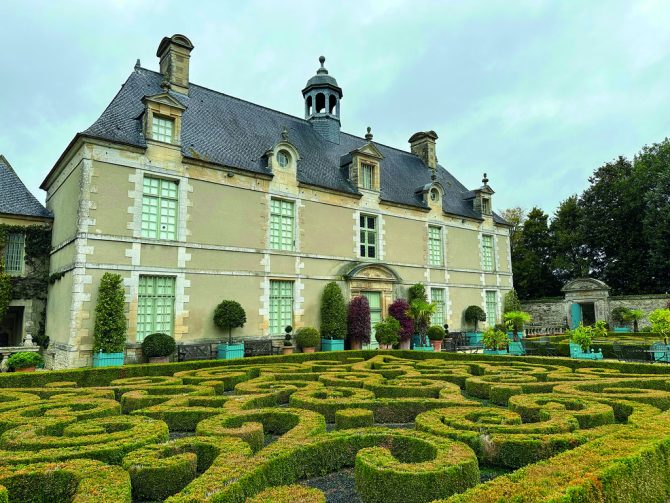
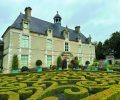
I travel southeast, to the outskirts of Bayeux, where the Jardins du Château de Brécy are laid out in formal French style. It is one of few remaining 17th-century classical gardens, extraordinary in detail with broderie, symmetry and neatly clipped topiary. Designed over four levels, each layer reveals another garden and another, with a central stone staircase leading to opulent pillars.


Planting a future
The gardens were in a dishevelled state, however, when Didier Wirth and his late wife, Barbara, bought the château in 1992. It was their passion for trees and gardens that restored Brécy to the remarkable scene of soft and hard landscaping it is today, including water fountains designed by Barbara, who was described in 2012 by then Culture Minister François Mitterrand as ‘one of our country’s great women gardeners’. Didier, as chairman of the Fondation des Parcs et Jardins de France, also founded the Normandy-based Institut Européen des Jardins et Paysages.
Travelling through the Pays d’Auge, I arrive in Cambremer, central to the Route du Cidre and cider production and also Les Jardins du Pays d’Auge. The gardens have evolved over many years, developed by Armelle and Jacques Noppe from a three-hectare field of brambles to the 29 garden ‘rooms’ there are today.
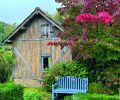
There’s more to the intimate gardens, though, than merely plants. Jacques has spent 30 years collecting small, abandoned and ruined farm buildings from the region, moving and carefully restoring them to create a unique museum of traditional Norman maisons à pans de bois. A washhouse, chapel, stable and other such finds break up the gardens, interconnected by alleys and avenues.
Arriving on the Côte de Grâce, I shelter from a rainstorm by moving indoors to see family-orientated Naturospace, a climate-controlled biotope where tropical butterflies suck nectar from colourful equatorial blooms and equally vibrant birds swoop over the heads of visitors.
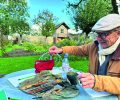
But Honfleur is better known for its brush with Impressionism: La Ferme Saint-Siméon, once a humble farmstead and now a five-star hotel, is considered its birthplace, where young Claude Monet and his painting chums would make merry, gaining artistic advice from Honfleur resident Eugène Boudin. The hotel now offers private painting classes en plein air in its gardens. Local artist Laurent Le Roy sits me down in the kitchen garden to spend an afternoon working on artistic techniques to produce a memento. “It doesn’t matter if you don’t walk away with a masterpiece,” he says, as I comment on my beginner status as a watercolour artist. “You’ll have spent two hours concentrating on nothing other than the garden and painting, clearing your mind of all else.” He’s right – I don’t have a masterpiece, but I leave refreshed and ready to explore the Côte d’Albâtre and my next pair of gardens, Les Jardins Suspendus in Le Havre and Les Jardins d’Etretat.
Le Havre boasts 750 hectares of parks and gardens, so it’s not hard to find a green space within a city deemed a UNESCO World Heritage Site for its concrete architecture. Among the selection like Le Jardin du Silence and Le Jardin Japonais, I plump for Les Jardins Suspendus (named after the mythical Hanging Gardens of Babylon), one of the city’s more recent garden creations, established 16 years ago within a 19th-century military fort. In those few years of development, the extraordinary gardens have managed to accumulate accredited status as a Jardin Remarquable and a Jardin Botanique for its imaginative design of the space and its trial plant collections from five continents, housed in enormous greenhouses. On the upper terrace of the fort are views over the city and the Baie de la Seine.


A slice of history
There are views, too, from Les Jardins d’Étretat, whose artistically trimmed greenery creates a canvas for contemporary artworks on the clifftop. Without doubt, though, the garden’s biggest sculpture is its natural backdrop overlooking the coastline and, on the opposite side of Etretat, Falaise d’Aval, depicted famously by many artists, especially the Impressionists.
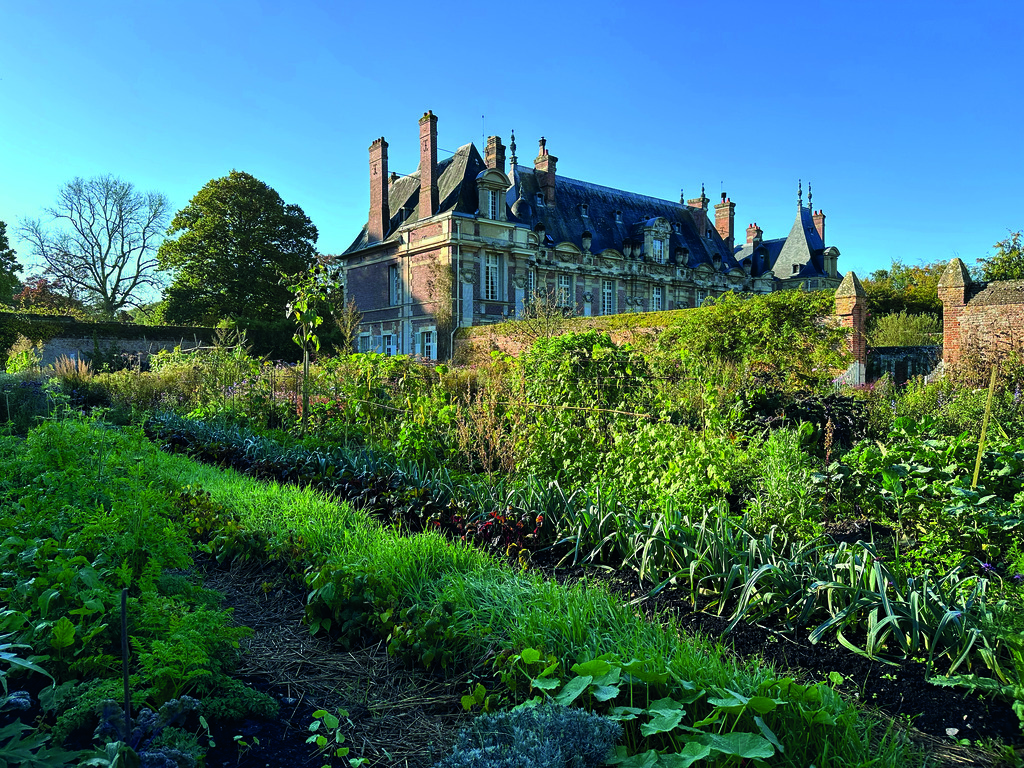
The Impressionist theme continues with a visit to the village of Giverny, but not before I stop at the Château de Miromesnil, the birthplace of writer Guy de Maupassant, between Dieppe and Rouen. Nathalie Romatet and her family have lived in the 16th/17th-century château – which was acquired in 1938 by her grandparents, the Comte and Comtesse de Vogüé – since 2004.
“My grandmother re-established the walled kitchen garden soon after the [Second World] War,” explains Nathalie, “introducing plants like delphiniurns from England and sweetcorn from the USA, then a rare commodity in France, which she sold to restaurants in Paris. It’s something we always grow today, to keep the spirit of my grandmother alive in the garden, along with heritage varieties of vegetables from local villages and a mix of cutting flowers and herbs, just like a traditional potager.”
As Nathalie guides me round, passing gnarled apple trees smothered in soft moss planted by her father, we brush past a scented pelargonium. “Ah, this scent reminds me of my grandmother; of visits to the château as a child,” she says. “It’s so important to have memories in the garden, as well as introducing new ideas.” Those new ideas include hanging gourds, grown as “funny plants for children”.
In Giverny, it is, of course, Monet’s garden that claims the limelight. I’ve visited in different seasons and at various times of day: it is always busy. This visit is no exception, although I arrive at 4pm – two hours before closing – and by 5pm coach-loads are departing. By 5.30pm, I can sit and reflect beside Monet’s famous lily pond alone, contemplating that the autumn palette reflections of the maple trees are vastly superior to the spring growth of his famous willow.
An hour northwest of Giverny is Arboretum d’Harcourt, a unique botanical collection of more than 2,900 trees. Some are specimen trees, a tree museum adorning the grounds of the medieval château, nine of which are designated Remarkable Trees of France. Others are grouped stands which have been cultivated for research into climate change and forestation.
Château de Miromesnil
Essential part of life
Due west is the Château de Canon, whose pretty park allows walks through woodland and bosquets, beside canals and cascades. But it is for the unique Chartreuses de Canon that I have come to visit: 13 walled gardens filled with perennials. The château has become known for its flowers, with a flower farm where visitors can create their own bouquets in summer months.
I choose an urban park that offers more inspiration than many for my final destination. The Parc de la Colline aux Oiseaux was once the city of Caen’s municipal landfill site. The 17-hectare park was created and inaugurated for the 50th anniversary of D-Day and is dedicated to peace. With a belvedere over the city, kids’ play areas, a small ‘farm’, multiple gardens devoted to twin towns and dedicated fitness trails, the landscaped park is manifestly designed for all.
But the area that brings the most amazement is the rose garden, linked to a labyrinth. Its sheer scale, created in a vast bowl, is breathtaking, its 15,000 rose bushes part of a progressive rejuvenation programme a look to the future in a city that, in 2025, is celebrating its 1,000-year past.
There are more than 120 parks and gardens in Normandy open to the public. I manage to see a tenth of those across the north of the region. What’s apparent, though, is the significance of the garden to the foundations of Norman life – past, present and future.
From France Today Magazine
Share to: Facebook Twitter LinkedIn Email
More in France Today Membership, Normandy, parks and gardens
Related Posts

Leave a reply
Your email address will not be published. Required fields are marked *