
Interview with Mark Greenside, Author of I’m Finally, Finally French!

Mark Greenside has been a civil rights activist, Vietnam War protester, VISTA Volunteer, union leader, and college professor. He is the author of a short story collection, I Saw a Man Hit His Wife, and two memoirs about life in France: I’ll Never Be French (No Matter What I Do) and Not Quite Mastering the Art of French Living. The third book in his series of memoirs based in Brittany, I’m Finally Finally French, is now available for preorder.
In this interview, Mark answers Janet Hulstrand’s questions about his life in France.
First, for those who may think of Brittany as “just a part of France”, what should they know about la Bretagne?
When I first came to Brittany in 1991, I saw more Breton and Irish flags than French. Today, there are more Breton flags than French (and more French flags than EU). The Irish Rovers, Sinéad O’Connor, and The Chieftains regularly performed here. As with the Basques, in Brittany there is a separatist movement, though not as strong or pronounced.
The Hundred Years War (1337-1453) was about French sovereignty and who – England or France – owned Brittany, Normandy, and Aquitaine. The war sort of settled that matter, though Brittany remained an independent duchy until 1532 and maintains its independent language and culture today.
France, like most modern nations, is a mélange of peoples, cultures, and languages, and Brittany and Bretons are a part of that mix but also separate and distinct from it. In French stereotypes, Bretons are backward, hard-headed, stubborn, and proud; they are also dreamy and mystical—think fairies, witches, leprechauns, Merlin, and King Arthur, all of which are placed in Brittany. It’s also Druid land with its menhirs and dolmen, linking it to a magical, mysterious past. Asterix, the most popular comic book in France, is based in Brittany, illustrating a strange, colorful, strong, independent, proud, stubborn, inventive, persistent people.
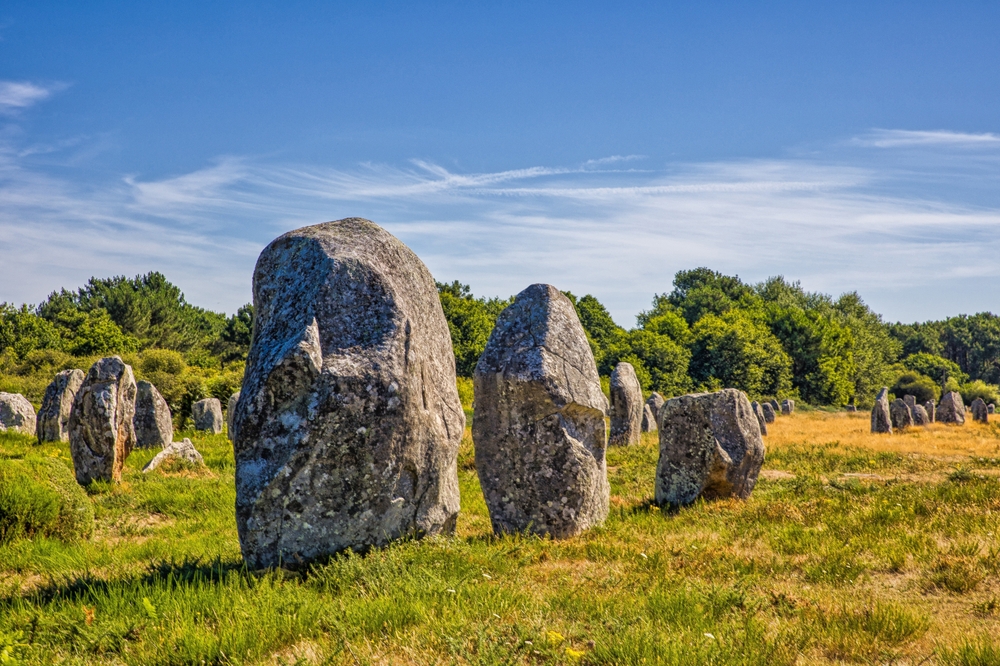
The famous menhirs at Carnac © shutterstock
What made you fall in love with France? And what has surprised you the most about it?
I first fell in love with France from afar – from the US and my study of history, art, literature, philosophy. Dada, Surrealism, Cubism, Fauvism, the Theatre of the Absurd; Danton, Marat, Jean Moulin, Jean Jaurès; Stravinsky, Isadora Duncan, James Joyce, Beckett, Duchamp, Picasso, Matisse, Nijinsky, Proust, Camus, Sartre, Cummings, Brancusi, Man Ray, Truffaut, Godard–Revolution and Modernism, all of it, seemed linked to Paris and France.
Years before I went to Brittany, my friend, the poet Lucha Corpi, did my aura reading (It was the 80s – I did those things then.) In her reading it came out that I wanted to live in Paris in the 1920s – my own Midnight in Paris moment – like millions of others of my generation. Well, I’m not in Paris (though I visit often) and it’s not the 20s. I’m in rural Brittany, at the end of the world, Finistère. I’ve been here thirty summers, and I’m still in love with it.
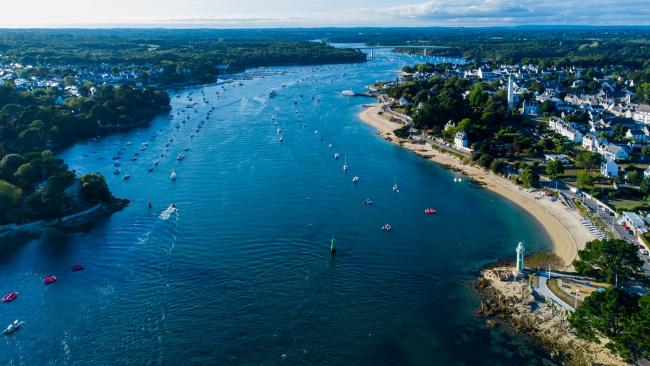
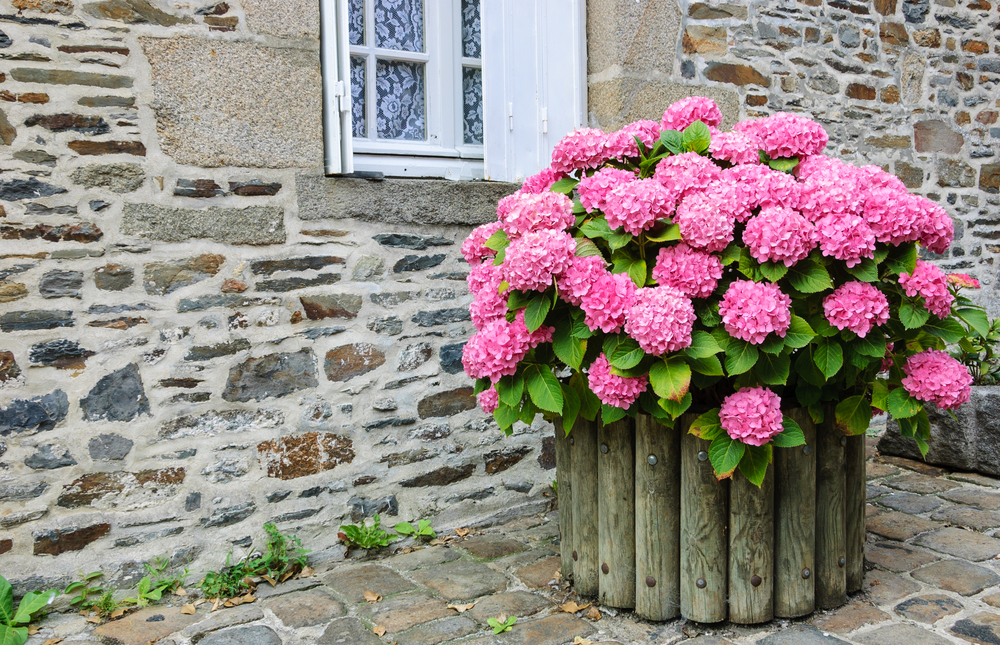
The first attractions came through my eyes, as the area is gorgeous: a myriad of lush greens (it rains a lot), huger-than-Montana big skies; sea-level long horizons, powder puff clouds, shimmering northern Gauguin, Matisse, Monet and Seurat light; long, wide beaches and spring tides; wild heather on the hills, bowling ball size hydrangeas, slate and granite houses, ocean and seas in every shade of green and blue; mist rising from the river in the morning, planetarian nights, fireflies, and rainbows….
It’s quiet: scarcely a plane overhead; a stone house on a small two-lane country road; goats and sheep across the street; doves cooing in the morning; no car horns, alarms, sirens, or garbage trucks; no barking dogs, industry, construction, or loud music; barely an Amazon delivery van. The loudest noise is a knock on the door. I smell the sea and the roses, the land when it’s turned, grass when it’s cut, and thankfully, only rarely, pig shit when the wind blows the wrong way.
The food is delicious, fresh, and healthy: a multitude of fresh-from-the-sea fish, crustaceans, and mollusks, especially mussels, oysters, lobster, clams, and langoustine; fresh veggies and fruit (and the best strawberries in the world). Brittany is the pork capital of France – the meat is tender, moist and sweet. The free-range chickens are the size of eagles.
And the people – they are curious, friendly, welcoming, helpful, stubborn, appreciative, generous, thoughtful, proud, and loyal and they bring out the best in/of me. My wife Donna says I’m nicer here, more accepting, less anxious and angry, not so judgmental. What she really means is I’m more like her, which is true, and is fine with me: be here now; accept what is; be grateful for what you have; live in harmony with the world…. I ain’t perfect, and I ain’t there yet, but I’m closer to it in Brittany than I am in the US…. That’s what surprises me most.
© Shutterstock
Since the French are known for saying everything is “impossible,” I have to say it’s amazing to read your accounts of how workman after workman finds some ingenious way to do the impossible for you, always delivered at the same relaxed, insouciant pace, and with the same relaxed, insouciant attitude. How do they do this?!
In the US, I’m a very independent guy, Type A, relatively successful. I’m able to get things done. I know who to contact and what to say. In the US, I’m often the person people go to when they want help, direction, advice, support, connection. In France, I don’t know anything and can’t do anything without asking for help. I lack all requisite skills, knowledge and abilities (starting with language) and have no mechanical or electrical talents. I don’t know who to call for what, and even if I did, I don’t have the language to say what I need, and even if I did, I wouldn’t understand the response.
All of this is to say, in France I’m helpless, clueless, needy – talk about giving up control! – and for some reason this has brought out the best in people. I don’t know if it’s France’s Good Samaritan law or not, but people see someone in need (me!) and they rise to the occasion. My welfare and need – to fix a blocked pipe, electrical short, flooded house – becomes their professional and personal responsibility. The result often is a professional relationship that becomes personal. Their phone numbers go on my speed dial, and they answer when I call even when they know it’s me.
It helps, I think, that I’m American. First, it makes me a curiosity, and these are a curious people. Second, it brings out their pride, as in, “See, this is how we do it.” Third, I break the social boundaries: I talk to people (as best I can); I listen (understanding about a third to a half of what is said); I offer drinks and a seat at the table. I don’t question, demand, challenge, or complain. I beg. I ask for help, and they – being Breton and professional – provide it. I, being American, thank them in superlatives – merveilleuse, incroyable, parfait, magnifique – and offer praise worthy of a Nobel Peace Prize for saving the world, which in fact they have done for me. We’re a perfect fit: I see their skills, pride, and kindness; they see my needs, ineptness, and geniality….
Given my needs and lack of skills I call the same people often, and over the years the relationships have become as personal as they are professional. Mr. C, my plumber friend, stops by the house to check on the furnace and sometimes comes in for a chat and a cup of coffee.
The key is to understand that in France people come first, and that everything in France is personal. Once that is acknowledged, anything is possible, like getting friendly, above-and-beyond excellent professional work in a timely manner.
© Shutterstock
You’re mostly telling some really funny stories about your life in France in this book. But you also have woven in some interesting philosophical reflections about life, death, and other such matters and how these things are viewed differently, in general, by the French and by Americans. At one point I was reminded of an interesting pronouncement Gertrude Stein made in her book Paris France ; she said ”There is no difference between death and life in France.” Does this strike you as getting at something true about the French?
I hate to disagree with Gertrude, but she’s wrong. French people know the difference between life and death. The word I would use is distance: there is no distance between death and life in France.
Death is always visible and present in France. Every city, village, town, and hamlet has its World War I memorial/statue with the names of the dead. Many have added the names of World War II soldiers, civilians, Résistants, and deportees who were killed; others include those who died in Algeria and Vietnam. There are memorial and remembrance plaques everywhere in France, on street corners, squares, private houses, bus stops, train stations. Streets are named for artists, soldiers, battles, inventors, politicians, philanthropists, actors, singers, musicians, prostitutes, and now for those killed in terrorist attacks. Reminders of past lives and deaths, memorials and remembrances, are everywhere in France. There is a deep, continuous connection with the dead. They are always present and inescapable.
So are cemeteries. In the US, we hide them or outsource them to outlying areas. In France, they are in every town and city. The dead are “living” close to the living.
Over the years, six of my French friends have died, and I’ve been to two of their funerals. The response is always the same: “C’est la vie.” Such is life. Death in France is part of life, close to life, a process of/in life, but is not life. There is a difference, but not much distance.
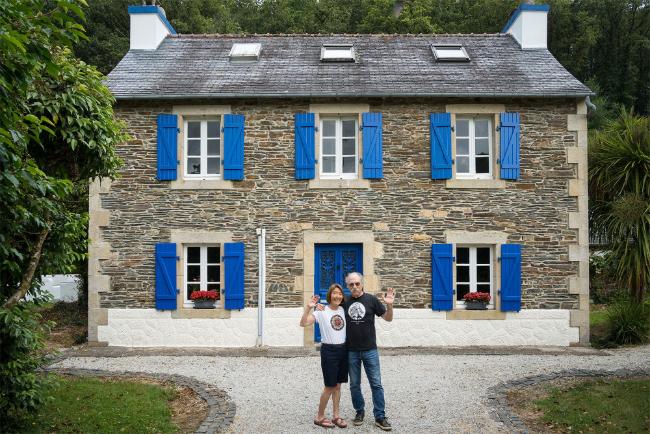
Mark in front of his home in ‘Plobien’ © Norbert Uzseka
To what do you attribute your integration into so many French families?
Five families have basically adopted first me and then Donna. We’re invited to all the big family events – weddings, funerals, baptisms – as well as Sunday dinners and holiday fêtes. As with most things, I think it began situationally: Madame P was the keeper of the keys to the house my girlfriend and I rented the first summer I was in Brittany; Bruno and Françoise are my neighbors to the east; Gilles is the son of Georges and Yvonne, who were my neighbors to the west; Sharon is a friend of Susan, the woman who owned the house my girlfriend and I rented. These situations brought us all together.
After that, I think it was curiosity. I was a curiosity: an American, a writer, middle-aged, no wife, no kids, no family; also, no language and no visible/useful skills. Plus, French people, for all their worries about being proper and correct – in the mode – appreciate and adore the sauvage. Think Buffalo Bill, Annie Oakley, Jerry Lewis, The Three Stooges, and the Marx Brothers: all rule breakers and boundary crossers whose behavior French people find fascinating. So: I was a curiosity and a fascinating, clearly not challenging, oddity, which made me interesting and entertaining. And since I knew nothing and could do little, they regularly helped and saved me, and who doesn’t enjoy the pleasure of saving others and being thanked profusely, and needed? We formed mutual admiration societies.
These are the short-run things that brought us together. In the long run, what I think holds us together is loyalty. I keep and maintain my friendships. If you’re a friend, you’re a friend, and that’s that. Basically, I’m a look-em-in-the-eye, shake-the-hand, old-world guy. All my grandparents were born in Europe. My dad was born in Hungary. European music, art, literature, culture, manners, customs were all around me as a boy. I’m one generation removed as a man. It’s a way of life I’m familiar and comfortable with and live.
I’m conscious of other people, who they are, and where/how I fit in. I try to give as much as I take. I say thank you, please, hello, and good-bye. In France my favorite word is bon. (In the US, it’s WTF.) I write notes when I’m not here, send cards, messages, remember birthdays, anniversaries, and special occasions. I’m careful, respectful, inquiring, accepting, caring, responsive, and discrete. I understand that I/we have a special place in their lives, and they have the same in ours. I know this because I see that they are different with me/us than they are with other French people. Their borders and boundaries expand, and they do and say things they wouldn’t otherwise, and we do, too.
I, who fear being a fool in my American life, am a fool everyday in France. They, who loathe ridicule, laugh at being ridiculous with us. You cannot be this way and do these things without loyalty, trust, and love.
Do you really, really feel that you’re finally, finally French? And if so, what has made you feel that way?
I feel inordinately comfortable here, in Brittany and in France, though there’s little reason for it. I can’t speak, read, or write French beyond a rudimentary level. I don’t know, and frequently violate, basic rules (tu vs. vous; air-cheek kiss vs. skin-cheek kiss.) I don’t like to cedez le passage, wait in line – or wait anywhere else; I don’t dress French, look French, sound French. Yet, with profound knowledge and understanding that I am not French and don’t belong, I feel like I do.
When I say I’m finally, finally French, I mean it on a different level and different way than most people will assume – not culturally or socially, but physically. First, because I feel it in my bones. That’s the comfort level. Second, because of French people’s very strong and particular connection and understanding of their specific homeland, their terroir. The idea of terroir, is critical to French people, and to understanding them and their lives. To be Breton, Provencal, Auvergnat, Norman, even Parisian, is important and crucial to who a person is. It’s their roots, their history, their connection to the past, their heart and quality, the air they breathe. For example, the label AOC, Appellation d’origine contrôlée tells you where something is from and guarantees its genuineness and authenticity. When someone says, “I’m Breton,” they are claiming, offering, presenting, and asserting their hearts, their cores, their best and most important and impressive selves, just as when you buy an AOC something, you know it’s true, genuine, the real thing.
At the end of the book, when I become part of the terroir, I become part of Kostez Gwer, Plobien, Finistère, Brittany, France – my own appellation, I like to think – and finally, finally, French.
Lead photo credit : Photo: Shutterstock
Share to: Facebook Twitter LinkedIn Email
More in author interview, book, Brittany, interview, life in France
Related Posts



Leave a reply
Your email address will not be published. Required fields are marked *